Showing posts with label Eurasian reed warbler. Show all posts

Friday, 20 June 2014

Summer warblers at Al Hayer

I went to Al Hayer today for the first time in nearly two months. Yet I used to go there virtually every week until I started travelling more widely in Saudi Arabia.

It will be my last visit for some time too. I will explain why in the next blog.

As it is now generally seriously hot in central Saudi Arabia, I began birding at about 5.45 am and finished at 10.15 am. Luckily, I was helped that it turned out to be a relatively less hot morning than average for this time of year.

This blog only looks at one aspect of the visit: the summer warblers.

One of the first observations I made on arriving this morning was the huge number of Eurasian reed warbler about. It must have been a very successful breeding season.

one very cooperative Eurasian reed warbler

They weren't just keeping to the reeds either. Plenty were spilling out on to near-by bushes and even into the fields. This wandering away from the reeds was a new phenomenon for me.

At first I struggled to get clear photos until one warbler cooperated in the open.

another pose of the same bird

Before that, in classic warbler style they would move off before I could focus. 

warbler ready to fly off

Having had a chance to see many together (and regretting not looking closer before), some of reed warblers didn't look particularly different from the tones of the nominate species. This is opposed to being greyer on top and whiter below like the fuscus sub species (often called Caspian reed warbler) which dominates breeding in Arabia. 

an apparently darker, browner looking Eurasian reed warbler

For once, graceful prinia wasn't the most common warbler on show at Al Hayer.

graceful prinia

Two hours into the walk, my attention was diverted to loud calls in some dried reeds and small tamarisk bushes. These calls were between a small group of Eastern olivaceous warbler. Small numbers breed here but I rarely see them in the open. However I have rarely visited Al Hayer in June before.

eastern olivaceous warbler calling

This species can be overlooked if you are not careful. It's song is similar to a reed warbler though I think it is more pleasant. It is greyer, the bill is longer and the supercilium more obvious yet in bright sunlight, it would be possible to walk past and miss it.

closer view of eastern olivaceous warbler

Two other warblers are known to breed or have bred at Al Hayer. These are great reed warbler and moustached warbler. I personally have only seen them in the passage seasons at Al Hayer. However others have seen great reed warbler in the summer months. On the other hand, I don't think anyone has seen moustached warbler in summer among those currently birding.

second close up of an eastern olivaceous warbler

In the next blog, I report on all the other birds observed at Al Hayer.

Sunday, 15 June 2014

East Salbukh settled down for the summer

Sometimes during a birding session, you can have one small area and moment which produces a totally disproportionate part of your birding enjoyment.

This happened to me as I birded East Salbukh early on Saturday morning.

One corner on the western side of the wetland was a treat to stop at, listen and observe.

little bittern

It was noisy but initially there seemed to be nothing to see. One of the noises was little bittern screaming calls. I soon saw both an adult and a juvenile.

little bittern screaming

Sounds lower down were competing with the little bittern calls. There were intermittent screeches which I suspected were water rail.

young water rail

When I finally saw one it wasn't an adult. The bill was not completely red but had some black. The underparts still had some mottling of a juvenile bird. The black and white stripes on the flanks were not fully developed. This bird was a young bird.

I am now confident that water rail breed there. I also saw four others scattered over the west, north and east side of this rectangular wetland. They aren't going anywhere and its mid June.

Evidence of breeding among little bittern and water rail was not all that I observed in this small patch of the wetland.

young Eurasian reed warbler

Young Eurasian reed warbler were darting around. Luckily they often rested on a small tamarisk bush in the middle of the low lying reeds making views easier than usual.

adult Eurasian reed warbler

I saw incidents of adult Eurasian reed warbler feeding young birds too. The picture below was taken from distance but you can see this happening.

feeding Eurasian reed warbler

Elsewhere in the wetland, there was other evidence of breeding. I was continually mobbed by black winged stilt over part of my walk even though I was nowhere near the water's edge in that area due to the deep mud that fringed it.

black winged stilt

In contrast both Kentish plover and little ringed plover breed earlier.


Kentish plover

There was little sign of adults still caring for young at least as far as feeding is concerned.

Little ringed plover

The overall picture is one of a wetland left for the summer with only the breeding birds left around. It should stay that way for about 6 or 7 weeks before the first birds are once again on the move.


moorhen

Funnily enough I don't recall seeing any young moorhen since I started visiting the wetland. However they are known to breed very early in central Arabia. 

graceful prinia

Likewise with graceful prinia. They are lots of old graceful prinia nests to see in the the tamarisk bushes.

Namaqua dove

Other sightings at the wetland  included hoopoe and a young Asian grey shrike.

hoopoe

The pink bill on the Asian grey shrike is one of many signs this is a young bird too.


young Asian grey shrike (Aucheri)

Other species seen at the wetland were: Eurasian collared dove, laughing dove, little grebe, crested lark. pale crag martin, house sparrow and perhaps surprisingly barn swallow.

lizard

As I left, an unknown lizard  with a distinctive blue face was seen sunning itself. 

In other news, earlier in the weekend, on Friday, I spent an hour in the early morning visiting a site within walking distance of my flat in the Nakheel district. I was acting on a tip off from a friend.

wadi at Nakheel

I had been missing an very good prospect so close to home. The wadi is a mix of orchards, grassland, trees and vines.
more of the wadi at Nakheel

In summer the birding won't be too exciting but in the passages seasons and in winter, I am sure it will be very good indeed.


young common myna

At the moment though birds were the most common birds were common myna, house sparrow, collared dove, laughing dove and black bush robin.

little green bee-eater

There were also little green bee-eater, white eared bulbul and rose ringed parakeet.


white eared bulbul


How could I have missed such a place under my nose?


Thursday, 3 April 2014

North of Hayer part two

During Saturday afternoon's birding north of Al Hayer, I was  privileged to see several Eurasian reed warbler out in the open.   They only do this for any length of time when their hormones get the better of them. For a two week period in the early breeding season they seem to forget their fear. Last weekend must have been part of that period. 


Eurasian reed warbler

All I had to do was head towards the noise, stand in one place and watch.

another picture of Eurasian reed warbler

This was one of the highlights of the afternoon which had begun with me surrounded by moorhen at the furthest north on my day's journey before turning back.

common moorhen

Also in the same area as the moorhen was a red eared slider.  I have seen this invasive terrapin in the diplomatic quarter in Riyadh but this was my first sighting outside the city.


red eared slider

A mallard flew past at great speed and was gone as soon as it appeared.

mallard

As I headed back south down the wadi, I had one last chance to see the grey heron which I had been seeing since late morning perched on the valley's slopes.

grey heron

Heading further back, I travelled through the part of the river where all the reeds have been removed. Only a few birds were to be seen. A single common sandpiper was close to the river. A large flock of pigeon were the main inhabitants. The only new species for the day near here was blackstart perched on one of the few remaining isolated trees.

blackstart

Immediately south of the dam the vegetation is still thick and undisturbed. I spotted the marsh harrier from the morning once again and a green sandpiper at the river's edge.

common myna

It was at the edge of thick reeds here that the Eurasian reed warbler mentioned at the start of the blog gave their display.

On the escarpment next to them I looked up and saw two common myna in a slightly strange environment for them.  Then I heard an odd noise from a little further along at the top of the same escarpment.  

baboons

I looked up and was absolutely amazed to see a troop of baboons. Baboons are native to the south west of Saudi Arabia but not Riyadh.

I knew a small number had been released many years ago in the Heet area near Kharj apparently by a departing expat and that they had survived. However this is 30 kilometres away across desert. If this is some of them, they have cleverly and bravely found a more hospitable habitat.

I didn't linger long as they shown an interest in coming down to drink.

After this I moved further south downstream. Indeed I moved past where I had entered the wadi in the first place. Here were a couple of clearings in the reeds. At one I saw a still wintering grey wagtail.

grey wagtail

A kestrel flew overhead while I was there.

kestrel

The other, larger clearing was my last stop of the day.  On arrival a green sandpiper and common snipe bolted and sadly didn't return.

profile of a bluethroat

However by way of compensation, a still wintering male bluethroat gave good views. The orange spot bluethroat breeds in Scandinavia and northern Russia in summer. Within the next week or so most of the remaining ones will have gone back north.


bluethroat

Almost the final bird I saw was a group of three Indian silverbill. I had been seeing the mall day but these three finally stayed still long enough for a photograph.

Indian silverbill

This turned out to be a good day's birding and I will return to this stretch of the river more often.

Sunday, 23 March 2014

The southern stretch of the "Riyadh River"

Bernard Bracken and I returned to Al Hayer on Friday.  I still call this my "local patch" although I don't visit it so often these days as in previous years.

Indeed it was my first visit for over 6 weeks.

We spent most of our time following the "Riyadh river" south of the landmark bridge. This decision was made because of so much recent disturbance through earth movement and reed clearances in areas further north.

Eurasian reed warbler

Early on the walk we concentrated on the reeds themselves. I wondered whether my target species of little crake had arrived on passage but none were seen in typical places like where the water spills out from the edge of the reeds.  Elsewhere we saw streaked weaver in reeds to the north and then plenty of reed warbler, house sparrow and graceful prinia to the south of the bridge.

Some of the reed warbler sounds weren't quite right and were too loud and continuous. The mystery was solved when a clamorous reed warbler popped up temporarily into view. This species isn't know conclusively to breed here but is know to disperse outside the breeding season. Know breeding sites near Hofuf are 225 kilometres way. 

Bluethroat

Wintering bluethroat were still around, all at the start of the walk (and on return). 

common kingfisher

Remarkably, a common kingfisher seen in November and January was in almost exactly the same place again. Surely it will soon be time for it to travel north out of Saudi Arabia. (Incidentally one of the local white throated kingfisher was seen as we drove off at the end of the session near the bridge.)

moorhen

After walking past the heavily reeded areas, we continued walking south where the Riyadh river widens out and cover is more sparse.

squacco heron

This was an area of grey heron, purple heron, squacco heron and little egret as well as waders.

grey heron

(Five black crowned night heron had been seen before the walk begin).


black crowned night heron

The waders in the wider river and sparsely vegetated area were very shy, flying off from a great distance out.

green sandpiper

The shyest of all were green sandpiper. Common sandpiper were nearly as timid.

black winged stilt

Black winged stilt were the bravest and allowed a little closer contact.

common snipe

Two common snipe were typically behaved. As ever, if you see them first you have a chance of some approach.

spur winged plover and little egret

Spur winged plover as being increasingly seen at Al Hayer. Three years ago they were only in Kharj to the south. I can say confidently their range is now expanding into the Al Hayer area. 

little ringed plover

By contrast, Little ringed plover has been a long standing summer bird there.


yellow wagtail and white wagtail

Surprisingly, there were only a few signs of passage. One of these was a lone yellow wagtail. It was the first sighting of one by me this season. 


grey wagtail

On the other hand, I have seen more grey wagtail this year than in previous years throughout the country.

local barn swallow 

Barn swallow and a small flock of high flying and non-stopping European bee-eater were other signs of passage.  The barn swallow shown above are not passage birds however. This small group are local breeders who could be seen flying in and out of a small barn with nests once again this year.  

greater spotted eagle

Although the focus of the day was on the southern stretch of the river with waders and birds close to the reeds, there were other interesting observations too.

Two greater spotted eagle were seen.

Turkestan shrike

Turkestan shrike aren't as common as Daurian shrike, but one was observed in the pivot fields near the bridge.

pied wheatear

A single pied wheatear was seen travelling to al Hayer. This my first sighting this spring of this passage bird.

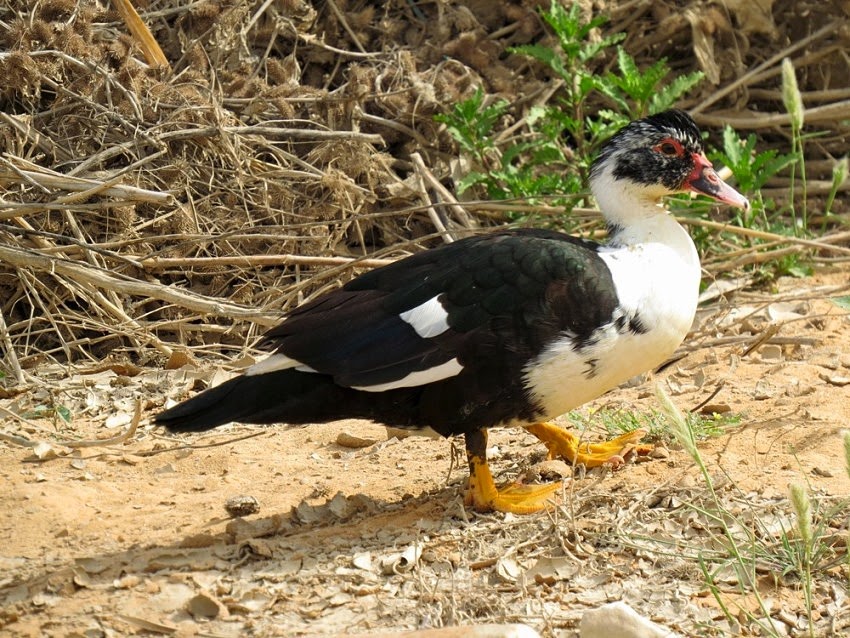
Muscovy duck

Finally but not necessarily least: there was a Muscovy duck swimming free near the bridge. As far as I know there is no duck farming in Saudi Arabia and this bird is almost certainly an escape from a private collection.

As I may have said at some time in previous blogs, I want to match and exceed Pers Bertilsson's list of 336 species seen in Saudi Arabia (see page tab in this blog called "The biggest Saudi list and where"). My total is 321 as recorded on e-bird. However I notice that Pers includes one escaped non-breeder in his list. So to be consistent with Pers, I either increase my list by one to 322 or I decrease Pers list  by one to 335. Either way, I am now 15 species short. I have vowed not to leave Saudi Arabia until this is achieved. 

It could be a long wait.