Showing posts with label fulvous babbler. Show all posts

Tuesday, 22 May 2018

Kandra

Kandra is just west of Kiffa on the way back to Nouakchott. It is the site of a permanent lake although small in the dry season.

Mohamed Vall and I stopped off there on our way back from Kiffa at the beginning of April.

It was a very hot day and partly because of this, most of the bird activity was next to the lake rather than in the near-by woodland.

black kite

The lake was a magnet for black kite.

immature Egyptian vulture

There was one other bird of prey present. It was an immature Egyptian vulture. All of these birds spent some time in the air and indeed directed us by their presence above the lake as to where to find the lake through the trees.

They were also joined by brown-necked raven.

spotted redshank

Given how little fresh water there is between the Savanna belt and the Mediterranean at this time of year, flocks of migrant water birds must love having found Kandra. There was a flock of 10 spotted redshank including one in pure breeding plumage.


black-winged stilt and spotted redshank

It is difficult to know if the black-winged stilt are passage or resident birds.

little grebe

This is likewise true with the flock of little grebe that were observed.

Abyssinian roller

Abyssinian roller is a resident though they can wander.

red-billed firefinch

While we didn't see any red-billed firefinch in Kiffa, we found them here. Like the roller it is normally a bird of the far south of the country.

red-billed quelea

They are hundreds of thousands of red-billed quelea along the Senegal River valley but you can often see ones and twos further north. We only found one there.

Also away from the water, we found a migrant lesser whitethroat and rufous bush-robin. However laughing dove and Namaqua dove were the most numerous birds.

Namaqua dove

With patience we found a group of fulvous babbler too.

fulvous babbler

I have no doubt Kandra like Kiffa are excellent birding places in the rainy season. The main problem is getting there. Nouakchott is 600 kilometres away.

After Kandra we headed west to Aleg to stay on Sunday night. I have already posted what we saw on Aleg on the Monday morning as we continued our journey home.

So I have nowhere else to report, except here, that after Aleg on the Monday, we had one final important sighting. At Boutilimit, barely 150 kilometres from home, we spotted a roaming tawny eagle high in the sky. The trip ended with me adding this to my country list making 303.


Species seen at Kandra on Sunday 1st April
Little Grebe  
Grey Heron  
Glossy Ibis  
Egyptian Vulture  
Black Kite  
Spur-winged Lapwing  
Little Stint  
Common Sandpiper  
Spotted Redshank  
Marsh Sandpiper  
Laughing Dove  
Namaqua Dove  
Blue-naped Mousebird  
Eurasian Hoopoe  
Abyssinian Roller  
Common Kestrel  
Southern Grey Shrike  
Woodchat Shrike  
Brown-necked Raven  
Black-crowned Sparrow-Lark  
Sand Martin  
Barn Swallow  
Lesser Whitethroat  
Fulvous Babbler
Black Scrub-Robin  
Rufous  Scrub Robin  
Common Redstart  
Northern Wheatear  
Greater Blue-eared Starling  
Western Yellow Wagtail  
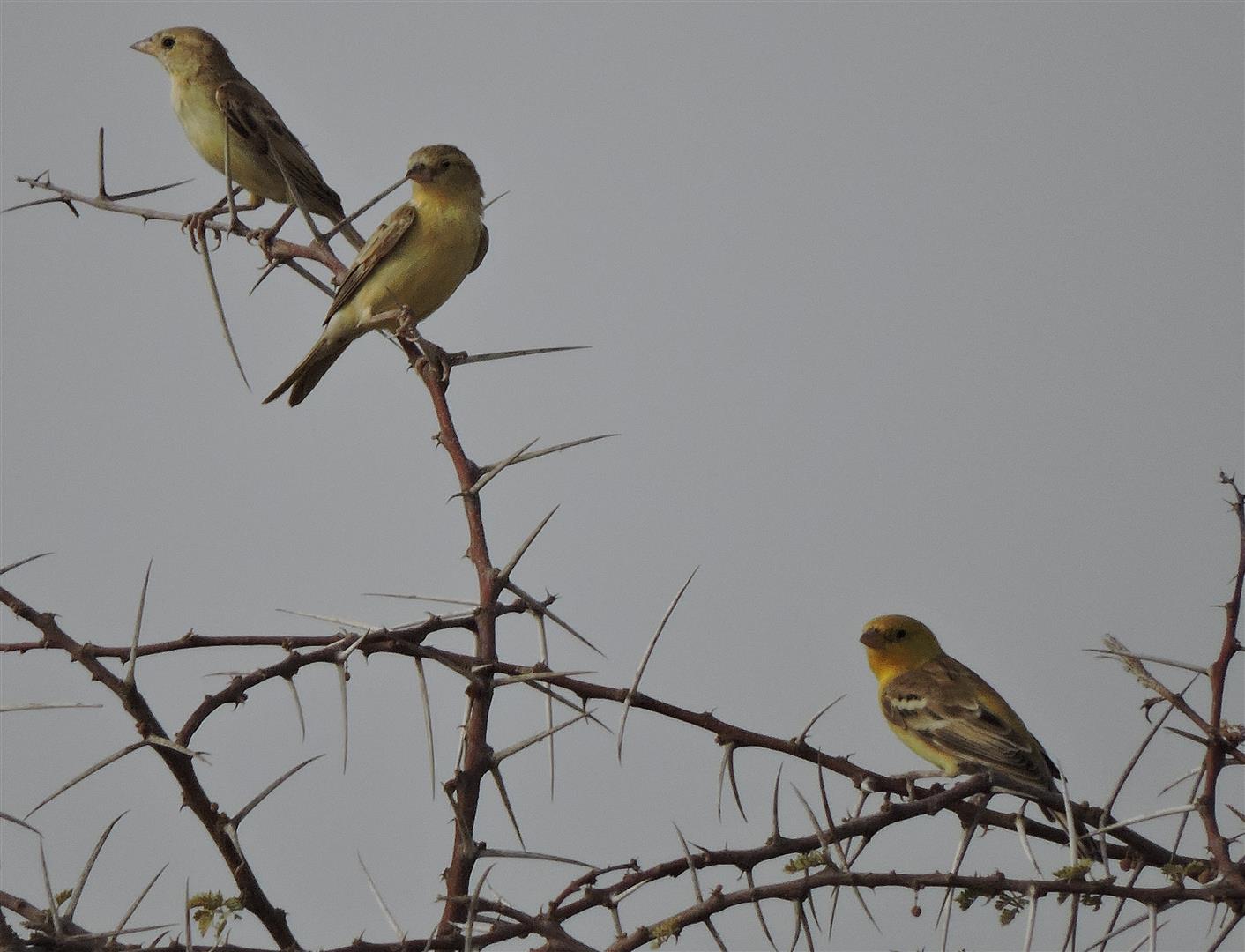
Sudan Golden Sparrow  
Red-billed Quelea  
Red-billed Firefinch  

Thursday, 8 December 2016

Atar road out of Nouakchott

Last weekend was the first time I failed to add to my Mauritanian list but that didn't make the birding bad.

Mohamed Vall and I journeyed 80 kilometres up the Atar road out of Noaukchott on Saturday. Atar is north east and inland. I expected different habitat from more westerly routes out of the city which are more saline. The hope was to see desert lark and prehaps other semi-desert species such as long-legged buzzard or even golden eagle.

We failed on all of them. We almost certainly have to go further out of the city.

Nevertheless, birding was interesting.

Just outside the city on the east side of the main road was a wadi with several sub-alpine warbler and a western orphean warbler. The green area was hidden from the main road behind sand banks as is often the case. 

A few kilometres later on the other side of the road was a small loose cluster of trees and some sign of non-halophilic vegetation (vegetation which showed we were out of the more saline area). We went off road to investigate.


some Sudanese golden sparrow

A mobile flock of Sudanese golden sparrow was a good sign.

three sudanese golden sparrow

A couple of hoopoe were also present.

hoopoe lark

Hoopoe lark was the only lark species in the area.

In the densest area of trees and bushes good views were had of a second western orphean warbler. This one was female and the previous one had been male. The distribution map in the Birds Of West Africa show this species to winter south of Nouakchott all across the southern eigth of the country. However this area is well north of that zone yet I suspect these were wintering birds. It's very late for any further warbler migration.

A family of fulvous babbler was a pleasant surprise. This was the first time I have seen them close to the city.

one fulvous babbler

Both birds in the pictures are juveniles as is indicated by the yellow gapes to their bills.

another fulvous babbler

Two northern wheatear were observed as well as a smart male dark-throated black-eared wheatear.

black-eared wheatear

From this angle and distance it is difficult to tell apart from a male desert wheatear. However there was a clear and considerable gap between the black on the wing and on the head when viewed side on.

blue-cheeked bee-eater

This area marks the northern limited of the resident blue-cheeked bee-eater in Mauritania.

cream-coloured courser

Further up the Atar road we came across two separate groups of cream-coloured courser. This was one of a small set of birds that I had on my list but not previously managed to photograph. This time it was relatively easy. The birds were settled.

upright cream-coloured courser

Not far past the second group of courser the habitat turned from semi-desert (with isolated patches of grassland) more fully into desert. We didn't venture further.

bar-tailed lark from the rear

On the way back, Mohamed Vall spied a lark while driving. We managed to park up and track it on foot.

We eventually identified it as a bar-tailed lark.

bar-tailed lark 1

From my observations, bar-tailed lark appears to be low density in the semi-desert areas north of the city. We have looked very hard for desert lark with no success. Indeed the terrain looks much more suitable for bar-tailed lark anyway. The land is almost all flat and rarely even rocky.

bar-tailed lark 2

Yet, the atals of Mauritanian birds has a sprinkling of records of desert lark in the very areas that we can't find anything but bar-tailed lark. Is it too arrogant of me to believe that these observations could be misidentifications? Time will tell.

I thank Mohamed Vall once again for driving and as my birding companion.

Tuesday, 1 November 2016

Aleg

Last weekend I made a long trip to the south of the country with Dr Mohamed Vall. We arrived at Aleg 240 kilometres south east of Nouakchott on Friday evening ready for a full day's birding in the area on Saturday.

We got up early and were on our way to Lake Aleg shortly after dawn.

We had two additions to my country list within half an hour. The first was yellow-billed kite. More than twenty were seen flying around the road.

Next seen was fulvous babbler as we moved the car off the road and attempted to drive close to the lake as possble.

blue-cheeked bee-eater

It wasn't possible to drive up to the lake side. There is 50-100 metres of marsh land between the dry land and the water's edge. Unfortunately this meant we couldn't see what was on the water.

Nevertheless we picked up birds anyway. Blue-cheeked bee-eater were numerous in the trees.

At the edge of the marsh both cattle egret and glossy ibis were grazing. The latter was another addition.

glossy ibis and cattle egret

African swamphen are too large to hide themselves in the tall grass in the wetland. This was a fourth addition already and it was only mid morning.

African swamphen

The most numerous bird around our relatively dry vantage point was yellow wagtail.

yellow wagtail

Although we couldn't see what was on the water, some of the water birds came towards us. The best find of this type was a group of spur-winged goose. This was a fifth addition and a lifer.

spur-winged goose

At least two marsh harrier were patrolling the part of the lake near us. This was yet another addition.

northern wheatear 1

Having failed to find a way closer to the water on foot we eventually turned our attention to the scattered trees and land further back from the water.

Northern wheatear were common. A few required special attention including the one above to be sure of the species. This one had some similarity with heuglin's wheatear though it was concluded in the end to probably be a northern wheatear.


northern wheatear 2

Most were more straightforward identifications like the bird above.

Occasionally we came across resting yellow-billed kite.

yellow-billed kite

A brown rat was an unpleasent surprise find under a small cluster of trees.

brown rat

In this area, the most numerous birds were no longer yellow wagtail.  They were Sudanese golden sparrow and a lesser number of red-billed quelea. Another family of fulvous babbler were observed as were a few chestnut-bellied starling.

yellow-billed kite in flight

We had mixed emotions at this stage, we had worked hard and walked long but not found a way close to the water's edge. However, despite this new birds had been seen. 

Yet we suspected others on or over the water which we could not reach.

We elected to head back to the edge of the town of Aleg where we had seen a water course heading north. We presummed this was feeder to the lake and so following it might give us a back way to the open expanse.

The first omens were good. We spotted three yellow-billed kite flying around and several cattle egret heading back and forth along the "river".

squacco heron

A squacco heron was spotted in one of the riverside trees.

river leading to lake Aleg

About two kilometres up stream we came across a flcok of red-billed quelea about 2000 birds strong. Watching them move around was like a liquid being poured such was thier density.


red-billed quelea

We watched for over half an hour as a pair of lanner falcon tracked the red-billed quelea flock. At one time about 300 quelea were isolated on a small bush. Both lanner falcon swooped down next to the bush but made no effort to pick any quelea off. We assumed the falcons weren't hungry and were playing with the quelea. It was a fascinating time.

In the end we moved on up the river.

common sandpiper

More species were seen including , common greenshank, common sandpiper and spur-winged lapwing.

spur-winged lapwing

Two more birds of prey were sighted. One was a pale morph booted eagle. The other was an osprey. Both were more additions to my Mauritanian list.


booted eagle

A single little egret was the only one seen all day.

little egret

The river got stronger and wider. It also started to head more westward. However the lake was not in sight and it was getting very hot in the midday sun. Furthermore there was obviously no track fro cars. We reluctantly gave up on this route and the lake.  

There is clearly more to see.

In the late afternoon, we went 10-15 kilometres east of Aleg to try out luck in different habitat. We picked out more wooded areas along the main road heading out of town towards Kiffa. In no case were the woods very large. This is the northern edge of Sahel.

Sudanese golden sparrow were common but other birds captured more interest.

Black bush robin were sighted in the more densely wooded areas.

desert wheatear

Several desert wheatear were observed. These were my first in Mauritania.

fulvous babbler

We finally manged to photograph some fulvous babbler.

However the strangest sighting was an African grey hornbill which constantly calling. It was well north of its expected range and its calls will almost certainly remain unanswered.

African grey hornbill

It was the tenth addition to my list and a fitting end to the day.

I am extremely grateful to Mohamed for his company, driving and help.

On Sunday we headed further south to the edge of Bogue before taking the road to Rosso along the northern side of the Senegal river valley. We went one better than Saturday. Eleven species were added to my country list. I will blog about this next.

Monday, 31 January 2011

The birds of Wadi Kaam valley

On Saturday, I went with Andy, Helen and Ibrahim to Wadi Kaam. It was a gloriously sunny and warm (but not hot) day to visit arguably the greenest area in Tripolitania.


The northern, lower, section of the valley is fertile farming land with many cypress trees. The dominant finch of these trees in Tripolitinia - serin - were everywhere to be seen and heard.

serin in the lower Wadi Kaam valley

In contrast, in Cyrenaica (north east Libya), the dominant finch is chaffinch. In Tripolitania (including Wadi Kaam) that bird is rare. Conversely serin is a rare winter visitor to Cyrenaica. This at variance with the guide books which surprisingly over-report serin distribution there!

a green field in the lower Wadi Kaam valley

In winter, walking along the shaded country lanes in the lower Wadi Kaam valley, within minutes you can easily pick out cattle egret, serin, goldfinch, meadow pipit, sardinian warbler and spanish sparrow.

Cattle egret is nowhere near as common in Tripolitania as in Cyrenaica but is common in Wadi Kaam.

view of the middle Wadi Kaam valley from the reservoir

The valley stretches for several kilometres north of a very large reservoir, getting wider and greener as it heads north.

view of another serin in the lower wadi kaam valley

I was a little surprised to see so many black redstart in the lower valley.  Some seemed to be moving around in pairs.

male black redstart 

Here all the black redstart were gibraltariensis. When I bird around Benghazi (850 kilometres east) they are a mix of the European sub species gibraltariensis and the Turkish sub species ochruros.

The easiest way I separate the two sub species is the white flash on the wing of the European but not the Turkish male bird. Females I find impossible to distinguish.

an apparent black redstart pair at Wadi Kaam

I didn't find chiffchaff that common at Wadi Kaam but they were there is low numbers.

chiffchaff at Wadi Kaam

In the drier areas of the middle and upper valley the bird life changed. Crested lark and black wheatear were easily seen. They were also present at Wadi Lubda (the next valley along which we visited briefly before reaching Wadi Kaam).

black wheatear

My favourite resident of theses drier areas is fulvous babbler. There were several family groups around to view.


fulvous babbler

This article is not a full audit of the birds of Wadi Kaam valley. Take a look at an article on a trip report from February last year . You'll find some more birds from this area there. Between the two articles I hope you'll get a good overall picture.

Tomorrow we can look at the birds seen at the reservoir itself.