Showing posts with label cream-coloured courser. Show all posts

Thursday, 8 December 2016

Atar road out of Nouakchott

Last weekend was the first time I failed to add to my Mauritanian list but that didn't make the birding bad.

Mohamed Vall and I journeyed 80 kilometres up the Atar road out of Noaukchott on Saturday. Atar is north east and inland. I expected different habitat from more westerly routes out of the city which are more saline. The hope was to see desert lark and prehaps other semi-desert species such as long-legged buzzard or even golden eagle.

We failed on all of them. We almost certainly have to go further out of the city.

Nevertheless, birding was interesting.

Just outside the city on the east side of the main road was a wadi with several sub-alpine warbler and a western orphean warbler. The green area was hidden from the main road behind sand banks as is often the case. 

A few kilometres later on the other side of the road was a small loose cluster of trees and some sign of non-halophilic vegetation (vegetation which showed we were out of the more saline area). We went off road to investigate.


some Sudanese golden sparrow
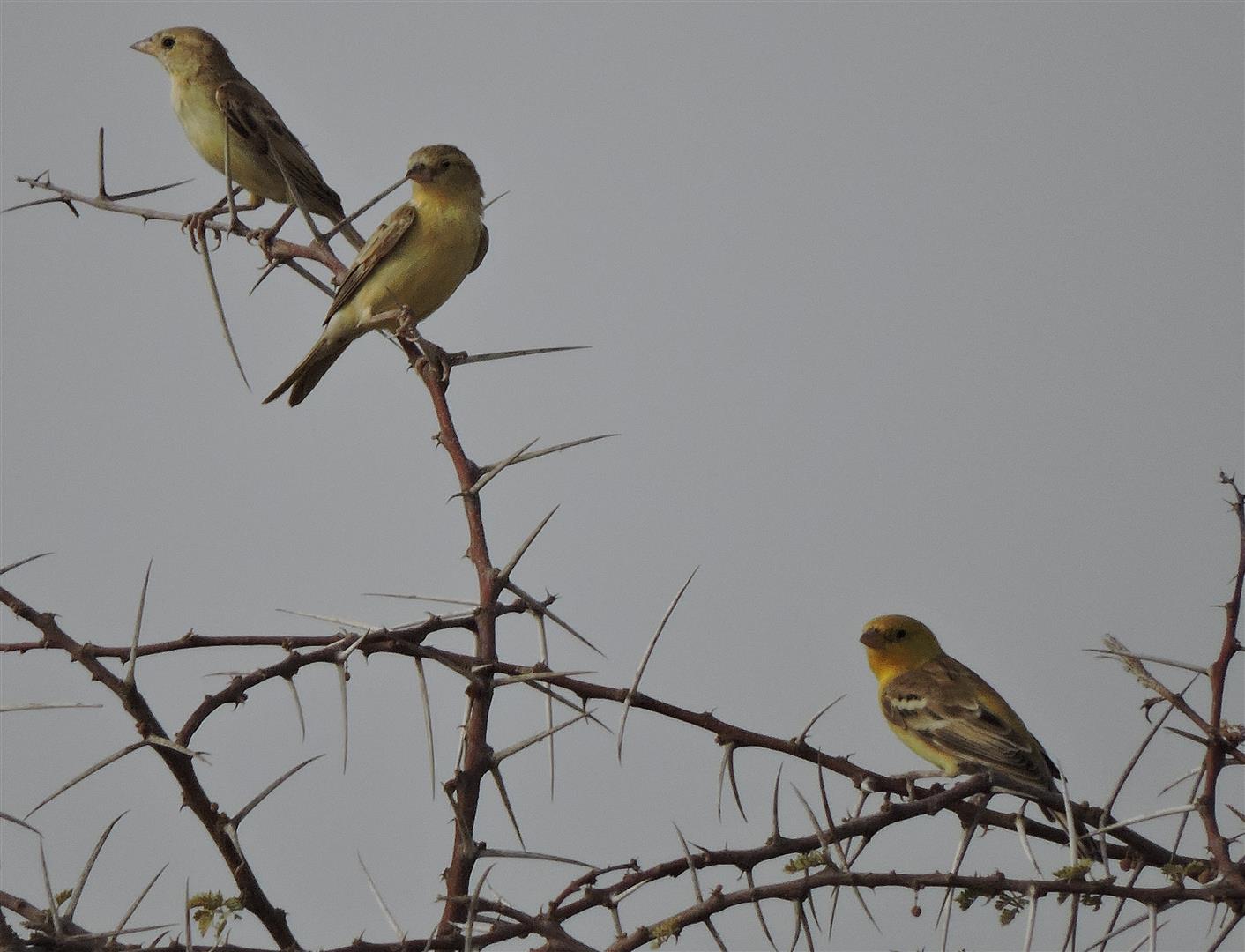
A mobile flock of Sudanese golden sparrow was a good sign.

three sudanese golden sparrow

A couple of hoopoe were also present.

hoopoe lark

Hoopoe lark was the only lark species in the area.

In the densest area of trees and bushes good views were had of a second western orphean warbler. This one was female and the previous one had been male. The distribution map in the Birds Of West Africa show this species to winter south of Nouakchott all across the southern eigth of the country. However this area is well north of that zone yet I suspect these were wintering birds. It's very late for any further warbler migration.

A family of fulvous babbler was a pleasant surprise. This was the first time I have seen them close to the city.

one fulvous babbler

Both birds in the pictures are juveniles as is indicated by the yellow gapes to their bills.

another fulvous babbler

Two northern wheatear were observed as well as a smart male dark-throated black-eared wheatear.

black-eared wheatear

From this angle and distance it is difficult to tell apart from a male desert wheatear. However there was a clear and considerable gap between the black on the wing and on the head when viewed side on.

blue-cheeked bee-eater

This area marks the northern limited of the resident blue-cheeked bee-eater in Mauritania.

cream-coloured courser

Further up the Atar road we came across two separate groups of cream-coloured courser. This was one of a small set of birds that I had on my list but not previously managed to photograph. This time it was relatively easy. The birds were settled.

upright cream-coloured courser

Not far past the second group of courser the habitat turned from semi-desert (with isolated patches of grassland) more fully into desert. We didn't venture further.

bar-tailed lark from the rear

On the way back, Mohamed Vall spied a lark while driving. We managed to park up and track it on foot.

We eventually identified it as a bar-tailed lark.

bar-tailed lark 1

From my observations, bar-tailed lark appears to be low density in the semi-desert areas north of the city. We have looked very hard for desert lark with no success. Indeed the terrain looks much more suitable for bar-tailed lark anyway. The land is almost all flat and rarely even rocky.

bar-tailed lark 2

Yet, the atals of Mauritanian birds has a sprinkling of records of desert lark in the very areas that we can't find anything but bar-tailed lark. Is it too arrogant of me to believe that these observations could be misidentifications? Time will tell.

I thank Mohamed Vall once again for driving and as my birding companion.

Sunday, 14 December 2014

Muntasar Oasis and Al Beed farm

As I had driven as far as Qatbeet I decided I might as well drive on an extra 25 kilometres to Muntasar oasis. I also stopped off at Al Beed farm half way back towards Salalah.

cream-coloured courser

Muntasar is a natural oasis with some ground water and plenty of reeds with a few scattered trees. I suspect it is a very good birding destination during the passage seasons.

There are plenty of Eurasian collared dove in the trees. When I arrived though the first bird I noticed was a lone cream-coloured courser on the far bank.

part of Muntasar oasis

It was a case of several single birds. In the water was a single green sandpiper.


Asian grey shrike (aucheri)

As I walked round I came across one Asian grey shrike. 


northern pintail

Near by was one northern pintail.

Asian desert warbler

Back near the car was an Asian desert warbler.

spotted sandgrouse

A flock of spotted sandgrouse flew over but didn't stop. I don't know whether my presence prevented them from landing. Two minutes later just as I was leaving two spotted sandgrouse arrived separately and did land to drink. It was 12.30.

In my experience, I have seen sandgrouse drink at all times of day with only a preference for early morning or late afternoon. Much must depend on how close their eating places are to the water. If they are close I suspect they will pop into drink at all times.

160 kilometres north of Salalah is a cluster of three or four desert farms. One is very large but strictly private. However Al Beed which could be the smallest is accessible to birders.

black crowned sparrow lark

I didn't stay too long as I was very tired. On the adjacent ground to the fields I was particularly looking for Dunn's lark but failed. Female and immature black crowned sparrow lark look similar to Dunn's lark and great care must be taken. 

There was Montagu's harrier which almost took out a desert wheatear while I was there.

white stork

Two white stork and a grey heron were together in one of the fields with longer grass.

On the road back and in the Thumrait area, I invariably see a few spotted sandgrouse by the side of the main road. This time I stopped to photograph a pair.

pair of spotted sandgrouse

The female is the one with the spots.

female spotted sandgrouse

You can see by the shadows that it was getting late. It had been a very long day.

male spotted sandgrouse

The overall trip was very long but productive. I will probably do it again in two or three months when the cast has had time to change.

Wednesday, 3 December 2014

Cream coloured courser near Mughsail

On Saturday, I went to the fishermen's marina at Raysut and near-by coast on the way out and the Eftelqoot area on the way back. Eftelqoot is an area of steppe above coastal cliffs.

The Raysut birding this time was a little disappointing. The Eftelqoot birding was the opposite.

sooty gull

At the marina I walked out to the end of the harbour wall. There is unfortunately lots of plastic flotsam but I saw this an opportunity to see if any pelagic species were resting on any pieces.

The best I managed was a greater crested tern and several gulls.

desert wheatear on the harbour wall

I also looked for Pallas's gull among the many tens of gulls in the harbour but with no success.

whimbrel and curlew

One minor interesting point was when I had the opportunity to compare a whimbrel with a curlew side by side. The whimbrel is so much smaller and with the very long bill of the eastern sub species of curlew we mostly get here, I don't see how they can be confused.

cream-coloured courser

Eftelqoot on the way back was very interesting even with the light fading. The dominant species was Tristram's starling near the small village and in the bushes. However out on the plain, I saw a group of cream-coloured courser. This was a first for me in Oman. They actually flew straight over my head when they arrived in the area so it was just a case of watching where they landed and heading for it.

cream-coloured courser

I made the mistake of following them on foot. They can really run fast if they choose to.

Tristram's starling

Barely minutes later I came across my first streaked scrub warbler in the country. I failed to photograph it but I am showing the hillside it was on. The courser had been seen on the plain below.

hillside at Eftelqoot

There were also Arabian partridge on the plain near a thin line of bushes. The groups was eleven birds strong and was quite confiding.

Arabian partridge

I will certainly visit the area again. I ran out of daylight just as I started to tour around.Some the last birds I observed were black-crowned sparrow-lark. The one below was photographed through the car window.

female or immature black-crowned sparrow lark

I don't get time to bird on Sundays nor usually Mondays. However I snatched one hour on Monday to visit the perimeter of Sahnout farm which is very close to home. I will blog about that next.

Monday, 2 December 2013

Southern farms at Wadi Dawasar

The farms furthest south in Wadi Dawasar and particularly the more easterly ones near the escarpment provided for some very rewarding birding on Friday.  

two Caspian plover

The biggest highlight there and also of the whole weekend trip was the discovery of 14 Caspian plover at the edge of a fodder field.

Saudi Arabia is on a direct line between their central Asian breeding grounds and their known wintering grounds in East and South East Africa. 

However there are two main reasons why the sighting was a shock albeit a very pleasant one.  First, conventional wisdom has it that they should all be in East Africa by now. Second they are much more rarely seen in "autumn" than in spring. Some people reason that they fly directly in autumn over the Middle east without stopping.  

Caspian plover takes off

Both of those hypotheses are looking a bit shaky. Either way, seeing them were moments to enjoy. 

The birds hardly moved in all the time Lou Regenmorter and I observed them leading us to believe they were either tired or sated.

They were not fazed by our presence. Indeed we left them without them flying off only to see the water sprays on the field's pivot bar disturb them minutes later.  

4 out of 14 Caspian plover

Caspian plover is the 314th bird on my Saudi list which is getting increasingly difficult to add to.

Eastern imperial eagle

There was more to these fields than Caspian plover. 

The fields nearest the escarpment held the occasional eagle. Most eagles were steppe eagle though two Eastern imperial eagle were also observed.


steppe eagle

Harriers in the fields were even more common. Although there were a small number of marsh harrier, the more common bird was pallid harrier.


marsh harrier 

There was a high proportion of adult males among the pallid harrier too.

Steppe eagle with pallid harrier

Another feature of the fields was the very large number of wintering wheatears. In the southern farms most were northern wheatear. Incidentally northern wheatear does not winter in the Riyadh area, 650 kilometres north east.

Isabelline wheatear

A much smaller number were Isabelline wheatear and desert wheatear. No other wheatears were seen in these farms but I'll report on two other wheatears seen elsewhere on the trip in a later blog.


The bird above is identified as an Isabelline wheatear (rather than northern wheatear) primarily because the supercilium is broadest and whiter in front of the eye.

desert wheatear

Another feature of the fields were the huge numbers of flocking house sparrow. In this area at least no Spanish sparrow were among them.

Larks were extremely common and flocking too. These were all apparently crested lark and greater short toed lark.  

house sparrow

Once again on one of our trips, we picked up a group of cream-coloured courser. I have now seen them in many parts of Saudi Arabia. As well, as in natural surroundings, they are often seen on arable fields with low level or very low level vegetation. Here we saw eight of them in a newly sown field which was being watered.


cream coloured courser

Other notable birds present were Asian grey shrike (aucheri) formerly designated southern grey shrike.

Asian grey shrike (aucheri)

Actually this area had the highest density of this shrike that I have seen in Saudi Arabia.


Tawny pipit

The pipit family was represented by tawny pipit and white wagtail though the numbers weren't as high as in the Riyadh area.

The picture of the tawny pipit was taken through the car window because some parts of the area were literally thick with flies. It was better to stay in the car with the windows up. The flies were non-biting but still a real nuisance and we couldn't work out where they were coming from. 

white wagtail

I always try to look out for other wildlife on our trips. This time a type of fox was seen on different occasions.

fox

Obviously, I was very pleased about the Caspian plover but there were other surprises in the area just to the north of the southern farms and in Sulayyail too. The next two blogs will cover these areas and birds.

Wednesday, 23 October 2013

Tabuk farms in October

On Friday around midday onwards, Lou Regenmorter and I visited a few farms north of the city of Tabuk.

We spent most of our time close to where we had seen sociable lapwing last winter though we weren't expecting any this early in the season.

As well as a more general inspection, we were looking out particularly for pin-tailed sandgrouse which have been previously recorded in the area.

Despite a thorough search none were found.

However there were some interesting observations. Top of these was finding in field with no less than 23 cream-coloured courser.


cream-coloured courser through the heat haze

This is more than three times the number of these birds I have ever seen in one place before.

Seven out of 23 cream-coloured courser in the same field

Another large concentration of a species was of desert finch in another near-by field. Desert finch were flocking almost like sparrows. Indeed a small number of Spanish sparrow were mixing with them. 

desert finch

Spanish sparrow have been very common and numerous every time I have visited Tabuk's farms even in summer.

desert finch with one Spanish sparrow

In both Haql and Tabuk there was clearly a migratory wave of northern wheatear going through while we were there.

female northern wheatear

There seemed to be equal numbers of both sexes.

male northern wheatear

However red-backed shrike was arguably the most numerous passage migrant of all. it was certainly present in the widest variety of habitat.


red-backed shrike

Tabuk's farms house many chiffchaff in winter but at the moment willow warbler is the most abundant migratory warbler.

first winter willow warbler

Graceful prinia the most common of all but it is a resident.

rear of willow warbler

Last time I was in Tabuk, I reported seeing white-cheeked bulbul in what is a fairly recent range expansion.


white-cheeked bulbul

This expansion is not recorded in the main regional guide.

spur-winged lapwing

Spur-winged lapwing is present up most of western Saudi Arabia as well as some central districts. Apart from Haradh it seems to be missing from eastern province.


kestrel

Common kestrel was another exceptional numerous bird. We saw twelve in one field. We checked them out for lesser kestrel but none were seen. It's a common resident but these numbers can only be explained by migrants adding to the total.


steppe buzzard

Two steppe buzzard were observed and once again they were very dark birds. Last time one was photographed I presented it to BirdForum with the question whether it could be a nominate common buzzard. The experts felt not.  Quite frankly I nearly have the confidence to disagree with them. I can't believe so many steppe buzzard are seen here and they are always dark!  Tabuk and the far north of Saudi Arabia has different bird life which is not truly reflected yet by distribution maps.

possible greater spotted eagle in flight

No eagles were seen on the farms close to Tabuk. However we also travelled speculatively 20 kilometres past the main cluster of farms north of Tabuk on the north road towards Jordan. 

Here we noticed several steppe eagle, a greater spotted eagle and many brown necked raven circling in the air.

close up of steppe eagle

We guessed correctly that there was a dumped animal carcass below.

steppe eagles and food

The steppe eagle were tired birds and allowed very close access. 

This was another fascinating look at Tabuk's farms but it was the waste water wetland in another part of town that generated the best birding locally and two final additions from the trip to my Saudi list.  I'll blog about that next.