Showing posts with label goldfinch. Show all posts

Wednesday, 12 August 2015

Inside Bishkek

I had tine for two short sessions in isde the city of Bishkek last week. One was a walk round the area (Lebedinovka) where my hotel was situated. The other was a trip to the Gareev Botanical Gardens in the city cenre.

Birding conditions weren't ideal as it was 37C at the height of the day. Nevertheless I birded around my hotel early evening and in the Botanical Gardens until mid monring to give myself a chance. 

I like Botanical Gardens for many reasaons including a sentimental one concerning Oxford where I was a student.

However the gardens in Bishkek are in a sad condition despite evidence of foreign partnerships aiming to maintain the area.

Some of the taller trees had died and the undergrowth looked untended.

On one of the dead trees ironically I was given very good views of an adult male sparrowhawk.

sparrowhawk 1

Not all adult males acquire eyes as deeply coloured as this one. Some maintain yellow eyes like females and juveniles.

sparrowhawk 2

The gardens are still a pleasant enough walk and there are shaded areas.

path in Gareev Botanical Gardens

There were wood pigeon in the denser areas.

wood pigeon

While feral pigeon were in the more open spaces.

feral pigeon

Common magpie was everywhere.

common magpie


The two most common birds in the trees were great tit. 

great tit

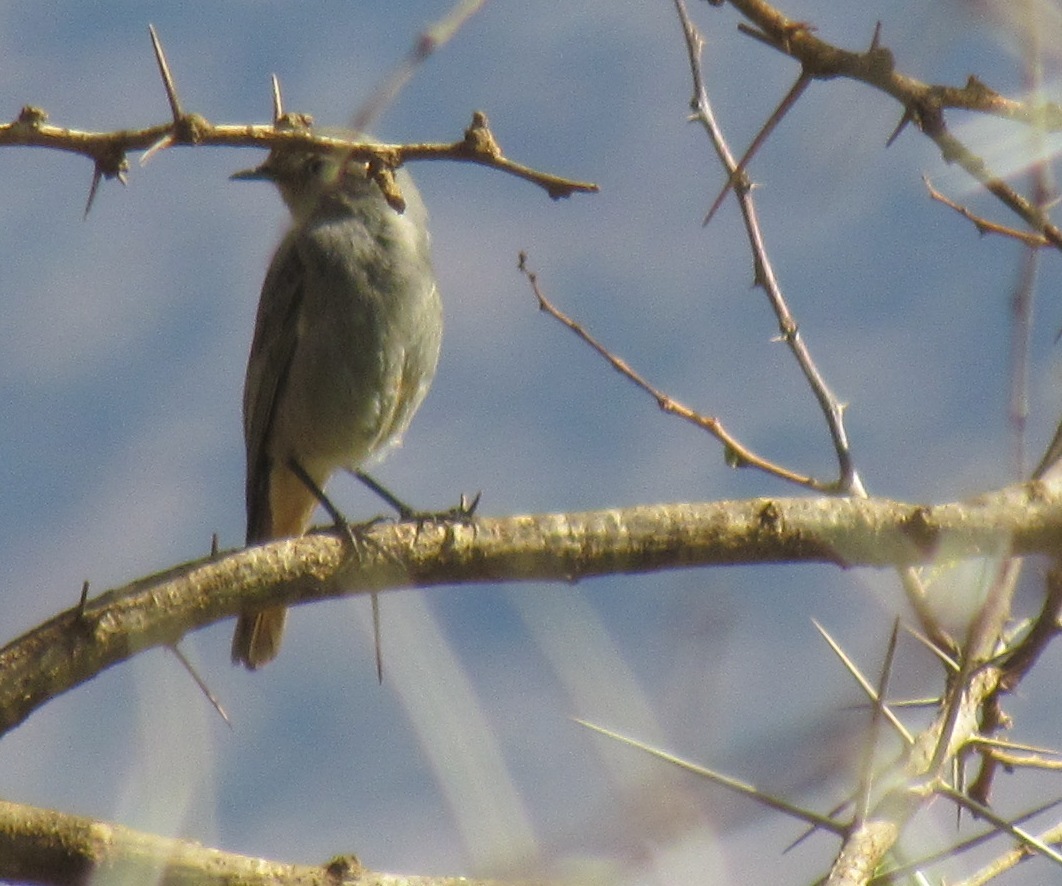
Though spotted flycatcher was more easily seen as they adopted more exposed positions.

spotted flycatcher


On one bush in clearing was a Turkestan shrike. This is a bird I see in large numbers in Arabia on migration and in winter.

Turkestan shrike

The botanical gardens are also home to several red squirrel.

red squirrel

Turkestan shrike was also one of the birds observed when I walked around the hotel one evening.


Turkestan shrike in Lebedinovka

In a sense I was disappointed to see laughing dove. This bird is still spreading north out of Africa and has reached Bishkek and even southern Kazakhstan to its north. It would never survive in winter without human settlements providing scraps of food.

laughing dove

Another and even more invasive species is common myna which is indeed common in the city.

common myna

More interestingly I came across goldfinch in gardens. These are of an eastern race which doesn't have a black head.

goldfinch

I would have loved to have had more time in Kyrgyzstan. I have checked whether it can be visited en route to anywhere else I am likely to visit in my quest to see every country in the world. There are a couple of options. Who knows I may return some day.

Sunday, 3 August 2014

Dukan

The Dukan area is about 60 minutes drive outside Sulaimani. Features include a very large lake with hydro electirc plant. Down stream there is an ice cold river runnig through Dukan town. I only had time to bird the town area. Thanks to my non-birding friend Steve K for accompanying me.

The lake area is actually well recorded and has some very interesting birds. If I ever return to Kurdistan that would be my first stopping point next time round.

However on July 26th we birded the town area. 

large white headed gull

One of the first birds seen was very difficult. It was a large white headed gull and I couldn't identify it properly.  The photos aren't the best but the default gull in this part of the country at this time of year suggested Armenian gull. 

The eye is very dark for a yellow legged gull which would be a very rare over-summering bird. Similarly the gonys (red patch on the bill) is very large for a Caspian gull which would also need to be over-summering.

I placed it on the birdforum identification forum and the consensus is that it is indeed an Armenian gull. It has a very weak black sub-teminal band while most Armenian gull have a strong one. However this apparantly can often disappear with age. 

River at Dukan

The water in the river was cold producing a natural cooling effect in the valley. It was not surprising then that I saw so many northerly species close to the river particualrly in the shade.


goldfinch

When I sat inside a small glade chasing golden oriole, I managed to photograph resting goldfinch and great tit. For an hour beforehand I had failed to photograph the goldfinch out in the open as they flitted back and forth into the shade. 

great tit

I didn't see a great tit in the open at all.

blackbird crossing the river

Some of the best birding results were achived by watching birds break cover to rapidly cross the river from one side to the other. I saw blackbird and jackdaw this way.

Upstream from the bridge in the town were some of the best birds but the photogrpahic possiblitites were poor as I was looking directly into the sun. There were red rumped swallow hawking over the river for insects most of the day. Briefly a few barn swallow joined them but moved on.

Mid morning,a mixed flock of blue cheeked bee-eater and European bee-eater visited. At the same time the only bird of prey seen on the whole trip soared above. it was a short toded eagle.

white eared bulbul

Although many of the psecies here were northerly birds at the southern edge of the range. Two species were the other way round. That is to say southerly species towards the north of their range. These were white eared bulbul and graceful prinia.

graceful prinia


While I was photographing the graceful prinia, a single European reed warbler flushed out of the small clump of bull rushes near-by. You just see one of the rush stems in the photo.

Other notable birds were a single white throated kingfisher seen flying upstream and two pied kingfisher spotted at different times and oplaces along the river. Unfortunately none of the three birds stopped to perch.

The next blog looks at my second visit to Tanjaro river in Sulaymani where I found the second lifer of my visit to Kurdistan.


Species seen at Dukan  I = addition to my Iraqi list

Short toed eagle I
Armenian gull  I
Feral pigeon
Collared dove
Laughing dove
White throated kingfisher I
Pied kingfisher  I
Blue-cheeked bee-eater  I
European bee-eater  I
Golden oriole  I
Magpie
Jackdaw  I
Northern raven
White eared bulbul  I
Great tit   I
Crested lark
Red rumped swallow  I
Barn swallow
Graceful prinia
European reed warbler  I
Blackbird   I
House sparrow
Golfinch I

Thursday, 22 November 2012

The other birds in the pivot fields in Tabuk

The pivot fields near Tabuk are north and south east of the city.  Lou Regensmorter and I spent Thursday morning and Friday afternoon in among them. On Friday we met up with Viv Wilson, a local birder and our very hospitable guide for much of the day.

There was more to the fields than  the flock of sociable lapwing that I have already blogged about. They are rich in passerines and birds of prey. The passerines include one which doesn't breed anywhere else in Saudi Arabia.

desert finch

We started birding just after daybreak on Thursday in the northerly set of fields. One of the early sightings was a flock of desert finch which are more numerous in this area than near Riyadh.

white eared bulbul

However two birds which are found in Riyadh were a real surprise here. Looking at the map in the 2011 edition of "Birds of the Middle East", white eared bulbul is not supposed to be within 250 kilometres of Tabuk. The closest place in KSA is meant to be Al Jouf.

The map on common myna is even more inaccurate. Its supposed to stop 450 kilometres south near Yanbu. Either the area has not been birded much or the birds are moving north and west rapidly or more likely both statements are true.

common myna

Another bird probably at one of the edges of its range is Namaqua dove. All three species were seen within an hour of starting birding in the early morning.

Namaqua dove

Both Laughing dove and particularly collared dove were common.

Spanish sparrow and corn bunting

One of the target birds which we expected to see was corn bunting. This was picked up quickly. There were several in a mixed group with Spanish sparrow. Late in the day we saw a large free standing flock too. 

Corn bunting was another addition to my Saudi list. Actually I miscounted in a previous blog. My additions numbered 6 during the weekend not 5 as previously reported.

chiffchaff

Some target birds never materialised. No wintering sylvia warbler such as Cyprus warbler were observed. Two of the warblers  which were seen in the fields were chiffchaff which was abundant and graceful prinia. 

Graceful prinia

Two wheatears were also seen in the area (not forgetting the Finsch's wheatear seen on the uplands on Thursday afternoon). These were northern wheatear and mourning wheatear. The former was a bit of a surprise because it doesn't really winter near Riyadh so why were so many seen further north at Tabuk? 

Northern wheatear

Stonechat was everywhere with proportionately fewer Siberian stonechat and more European stonechat than in the Riyadh area.

Stonechat

Viv Wilson told us the black kite arrived 6 weeks before in huge numbers. Since then they have been dwindling. Nevertheless there were almost certainly a few hundred left in the district.

black kite

Very close to a field with many black kite was a single blue cheeked bee-eater on a wire. This was a seriously late migrant. 

a late blue cheeked bee-eater

As sun started to go down on Friday night, the number of birds started to increase again to similar numbers seen early on Thursday morning. The birding was interesting to the end.

bluethroat

Bluethroat started to come out of the reed stands between the fields.

goldfinch

I finally got a good view of a goldfinch which had been tantalising me with glimpses all afternoon. Had I seen one for sure or not? In the end one stayed still enough for me to be certain. I finally added it to my Saudi list in the only place (the Tabuk pivot fields) in the whole of KSA where it is resident. This  meant alot to me. I really didn't want to go all that way and miss it. 

red throated pipit

As the sun went down , the pivot bars started to crowd with pipits. They must have been in the fields all the time. All the ones we saw were red throated pipit. This must be a good wintering place for them.  

The next blog will look at Friday morning when Viv showed us round his local patch which is the city's waste water lake and wetlands. He is lucky to have such a good venue.


Tuesday, 8 March 2011

A last look for sometime at Jebel Akhdar

This may not be my best blog on Libyan birds but sadly it will be my last one for some time. 


Just before the uprising started I visited the Jebel Akhdar in the second week in February. It is very green this year as rainfall has been higher than usual. This blog is about the Marowah area. It's towards the top of Jebel Ahkdar at about 650 metres.

a forest next to the town of Marowah

My first stop in the area was in a small forest right next to the town.. It is a typical forest of the area and I am fairly sure it is artificially planted. There were only cypress trees. This type of artificial forest doesn't have much diversity of bird species. Indeed in this forest I only saw goldfinch and heard chaffinch.

goldfinch singing at Marawah

The goldfinch above was singing its heart out for several minutes. In this sort of forest in Tripolitania you are bound to see many serin but once again I failed to see any in Cyrenaica. I am very confident in saying that serin is one of the very few birds which is over-reported in Libya by Collins. 

chaffinch near Qandulah

Another forest near Qandulah was quite similar with chaffinch and goldfinch but it held at least one wintering robin too which alluded my camera.

kestrel at a wadi near Marowah

The best birding in this high plateau area was not in a forest at all.

Most of the high plateau area is wind swept and not too fertile however there area few fertile wadi valleys which have been taken over for growing crops. One of these just east of Marowah had the best birding in the area - at least at this time of year.

Here I saw barn swallow and alpine swift. The former were almost certainly on passage. However the latter are probably resident in the area. 

There are plenty of kestrel (and common raven) in the upper reaches of the Jebel Akhdar. One kestrel at this particular wadi caught my attention. It stayed perched on a wire for a long time. I took this as a sign that the area had plenty of small birds.

linnet at a wadi near Marowah

Sure enough as well as barn swallow and alpine swift there was a large flock of linnet as well as a few laughing dove.

meadow pipit at wadi near Marowah

I took a close look at the pipits in the fields. Some were on the wires too. I had to check that they were wintering meadow pipit rather than passage tree pipit particularly as tree pipit more regularly perch on wires than meadow pipit. I am pretty sure they were meadow pipit though.

This wadi looked a good location to find passage birds and I had planned to go back there during March. I am sure it would hold tree pipit and yellow wagtail at very least. Alas I don't think I will be there to see them there or any other place in Libya for that matter. 

My next blogs will probably be about Bulgarian birds (where I have a home) or Namibian and Botswanan birds where I am taking a holiday in the near future.

Stay tuned.

Monday, 7 February 2011

Courting corn buntings and other land birds

There is more to Old Marj than water birds. For one thing many of my students say that the area is haunted since the 1962 earthquake killed so many and even those who don't believe it's haunted won't go near the lake at night. 


The other thing Old Marj has got is land birds. They may not be so prominent as the water birds but they are interesting too. 

two corn bunting sharing a tree

I'm dedicating this blog to the land birds of Old Marj. I've blogged once before about the land birds here so this blog will hopefully cover only new ground. 

First new observation was that the area has corn bunting. This is not surprising as I have seen flocks at two Wadis 30 -70 kilometres to the south and south west of Marj respectively.  However I think corn bunting may breed here.

left hand corn bunting at Marj

The two corn bunting in a tree stayed in the same position for over five minutes staring at each other. I don't know whether this is courting behaviour but it certainly looked like it.


right hand corn bunting

In breeding plumage corn bunting takes on a yellow look which makes them more like a non-breeding yellowhammer than at other times. Luckily we don't get yellowhammer here so there was zero chance of confusion.  Furthermore the bill on these birds was very heavy so they could only be corn bunting anyway.

black redstart

I managed to get quite close to a black redstart which I watch closely now to see if they are European or Turkish sub-species. The one above is European.

goldfinch and linnet together

The goldfinch and linnet I had seen on previous visits were in a super-flock of mixed species this time. I have seen this before (at Jardinah farm in the summer). At other times in Libya I have also seen goldfinch mixed with house sparrow (Jardinah again) and with greenfinch (at Farwa last winter).

hoopoe on a wire

Hoopoe was again easily seen at Old Marj.

white wagtail

Plenty of white wagtail and grey wagtail were around too. They are nearly all now in breeding plumage. Spring is very close now. I expect to see the first passage birds very soon.


Wednesday, 12 January 2011

Land birds at Marj

While I visited the water complex at Old Marj primarily to see the water birds this didn't stop me noticing land birds too.


As always in winter where there are bushes near water I saw many chiffchaff.

chiffchaff at Old Marj

It never ceases to amaze me how varied chiffchaff can be. The one above had the dark legs and weak supercillium of a chiffchaff but it under colours were much more like your average willow warbler. 

chiffchaff at Old Marj

Willow warbler make their return passage very early in northern Libya. Indeed many stay a week or two before moving on north. I would expect to see the first ones in about 5 weeks time. The spring passage is not far way.

Before I move on from warblers, I must tell you this is a great place to see reed warbler. They are present in winter and are presumably african reed warbler now known to breed in Libya thanks to work by Jens Hering.

flock of local goldfinch

There is no doubt that the all year round water and the bushes and trees  attracts more bird species than most of Libya.  Part of a flock of goldfinch is shown above.

plenty of linnet here

When I first saw the flock of linnet I dint instantly recognise them. They were directly into the sun and my ability to identify using songs and calls is still poor.

As soon as they moved out into the trees I knew. Actually the last time I saw them was at Ras Al Hilal and they were sitting on wires there too.

closer view of two linnet

Linnet is not as common as chaffinch and goldfinch in Cyrenaica so it was a pleasure to see them.

I still haven't seen a single siren in Cyrenaica since I arrived in May. It is the most common finch in north west Libya. It is in the guide books as resident in both areas but I am pretty sure its not in Cyrenaica in summer - certainly not in any numbers. There is no doubt that tourists have seen it while visiting the Ancient city of Cyrene because they have reported it. However all their reports have been in winter which is the tourism season. Furthermore, I haven't been birding in Shahat/Cyrene this winter. Logic suggests it is therefore a winter visitor in that area.

One final land bird I want to blog about is hoopoe. Once again it is found in a wetter area where there is a good supply of ground insects.

hoopoe at Old Marj

Tomorrow I am going to look at the birds of prey that the area attracts.