Showing posts with label grey plover. Show all posts

Sunday, 9 October 2016

Before Mederdra

My big birding event this weekend was a long day trip south east to Mederdra. Mederdra is about 70 kilometres north east of Rosso as the crow flies. 

The next blog will be about Mederdra where the birding proved to be very good.

This blog covers all the other birding I did this weekend starting on Friday afternoon and including an enforced stop on the way to Mederdra on Saturday morning. Sunday was simply too hot to do any meaningful birding at all.

grey plover

On Friday afternoon I walked once again directly north out of my house towards the desert through the F Nord district of the city.

The scrub on the edge of the city has held various migrants on other vists but this time it was virtually clean. This doesn't mean the best passage is over because passage can be very patchy depending where the windfalls have taken place before sunrise.

Into the desert a short way and one comes across a set of saline pools. They had a good selection of waders and waterbirds: flamingo, little stint, ringed plover, dunlin being the main ones. My intensive scanning paid off as I spotted a single grey plover. This is an addition to my Mauritania list albeit not an exciting one. This was species 114.


Kittlitz's plover

Another single wader observed was a Kittlitz's plover. This is still a relatively new bird to me haivng been a lifer here three weeks ago.

blue-cheeked bee-eater

Also in the area where several of the resident blue-cheeked bee-eater.

whinchat

On the walk back I checked the scrub and bushes more exetensively. I did find a very few migrants. I counted two willow warbler and a whinchat.

On Saturday morning Dr Mohamed Vall drove us to Mederdra which means taking the very poor quality road (N2) towards Rosso for part of the way.

Almost evitably we got a flat tyre and it was ironically very close to Amzela where we birded the weekend before. While the tyre was being replaced it was suggested I bird for a few minutes. This was done in the poor light of the early morning.

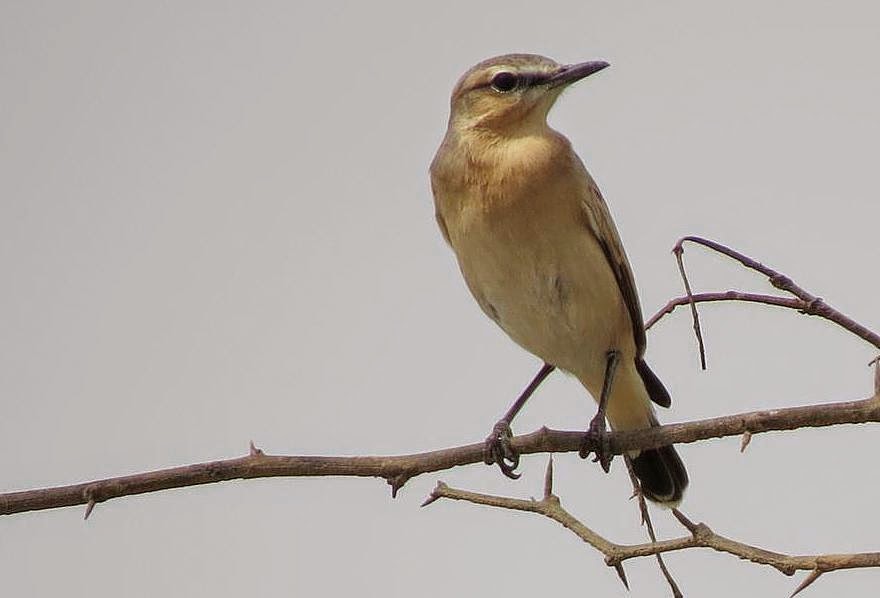
I wasted some of my time chasing a wheatear which spooked every time from about 40 metres away. I know it was most likely a western black-eared wheatear but I cound not rule out northern wheatear from such a distant moving target. A black-eared wheatear would heve added to my country list. Elsewhere I found white-throated bee-eater which had been present in the area the week before.

white-throated bee-eater

In the remaining time I tracked a huge flock of Sudanese golden sparrow.

some of the Sudanese golden sparrow

Separation from non-breeding Vitelline masked weaver is a bit tricky especially as the flock contained no obvious adult birds what so ever. I have meet this phenomenon before where I tracked a 200 strong flock of house sparrow near Riyadh which also contained no adults. It was also in October.

The birding around Mederdra had many positive components. For example I got nine extra birds on my country list including three lifers. I also had very good views and photographs of breeding and non-breeding Sudanese golden sparrow and Vitelline masked weaver. The next blog will cover all the happenings there including pictures showing the subtle differences between these birds.


Sunday, 24 May 2015

Now four Amur falcon at Jarziz farm

I have been reporting on the Amur falcon I have been seeing at Jarziz farm. Here is a further update as part of this blog.

I saw my first two on April 28th. In total I have visited the farm six times more since then. Each time there were between two and four birds present. I went there yesterday and there were two.

Each time, as far as I can tell, they have been different birds. There have been 20 in the seven visits.


The most (four) were on May 19th. This blog looks at my birding on that day both at the farm and later at East Khawr (Khawr Dahariz).

female Amur falcon

The only adult male I observed was on April 28th. This is consistent with the adult males returning first. Of the other 19 birds only six have been immature males. The other thirteen have been either adult females or immature females. 

female Amur falcon 2

When I go early in the morning, they are usually found perched on the big pivot bar. It's an easy find. As time goes on they venture into the field to hawk for grasshoppers and other flying insects.

three Amur falcon clustered together

On May 19th, four Amur falcon were all perched on the bar at the same time.

four Amur falcon

Three birds were female and one was male.

immature male Amur falcon 

On each of the days I visited, there was always at least one European roller.

European roller

Very large numbers of both African silverbill and Singing bushlark have always been present on each day.

African silverbill

Not only is the farm an obviously guaranteed place to see Amur falcon on spring passage but it is a guaranteed place to see singing bush lark for a longer period. Both are prized by visiting birders.

Singing bush lark

In the early evening of May 19th I visited East Khawr for a short while.

great white egret

There are still some intermediate egret at various khawrs around Salalah but here was the rarer (for Salalah) great white egret. It would appear small numbers of both over-summer.

The glossy ibis are also still present at east Khawr. There is no sign of any breeding with these either. Some thirty or so birds of this species also seem to be over-summering.

glossy ibis

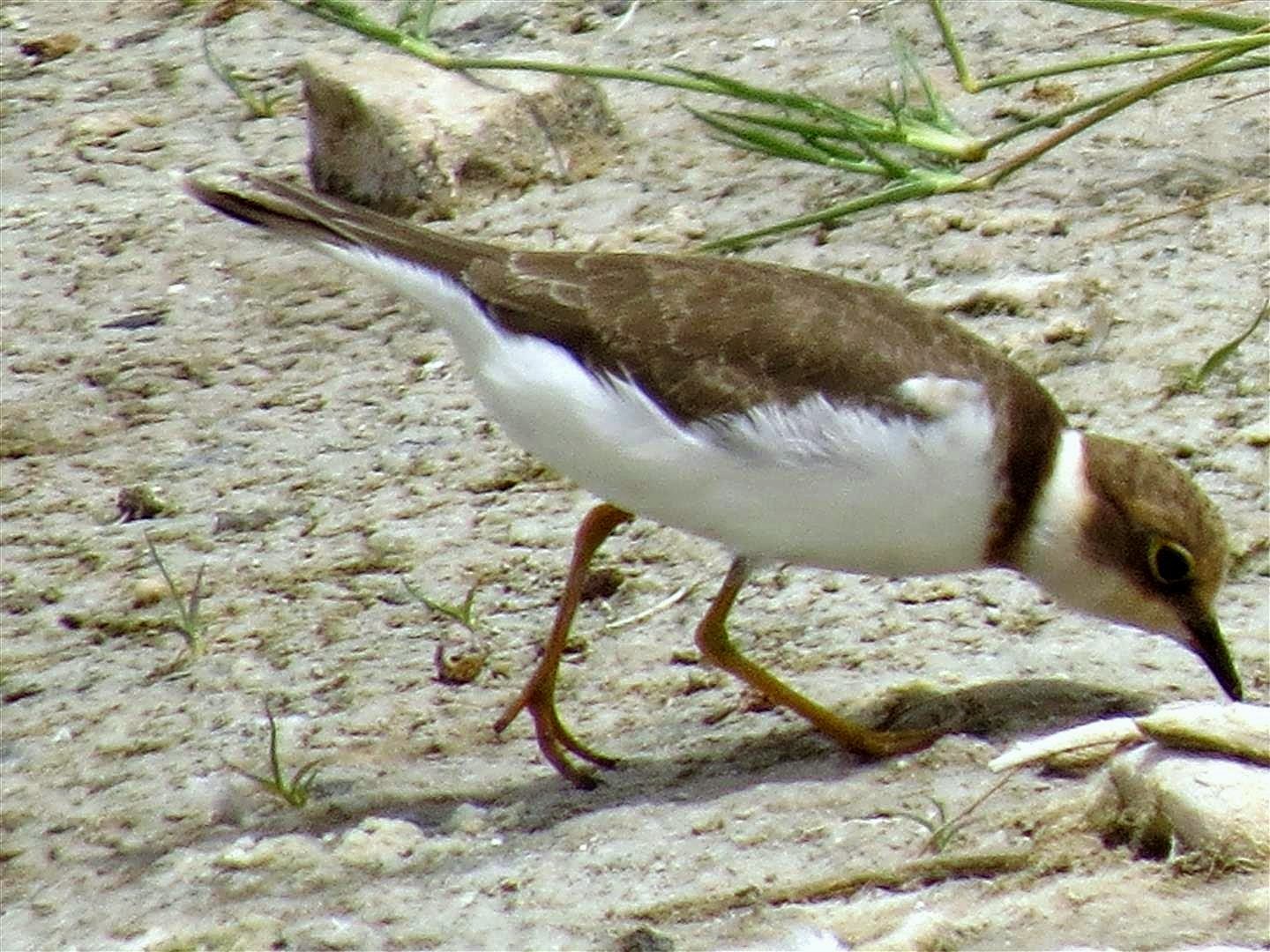
Very few waders were present. However, one interesting one was a grey plover.

grey plover 1

It was essentially in winter plumage.

grey plover 2

The orange at the base of the bill intrigued me. I can't find it referred to in any guidebook or on-line reference. However in the end I did find two images of birds showing this feature.

grey plover 3

The main waders however were lesser sand plover. Most had some degree of summer plumage.

lesser sand plover

They don't breed this far south and must have been on passage.

lesser sand plover 2

On Friday I went to Khawr Rori for the first time in over a month. I will write about what I saw next.

Monday, 29 September 2014

Caspian plover and lots more

On Friday the plan had been to visit Raysut treated water lake but an issue with a "recommended" driver caused this to be delayed for 24 hours hours. So at the last moment I made an impromptu decision to revisit central Salalah. This entailed starting at Wadi Salalah, moving down to Khawr Salalah on the coast and then walking up to the Central Park.

I had no high hopes as they had been visited a week before. I decided I would concentrate on getting better photos of birds already seen in Oman.

As it happened things turned out very well.

Indian pond heron

It didn't look that way to begin with. The wadi had far fewer birds than the week before. Perhaps this was due to the presence of a female marsh harrier. Either way, for example there were no garganey or ruff to be seen this weekend.

A close Indian pond heron allowed me better photos than I had had before of this species. 

Black tailed godwit

A black-tailed godwit was one of the fewer waders around.

common redshank

I got closer to common redshank than they usually allow. Since the wadi wasn't very productive I quickly moved on to the Khawr. It was here that things got interesting.

grey plover with pacific golden plover

Among the 40 or so Pacific golden plover scattered around the site but concentrated on the sand bar was a grey plover

grey plover

Grey plover is often a solitary bird on passage and in winter. This one was no exception. It soon flew off down the coast 50 metres to be alone. I followed it.

Caspian plover

When I turned back towards the sand bar that separates a khawr from the sea, there were tens of lesser sand plover and greater sand plover mixing with the pacific golden plover.

I suddenly realised that one of the closest plovers to me was none of these three species but a Caspian plover. It is far more graceful than the sand plovers.

Caspian plover with greater sand plover

Incidentally there is a big discrepancy between the size quoted for a greater sand plover in my three guides. Helms and, Madge and Beaman have it 10-15% larger than Collins. By comparing against other birds including the Caspian plover then Collins is right.


Caspian plover running

By scanning around, I saw there were actually three Caspian plover in the mixed group. More like Kentish plover than any other species, their preferred escape strategy is to run.

Caspian plover running further

My good run continued because as soon as I left the khawr to head to the Central Park I passed my first Isabelline wheatear since I came to Oman.

Isabelline wheatear

The route to the central park means walking past the wadi again. A quick look there showed a several little ringed plover had turned up. This is another first for me in Oman.

Little ringed plover

Little ringed plover love little pebbly islands in fresh water and that is exactly where they were this time.
.
common redshank

I was also pleased to see another common redshank but this time in part summer plumage.

Golden oriole

When I arrived at the park, I was lucky enough to get a clear view of one of the golden oriole. Last week I saw two. This week there were three: two females and a male. One female gave me a clean photo. 

spotted flycatcher

There were no new birds from last week but I am hopeful about this location for this winter. A spotted flycatcher was also photographed.

grey-headed kingfisher

I am still seeing plenty of grey-headed kingfisher around the city. This is supposedly a summer visitor. I am beginning to wonder when they will leave.

a splash of colour

Finally one of the things I like about salalah is its sub-tropical feel including its flowers. 

In the next blog, I'll report on my visit to Raysut treated water lake.

Saturday, 4 January 2014

Coastal lakes at Khobar

Yesterday I undertook a long day trip to the east coast centred on Khobar. I had in mind targetting two birds which I don't yet have on my Saudi list. I also more generally wanted to know what was there at this time of year.

My two target birds were great black headed gull and sandwich tern. Despite major efforts I saw neither. Yet I was not disappointed partly because of the variety and numbers of other birds seen but also because I picked up a different addition to my list quite expectedly. I'll explain this in detail in my next blog.

grey plover

When I arrived at Khobar's south corniche, I started out by inspecting the set of lakes which are 100 metres from the sea and separated from it by the corniche road.

Kentish plover

There were plenty of plovers on the lakes' "beaches". Most of them were Kentish plover and common ringed plover. A few were dunlin. two were different. One was grey plover (see photo above). The other was a broad-billed sandpiper. Note the broad bill base and kink in the bill toward the tip as well as head markings consistent with this species.

broad billed sandpiper at the back

There are common in this area on passage and they winter in "coastal Arabia" according to the main regional guide. It looks like at least one has lingered on this part of the Arabian coast though most must move further south.

striated heron

Another bird towards the edge of its range was a striated heron that I flushed as I walked round a lake. The regional guides map doesn't show it this far north on the east coast. The distribution in the map stops at UAE border. This is probably yet again more a function of under-reporting in Saudi Arabia than non-existence.

Unfortunately the bird flew into my direct sunlight so betters pictures weren't possible.


plenty of gulls

The lakes were full of gulls. About 80% were black headed gull with the balance nearly all being slender billed gull. Since I had come to Khobar looking for great black headed gull, I studied the groups intently.

Heuglins gull with black headed gull

There were two larger gulls among the many tens of medium sized gulls. Both of them were immature (probably third winter) white headed gulls and I believe Hueglin's gull because of the black sub terminal band and because the mantle is relatively dark.

another view of the Heuglins gull

Another feature of the lakes were the large number of herons. I came across at least eighteen grey heron.

grey heron

I hadn't realised the western reef heron roost together before though its not surprising. One cluster of bushes held at least fifteen of them of various morphs.

heronry of reef heron

There were also two little egret on site.

dark morph western reef heron

There were relatively few land birds in the adjacent scrub. House sparrow were the most numerous. Graceful prinia were the next.

Daurian shrike

Two Daurian shrike were seen there.

After two recent visits to the east coast in winter, I seen several Daurian shrike and not a single Turkestan shrike whereas in the Riyadh area both types of red tailed shrike winter. 

Finally one bird I didn't see at Khobar was white wagtail though they were easily seen on our stops on the way from Riyadh. Surely this local lack was just an oversight. 

white wagtail

Having finished with the lakes I moved on to looking at the sea and coast. This is where most of the day's action took place and where I got the 317th bird on my Saudi list. I will blog about this next.

Sunday, 23 January 2011

January at Ain Azziana

It's been four or five weeks since I last visited Ain Azziana a semi-saline area next to the coast near Benghazi. I thought it was due a renewed call.

The most obvious birds were the gulls. These were mostly slender billed gull with a small number of yellow legged gull. It still surpirises me that the more common (in winter) black headed gull  does n't seem to be next to the sea in great numbers but seems to prefer inland haunts.


four slender billed gull at Ain Azziana

The picture above has gulls of different ages but just look at how far the one on the right has extended its neck!

As well as the gulls you can't miss the large number of cormorant here at the moment.
cormorant at Ain Azziana

This time the heron family were in shorter supply (except for large numbers of cattle egret on the near-by land). No little egret but there was one great egret which is a much less common wintering bird.

great egret wading near a slender billed gull

I nearly missed the one grey heron present who was mostly hidden from view.

grey heron, Ain Azziana

Once again there were several wintering whiskered tern which is a common feature of this part of the coast (and even inland at Old Marj too).

whiskered tern

I have no doubt there were more of the larger waders here than when I last visited in December.  I was very pleased to see a grey plover. This is a bird the guidebook say is only on passage in north east Libya but which I see regularly albeit in small numbers.

grey plover

Likewise with greenshank, another regularly seen bird in small numbers but which the books say isn't here in winter. The one below was seen on the western side of the Ain which I hadn't visited before. 

greenshank

And yet again the same scenario is true of ringed plover! Seen in winter but not in the books.

ringed plover, Ain Azziana

I am ever hopeful of seeing a little ringed plover here (or near-by) in winter. I have seen in north west Libya near the border with Tunisia but never in north east Libya at this time of year. It would appear very few birds stay north of the Sahara.

common redshank

Along with black winged stilt (at Ain Azziana again but not pictured) the most common medium-sized wader here is common redshank but it is definitely shy.

I want to say something about the water level in the marshy area to the east of the site. It was the lowest I have seen since I started visiting. 

I really don't fully understand what's going on. It has rained harder this winter than in the previous three yet the water levels here is down. I have three ideas 
  • perhaps some of the water used to be "dirty water" and which has been stopped and diverted to the brand new sewage works the city is investing in
  • some construction somewhere has interrupted the fresh water aquifer which supplies some of the water (some is tidal from the sea)
  •  the underground aquifer simply releases water with a big time delay after the rains 

stonechat at Ain Azziana

A result of the drying out of some of the more marshy areas is the loss of any obvious sightings of bluethroat and reed bunting seen before.

Though chiffchaff, stonechat and crested lark which don't need really wetland have remained. 

crested lark at Ain Azziana

Time will tell me what's going on.