Showing posts with label Caspian plover. Show all posts

Monday, 29 September 2014

Caspian plover and lots more

On Friday the plan had been to visit Raysut treated water lake but an issue with a "recommended" driver caused this to be delayed for 24 hours hours. So at the last moment I made an impromptu decision to revisit central Salalah. This entailed starting at Wadi Salalah, moving down to Khawr Salalah on the coast and then walking up to the Central Park.

I had no high hopes as they had been visited a week before. I decided I would concentrate on getting better photos of birds already seen in Oman.

As it happened things turned out very well.

Indian pond heron

It didn't look that way to begin with. The wadi had far fewer birds than the week before. Perhaps this was due to the presence of a female marsh harrier. Either way, for example there were no garganey or ruff to be seen this weekend.

A close Indian pond heron allowed me better photos than I had had before of this species. 

Black tailed godwit

A black-tailed godwit was one of the fewer waders around.

common redshank

I got closer to common redshank than they usually allow. Since the wadi wasn't very productive I quickly moved on to the Khawr. It was here that things got interesting.

grey plover with pacific golden plover

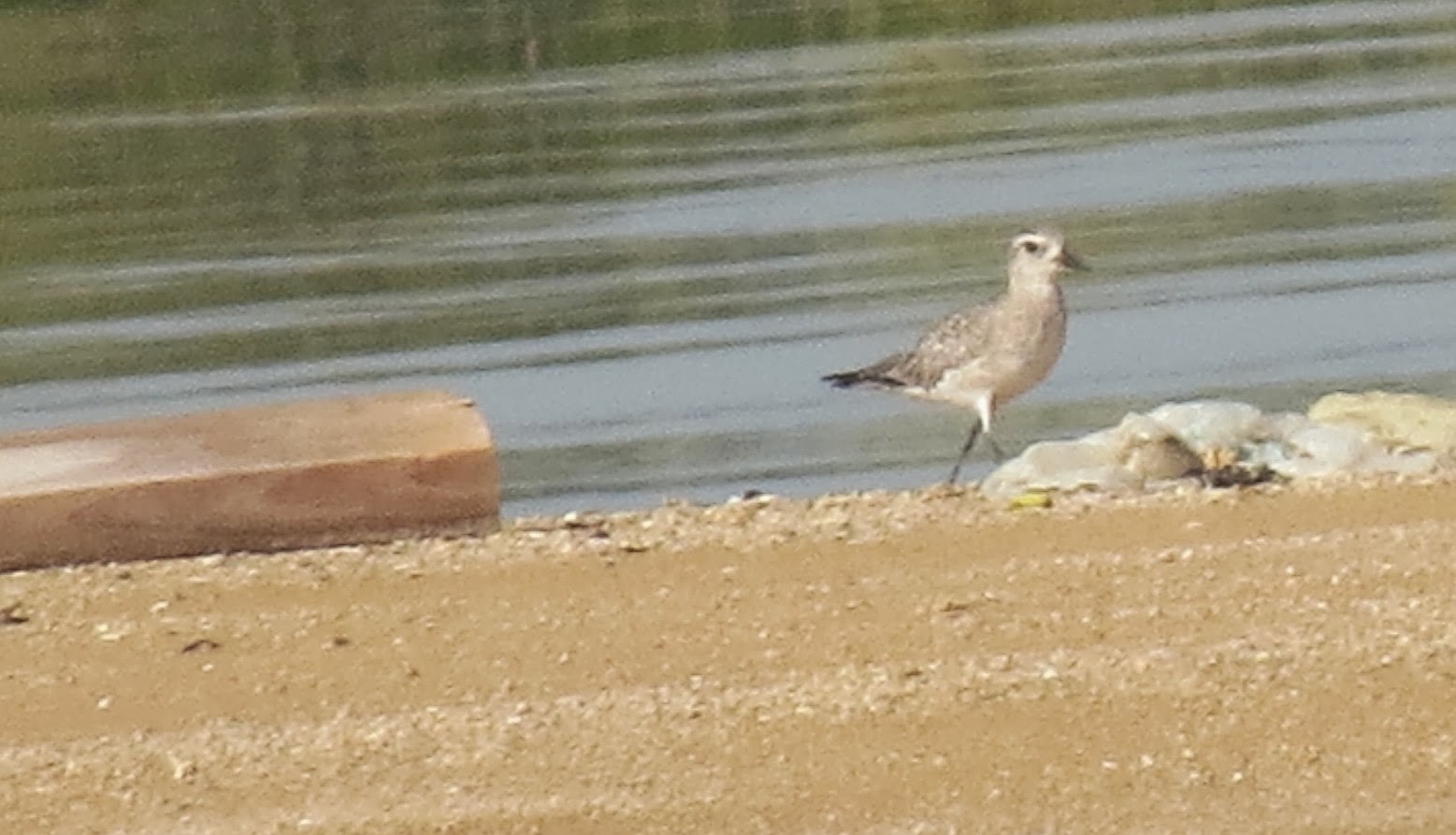
Among the 40 or so Pacific golden plover scattered around the site but concentrated on the sand bar was a grey plover. 

grey plover

Grey plover is often a solitary bird on passage and in winter. This one was no exception. It soon flew off down the coast 50 metres to be alone. I followed it.

Caspian plover

When I turned back towards the sand bar that separates a khawr from the sea, there were tens of lesser sand plover and greater sand plover mixing with the pacific golden plover.

I suddenly realised that one of the closest plovers to me was none of these three species but a Caspian plover. It is far more graceful than the sand plovers.

Caspian plover with greater sand plover

Incidentally there is a big discrepancy between the size quoted for a greater sand plover in my three guides. Helms and, Madge and Beaman have it 10-15% larger than Collins. By comparing against other birds including the Caspian plover then Collins is right.


Caspian plover running

By scanning around, I saw there were actually three Caspian plover in the mixed group. More like Kentish plover than any other species, their preferred escape strategy is to run.

Caspian plover running further

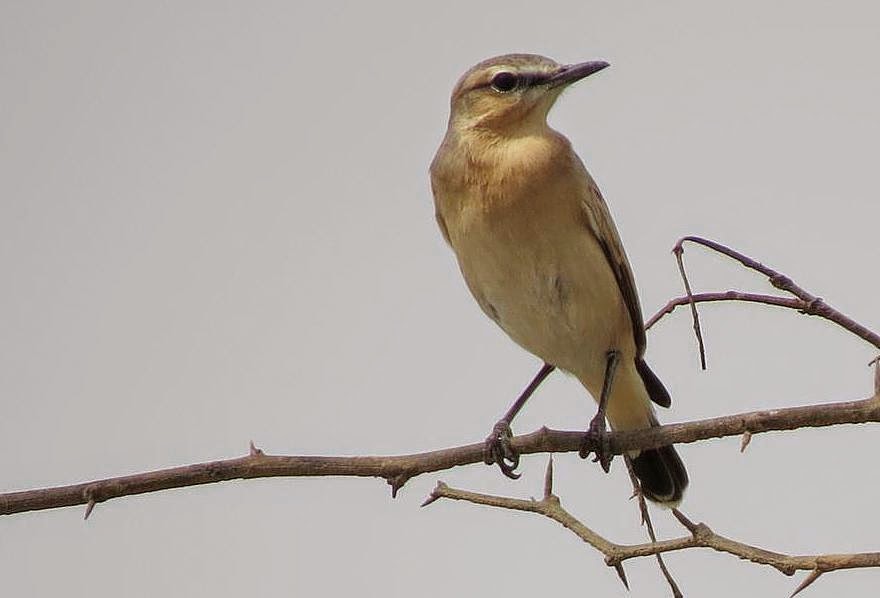
My good run continued because as soon as I left the khawr to head to the Central Park I passed my first Isabelline wheatear since I came to Oman.

Isabelline wheatear

The route to the central park means walking past the wadi again. A quick look there showed a several little ringed plover had turned up. This is another first for me in Oman.
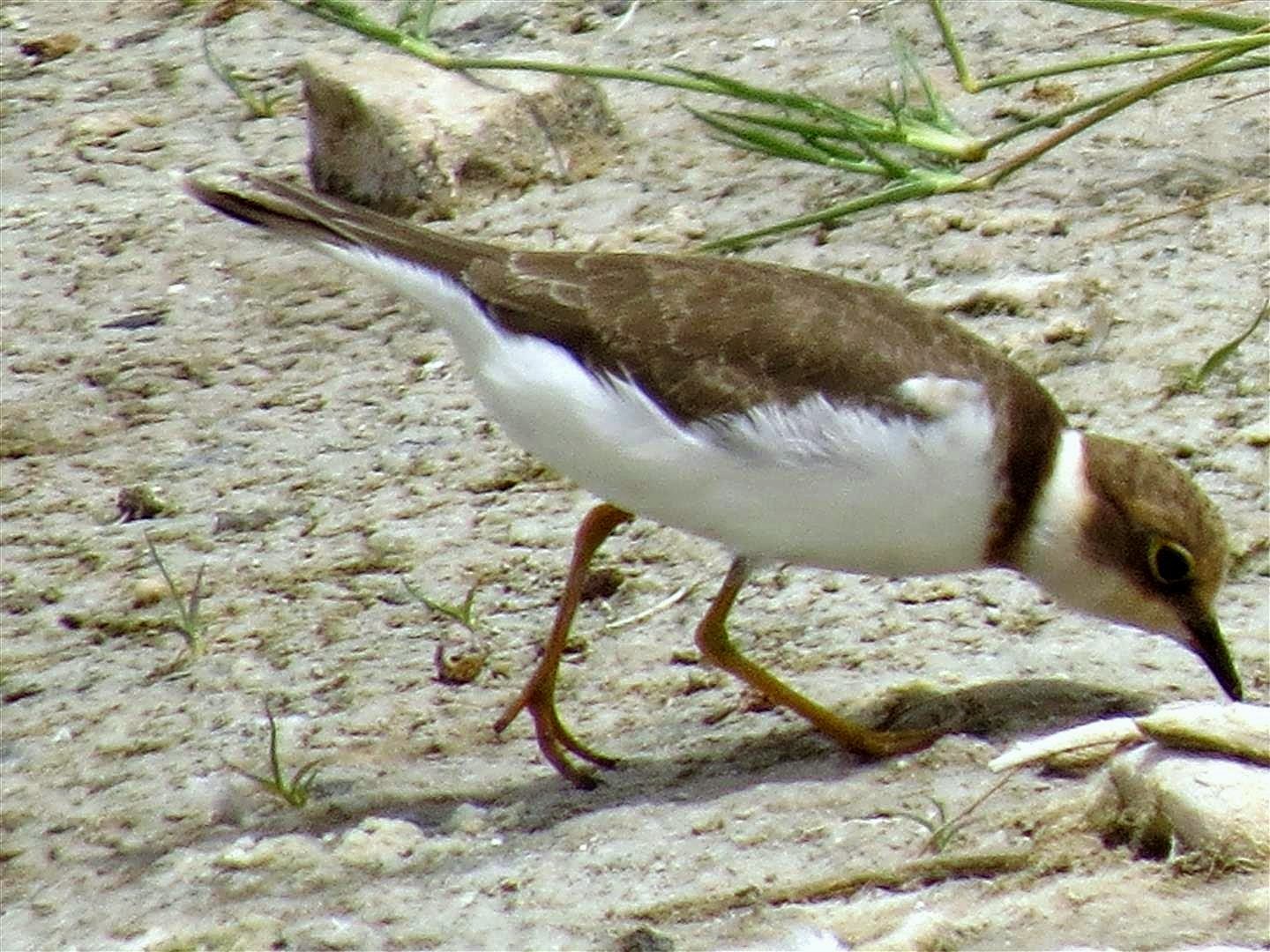
Little ringed plover

Little ringed plover love little pebbly islands in fresh water and that is exactly where they were this time.
.
common redshank

I was also pleased to see another common redshank but this time in part summer plumage.

Golden oriole

When I arrived at the park, I was lucky enough to get a clear view of one of the golden oriole. Last week I saw two. This week there were three: two females and a male. One female gave me a clean photo. 

spotted flycatcher

There were no new birds from last week but I am hopeful about this location for this winter. A spotted flycatcher was also photographed.

grey-headed kingfisher

I am still seeing plenty of grey-headed kingfisher around the city. This is supposedly a summer visitor. I am beginning to wonder when they will leave.

a splash of colour

Finally one of the things I like about salalah is its sub-tropical feel including its flowers. 

In the next blog, I'll report on my visit to Raysut treated water lake.

Wednesday, 5 March 2014

Yanbu royal commission corniche

On Saturday, Bernard Bracken and I birded straght out of the hotel in the royal commission-run part of Yanbu.Other ideas for birding were precluded by Bernard's early travel arrangments.

Nevertheless I have no regrets about staying local.

Ruepells weaver

We walked from the hotel to the corniche near the Movenpick hotel and back. By our recent standards this was leisurely birding.

Before moving more than 300 metres from the hotel we had seen the cosmopolitan nature of the birds within this garden city. As I said in the last blog, Yanbu has been coloised by Ruepell's weaver and is probably the furthest north they breed on the east side of the red Sea.

We chased a flock of Indian silverbill around while failing to get photographs. Mostly a bird of central and eastern Saudi Arabia, it has colonised gardens in Jeddah and Yanbu to the west. 

rose ringed parakeet

Yet another colonist is rose ringed parakeet. Three were seen right outside the hotel.

white spectacled bulbul

White spectactled bulbul is within its natura range but the density is artifically high as is the vegetation.


green sandpiper

After about 40 minutes we reached the coast. There has been a lot of attempts at landscaping here. A re-landscaping project complete with earth movements is taking place in the middle of the area we visited. The Movenpick hotel is just to the north of it and parkland then mangrove to the south.

Just in front of the area being re-landscaped is a man-made inlet. It yielded little but a lone green sandpiper and a white wagtail near-by.

white wagtail

Things got much more interesting when we walked along the coast in the area which is being re-landscaped. 50 metres out to sea there is an island called either oyster island or harbour island depending on the map you read.

grey heron

We strained our eyes, binoculars and cameras to see what was on the isalnd's shore facing us. There was a lone grey heron and plenty of gulls.

The gulls appeared to be mostly large white headed gulls and mostly Caspian gull. Among them were four ternas which were all gull-billed tern. Incidentally they were in breeding plumage.

gull billed tern

Further along that island as we walked south we saw an osprey. That means that every time I have been to Yanbu I have seen one or more.

osprey

Ironically, on this part of the walk, the best birds turned out to be on coast next to us. This was despite all the effort we put into looking towards the off-shore island rather than straight in front of us. 

common kingfisher

On our side a common kingfisher was seen ahead of us on posts on two occasions.

Caspian plover

A ringed plover was walking along with the beach with another plover which on close inspection turned out to be a Caspian plover.  Note its long legs and elegant, dainty look. 

I have only observed Caspian plover twice in Saudi Arabia. The first sighting was a flock in November in Wadi Dawasir. The second was here. Neither place is within the range marked out in the main regional guide. However Gary Bletch who birded in the Yanbu area in the years around the Millennium also reported them in Yanbu in early March.


desert wheatear


On our side we also came across a northern wheatear, desert wheater and Siberian stonechat in among the distrubed earth and rubble.

ringed plover seen near the Caspian plover

Walking further south thearea which is being re-landascaped finally meets up with parkland where many families were picnicking.

It was on the edge of the re-developing area on the beach that a large number of water birds had gathered. We took great care not to disturb them as moved close to them.

ruddy turnstone, white eyed gull and more

The birds inlcuded Heuglin's gull and black headed gull. It was also the first and only place at Yanbu where we observed white eyed gull which incidentally out numbered sooty gull among this group.

There were waders in the group too. Most noticeably they included ruddy turnstone and ruff.

ruff

After observing this mixed group for a while we headed further south along the coast. We walked briskly through the picnickers towards the mangroves.

ringed plover

Nothing eventful was seen in this family area though it would have been improper to linger there. We did notice some ringed plover in long grass which we thought was a strange place to see them. Kentish plover were also running around the sandy parking areas.

striated heron

There used to be many more mangroves at Yanbu but now they are split into three separete sections albeit now protected areas. The smallest of the three sections was south of the parkland on the corniche. It was the one we visited. This was our last major stop but time spent there was brief. 

A second striated heron of the weekend was observed there.

The waders seen were mostly ruddy turnstone and common redshank.

common redshank

Mangrove reed warbler was easily heard and eventually seen.

great cormorant on passage

As time was short, we had to briskly walk back to the hotel from the mangroves with bird watching not being the intent. Nevertheless, that didnt stop us spotting a small flock of great cormorant high in the sky flying fast northward with no intention of stopping.

This was stark reminder that the main passage is about to begin.

Monday, 2 December 2013

Southern farms at Wadi Dawasar

The farms furthest south in Wadi Dawasar and particularly the more easterly ones near the escarpment provided for some very rewarding birding on Friday.  

two Caspian plover

The biggest highlight there and also of the whole weekend trip was the discovery of 14 Caspian plover at the edge of a fodder field.

Saudi Arabia is on a direct line between their central Asian breeding grounds and their known wintering grounds in East and South East Africa. 

However there are two main reasons why the sighting was a shock albeit a very pleasant one.  First, conventional wisdom has it that they should all be in East Africa by now. Second they are much more rarely seen in "autumn" than in spring. Some people reason that they fly directly in autumn over the Middle east without stopping.  

Caspian plover takes off

Both of those hypotheses are looking a bit shaky. Either way, seeing them were moments to enjoy. 

The birds hardly moved in all the time Lou Regenmorter and I observed them leading us to believe they were either tired or sated.

They were not fazed by our presence. Indeed we left them without them flying off only to see the water sprays on the field's pivot bar disturb them minutes later.  

4 out of 14 Caspian plover

Caspian plover is the 314th bird on my Saudi list which is getting increasingly difficult to add to.

Eastern imperial eagle

There was more to these fields than Caspian plover. 

The fields nearest the escarpment held the occasional eagle. Most eagles were steppe eagle though two Eastern imperial eagle were also observed.


steppe eagle

Harriers in the fields were even more common. Although there were a small number of marsh harrier, the more common bird was pallid harrier.


marsh harrier 

There was a high proportion of adult males among the pallid harrier too.

Steppe eagle with pallid harrier

Another feature of the fields was the very large number of wintering wheatears. In the southern farms most were northern wheatear. Incidentally northern wheatear does not winter in the Riyadh area, 650 kilometres north east.

Isabelline wheatear

A much smaller number were Isabelline wheatear and desert wheatear. No other wheatears were seen in these farms but I'll report on two other wheatears seen elsewhere on the trip in a later blog.


The bird above is identified as an Isabelline wheatear (rather than northern wheatear) primarily because the supercilium is broadest and whiter in front of the eye.

desert wheatear

Another feature of the fields were the huge numbers of flocking house sparrow. In this area at least no Spanish sparrow were among them.

Larks were extremely common and flocking too. These were all apparently crested lark and greater short toed lark.  

house sparrow

Once again on one of our trips, we picked up a group of cream-coloured courser. I have now seen them in many parts of Saudi Arabia. As well, as in natural surroundings, they are often seen on arable fields with low level or very low level vegetation. Here we saw eight of them in a newly sown field which was being watered.


cream coloured courser

Other notable birds present were Asian grey shrike (aucheri) formerly designated southern grey shrike.

Asian grey shrike (aucheri)

Actually this area had the highest density of this shrike that I have seen in Saudi Arabia.


Tawny pipit

The pipit family was represented by tawny pipit and white wagtail though the numbers weren't as high as in the Riyadh area.

The picture of the tawny pipit was taken through the car window because some parts of the area were literally thick with flies. It was better to stay in the car with the windows up. The flies were non-biting but still a real nuisance and we couldn't work out where they were coming from. 

white wagtail

I always try to look out for other wildlife on our trips. This time a type of fox was seen on different occasions.

fox

Obviously, I was very pleased about the Caspian plover but there were other surprises in the area just to the north of the southern farms and in Sulayyail too. The next two blogs will cover these areas and birds.