Showing posts with label kentish plover. Show all posts

Wednesday, 23 May 2018

Mid-April around Nouakchott

Mohamed Vall and I birded around Nouakchott in mid-April having returned from Kiffa.

Our first stop was at the water treatment works south of Nouakchott in a district known as Riyadh.

There is a fresh water lake there. It was not as large as on our last visit.

Nevertheless, there were some interesting findings. First of all, we found a kentish plover chick. A look at the Atlas of Mauritanian birds shows Kentish Plover has found breeding in the Nouakchott area before. However, this is the furthest south it normally breeds in west Africa.

kentish plover 1

A parent of the chick was near-by all the time.

kentish plover 2

Other interesting birds in the same stretch of water included a lone ortolan bunting

ortolan bunting

Weavers are rare in the Nouakchott area with some evidence a few move up in the rainy season. 

Vitelline masked weaver

The one most often found this far north is Vitelline masked weaver though it is never common.

little egret

I don't ever find little egret easy to separate from white morph western reef heron. Indeed their DNA arguably suggests they ought to be treated as one species.

little egret

The relatively straight bill and elegant look of this bird, leads me to believe it is a little egret.

black-crowned sparrow lark

Other birds at the water included barn swallow and black-crowned sparrow lark.

common ringed plover

Waders weren't so numerous as on the previous visit but common ringed plover and wood sandpiper supported the kentish plover already mentioned.

After 90 minutes or so at the lake we headed north west to the coast south of the fishing port.

great cormorant (white-breasted)

Sightings were a bit thin though great cormorant were seen on the old wharf. I had seen some at exactly the same place at the same time last year too but not outside April or May.
tree pipit

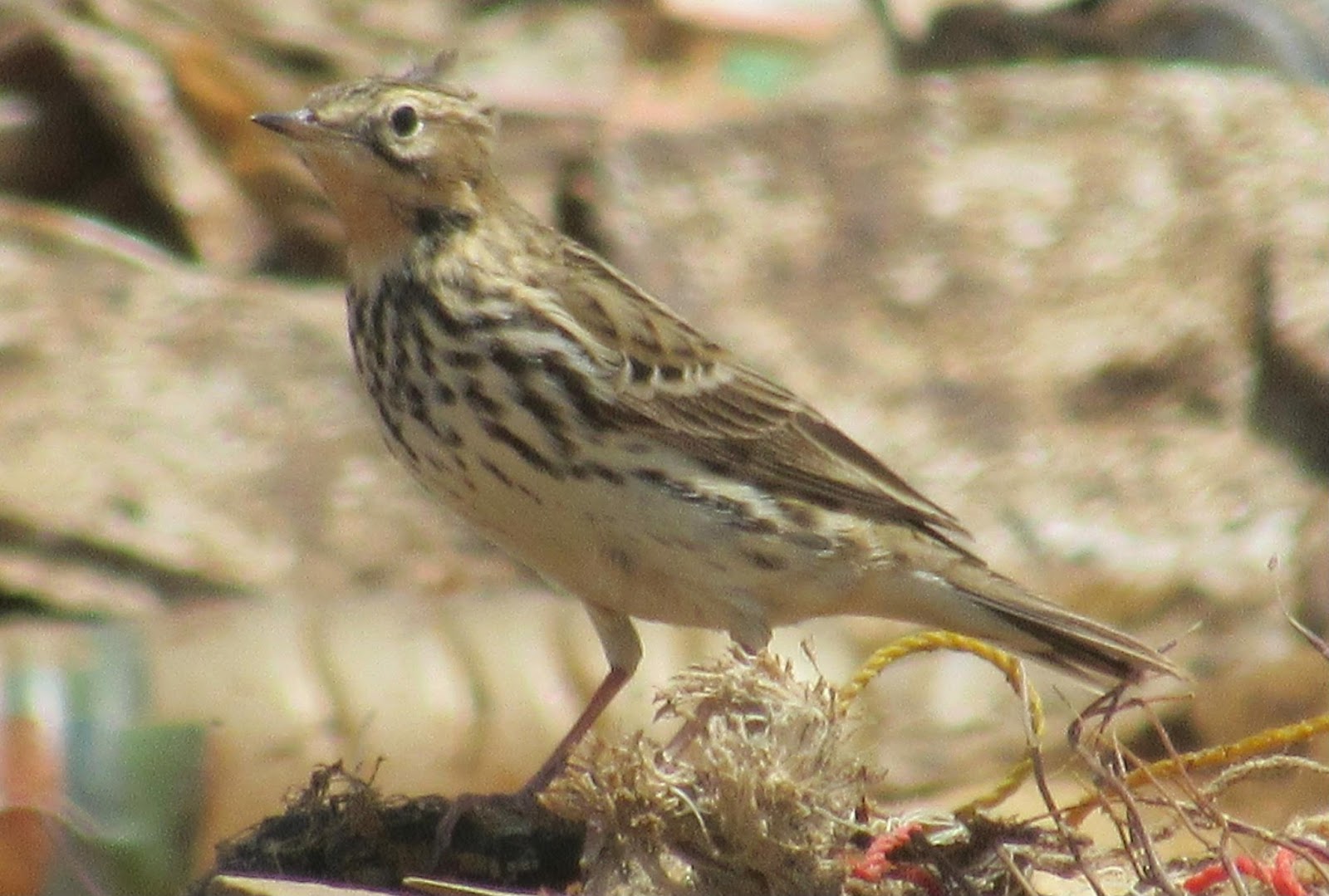
The large, very smelly, waste dump near the fishing port is always worth a visit. Yellow wagtail were numerous as were both barn swallow and sand martin hawking above. There was only one tree pipit though.

grey "pallid" heron

The whole city is being pumped out by the Chinese at the moment. While this means the water level is much lower overall helping residents fight rising damp, it has meant the total destruction of F-Nord lake. It has also had an effect on the man-made lagoons south of the fishing village. While it is not always the case, generally, there is less water being pumped into them. The previously guaranteed gulls, terns and waders are many fewer. A pallid heron was the best bird on this visit.

In early May I returned to the waste water site north of the city. To my surprise I added a species to my country list. I will write about that next.

Wednesday, 4 January 2017

New site but no new birds

I have not posted for two weeks because of work commitments rather than the festive season that most westerners worldworld have had.

I have a few blogs to catch up with concerning a trip down south over the New Year weekend but first here is one from Nouakchott from Christmas Eve.

These days birding around the city must include a visit to the large freshwater lake in the north of the citty. It is in Sukok district.

One reason to go there is to look for any new duck arrivals. The bad news on Christmas Eve was that though numbers were again up there were no additional species.

In these blog I have tried to show pictures from there of species not shown in the previous blog from the area.

African swamphen is one such species.

African swamphen

Little grebe is another although the two black-necked grebe were also still there.

little grebe

Many of the male ducks were moving out of their eclipse plumage into breeding plumage. This was most apparent with the northern pintail.

northern pintail

Indeed northern pintail was the species of duck with the biggest increase in numbers since the last visit.

female northern pintail

Wigeon numbers maintained a high of six.

wigeon

Wood sandpiper is the most numerous wader. The one spotted redshank was still there.

wood sandpiper

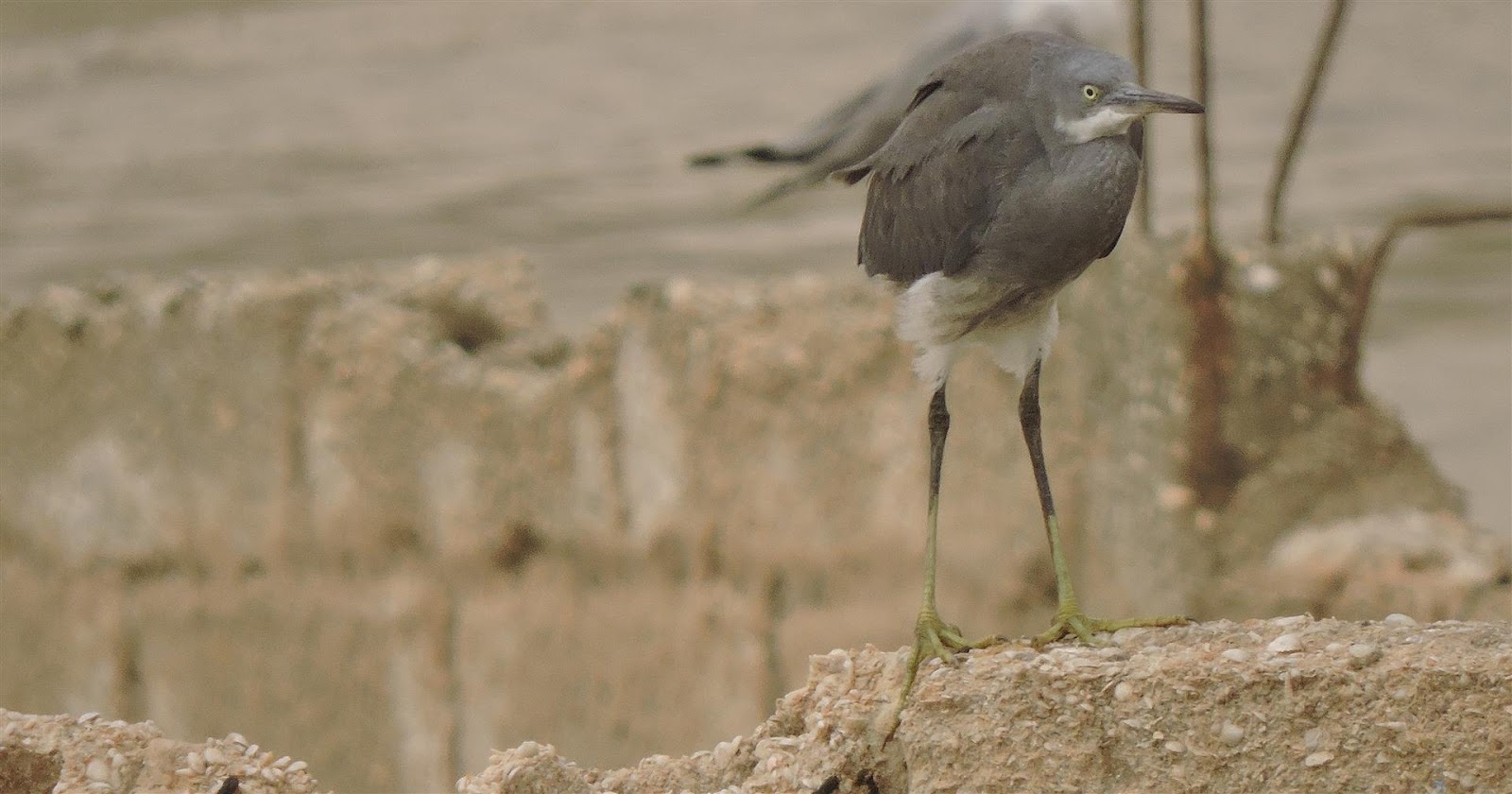
Over the weeks, an occasional western reef heron has turned up. This was the first time a dark morph bird was seen.

western reef heron

Part way through my visit to the lake, I met up with Dr. Mohamed Vall. Together we next went south out of the city.

There is a right turn just past the gendarmarie check-point that leads to a coastal fishing village. We investigated this for the first time.

Waders were mostly sanderling, red knot and grey plover

Kentish plover 1

However the best wader was Kentish plover which is surprisingly uncommon compared with what I was used to in the Gulf.

Kentish Plover 2

After this, we made it to another new site. This was one was the side of the water company which supplies tap water to Nouakchott. Friends of Mohamed Vall had told him that there was a water body at the back of the works.

The water was a lake and had attracted a good cross section of birds. Indeed I suspect it is going to be very interesting during the spring passage.

We were hampered by poor visibility caused by a sandstorm coming off the Sahara.

Nevertheless, we could see flocks of both Sudanese golden sparrow and of house sparrow.

Sudanese golden sparrow

There were waders including a common snipe and at least two little ringed plover.

little ringed plover

Three male black-crowned sparrow-lark came down to drink while we were there.

black-crowned sparrow-lark

Late on one green sandpiper was seen although wood sandpiper and little stint were more numerous.

little stint

This site will be regularly visited from now on.

wood sandpiper

A week later, over the New Year weekend, Mohamed Vall and I made a two night trip to Rosso on the Senegal River. It was highly successful. I added 14 birds to my country list including three lifers. A series of blogs on this trip will be published next.

Monday, 31 March 2014

Kentish plover distraction

I have several blogs and a very large number of pictures to show following birding last weekend. This includes a trip made to a new venue which I am calling east Salbokh wetland.

This site is a large wetland north of Riyadh which is fed clean water from the cooling towers of a factory and dirty water coming by tanker from the city.

The pictures and stories are taking time to compile. In the meantime this blog looks at just one of the birds seen at the wetland.

Benard Bracken was with me on Friday's trip there. At one stage we were walking through a salty flat area next to the wetland when a Kentish plover starting behaving very strangely. 


part of the distraction

We almost immediately realised we had accidentally walked straight into a breeding area. Somewhere very close by must have been the birds scrape. It behaved bizarrely to distract us. It was not really playing injured like many birds in this situation, it was more pure distraction with the oddness of its movements.  At one stage it walked straight towards us.

another phase

We didn't know which way to move to avoid the scrape. In the end we headed further down the wetland rather than taking any steps back. We think we avoided the nest. 

an energetic phase

While I was taking photos, Bernard had the good sense to change his camera to video mode.


the cycle begins again

He has kindly allowed me to post the video on line. The video gets even more interesting as Bernard started to zoom in about half way through.


I hope you enjoy it.

In the next blog, I'll write about the other birds seen at the wetland.

Saturday, 5 February 2011

Spectacled warbler in Cyreniaca

The wetland just east of Deryanah has been interesting every time I have visited it. Yesterday it was extremely interesting but I nearly left the place before the exciting things started to happen.


Deryanah wetland has recently changed. Until two months ago the dirty water from the town was channelled into the area and made its way towards the fresh water lake. 


Far from being bad for birding, the western side of the wetland which received the dirty water used to be rich!  There used to be large flocks of waders such as dunlin and common redshank. 


Following heavy rain the western side had some water but this time it was  fresh water. However the birds were restricted to a couple of drinking meadow pipit, a few white wagtail and a single kentish plover. Near-by were one or two black redstart.


kentish plover on western side of Deryanah wetland

I now take careful note of the black redstart since I visited Tripoli last week. There the birds had been from the European sub species. Here they are mixed with those from the Turkish sub-species. I am getting better at differentiating the females as well as the males now. I am pretty sure the one below is from the European sub species. 

black redstart, Deryanah

Despite the lack of birds in the western part of the wetland I decided to have a quick look in the direction of the eastern half. This means walking past a rubbish tip and a small waterlogged area with tamarisk trees.  There were plenty of chaffchaff still there. I find the types of area - trees next to rubbish dumps always have large numbers of chiffchaff in winter. The common snipe which were there earlier in winter when the area still had dirty water to re-in force the wetness have gone.

waterlogged tamarisk - good for chiffchaff

The rubbish tip housed plenty of cattle egret, white wagtail and a very large flock of starling. I didnt linger to watch them! 

cattle egret, Deryanah

I was half heartedly heading towards the eastern end thinking it is a huge distance to walk to the eastern water. Furthermore it was over low lying scrub and should I give up. Suddenly, I saw the whole flock of starling set off. Someone or a dog must have disturbed them.

More surprisingly still, two curlew also took off from roughly the same area. They must have been disturbed by the same event.

two curlew at Deryanah

The curlew headed off towards the eastern lake. Their movement changed my mind about going back. I am always on the look out for the elusive slender-billed curlew. I decided to continue going east. 

wet and endless garrigue at Deryanah 

I never did make it all across to the eastern lake. Within 5 metres of entering the garrigue I caught sight of two spectacled warbler. Apologies for the photos which are over-exposed and a bit bit blurred. Photographing warblers is fraught because they never stay still and on this occasion I was nervous too!

first sight of spectacled warbler

I know spectacled warbler from my time posted in Tripoli. It is a resident in a few areas (notably around Garabouli) and winters over a wider area.


spectacled warbler at Deryanah from the side

Records of spectacled warbler in north east Libya (Cyrenaica) are very rare. I found only one in my search. This was in the Bird Life International write up on the Ain Al Ghazala  IBA (Important Bird Area)  - coastal wetland just west of Tobruk. They say it is resident there.  I'm not sure how certain this information is. I have some doubts about the Libyan IBA write ups. For example the one for Jebel Nafusa says that Moussier's redstart is resident which it isn't! 

reproduced from Collins "Guide to the birds of Britain and Europe" 2nd edition by Lars Svensson, Killian Mullarney and Dan Zetterstrom. NB Green circle added by me

I don't make a habit of reproducing maps from books (only scientific papers!) but in this case please excuse the exception as it helps explain a point. 

The Collins guide doesn't have it in Cyrenaica. However if you look carefully at their map you see it is down as a passage bird in Albania. The passage birds there have got to go on to somewhere (that's what passage means) and the obvious place for such a short distance migrant is north east Libya. 


frontal view of spectacled warbler at Deryanah

I'm on the look out for more spectacled warbler and have made a mental note to visit more garrigue. I have certainly under-visited this type of habitat. 

Sunday, 26 December 2010

More news from Sirt

Les Edwards has sent me some more pictures of birds in the Sirt area. I am very grateful to all those who contribute to this blog and Les is proving how much can be done.


Here are four pictures Les took on December 20th and December 21st.

kentish plover

Les tells me that the best place to find birds is on the local farms. His observation is mirrored by me in all the drier parts of the country. In fact birding is often easier in the drier places because you know exactly where to go!

little owl

I am amazed how widespread in Libya that little owl is. It almost looks camouflaged. 

desert grey shrike

Les' picture proves that the grey shrike in Sirt is desert grey shrike algeriensis. This a great picture to see how much white there is in the wing.

crested lark

No gallery of Libyan birds would be complete without a crested lark.

I am always looking for contributions to the blog. if you have a story and pictures I'll happily post them. I want this to become a communal blog celebrating Libyan birds from all quarters.