Showing posts with label nile valley sunbird. Show all posts

Monday, 22 February 2016

Tudho and Mazyunah

Travelling towards the Yemen border, midway between Mudhai and Mazyunah but 12 kilometres west off the main road is Tudho. It is at top of Wadi Aydam but it is possible to get down in this widest and deepest of wadis in Dhofar.

The wadi is apparent a stronghold of Oman's trumpeter finch. This species is still a target for me in Oman and was the main reason for my detour.

It was recommended that I stake out a 10 metre long water trough where the finch is known to come down to drink. After a walk around the area especially looking up the cliffs a stake out is exactly want I did.

I waited patiently for two and half hours under a tree but no finches arrived. Perhaps it wasn't hot enough, perhaps it was the wrong tine of day. I will try again some time and later in the afternoon on a hotter day.

The place was not without other birding attractions. There were plenty of both Nile Valley sunbird and Palestine sunbird about. Not many birds find a use for Sodom's apple bushes but they do.
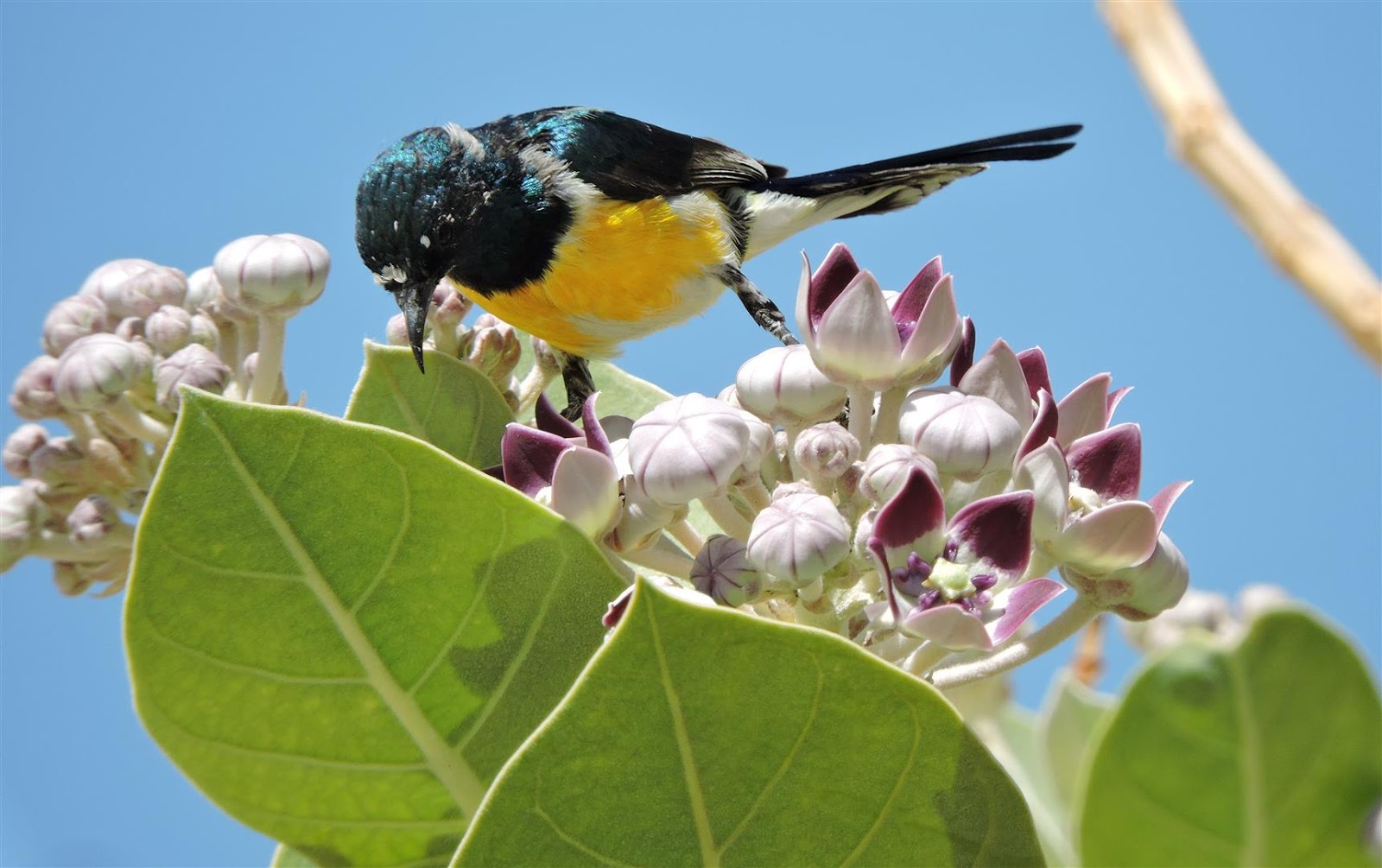
Nile Valley sunbird 1

The best observations and pictures of them were taken as I sat under the tree. Being totally still often works. The male Nile valley sunbird are close to attending their full breeding plumage at the moment.

Nile valley sunbird

Palestine sunbird also visited the same bushes and often at the same time as the Nile Valley sunbird.

Palestine sunbird on Sodom's apple

Palestine sunbird but not Nile valley sunbird was also seen drinking. They didn't drink from the water trough but from a leaking tap and its pool. I never underestimate the birding value of leaking taps in Arabia.

Palestine sunbird moving in to drink

The water trough did attract some birds to drink. The most regular was a desert wheatear.

desert wheatear at the water trough

The most numerous were desert lark and laughing dove.

desert lark

Indeed the density of desert lark in the area was one of the highest I have ever seen. In the near-by camel pens they were crawling around like a flock of sparrows.

laughing dove

White spectacled bulbul were drinking from both the trough and leaking taps.

white spectacled bulbul

After Tudho, I pressed on to Mazyunah and arrived at the Old Sewage pond around 3.30pm.

There was very little change since the week before and so this extension of the trip turned out to be unproductive. I expect this to be different once the passage season starts in earnest. 

Eastern Imperial eagle

Two eastern imperial eagle were actually wading in pool.

bluethroat

Passerines including white wagtail, water pipit and bluethroat were easily seen around the reeds and near-by water.

spotted crake 1

A spotted crake was walking out in the open as soon as I arrived at 3.30pm. I parked up and watched it from the car. This was surprising and yet I didn't see a little crake at all. Even though it is now on my Oman list, it is still a difficult bird for me.


spotted crake 2

Friday afternoon was not as successful as the morning where the Cretzschmar's bunting was seen en route. However I will certainly be coming this way again during the passage. I believe Mudhai, Tudho and Mazyunah have great potential then. I might even finally pick up the resident trumpeter finch too.

Thursday, 27 November 2014

Hypocolius at Mudayy

I have been to Mudayy oasis once before as it is one of the best places to see Nile valley sunbird. However I have seen them much closer to home since.

On Saturday I made the long trip again because of the high possibility of seeing a difficult bird. This time the bird was hypocolius.

Thanks are due to Jens Eriksen who told me some time ago that it winters there.

female hypocolius

Indeed it was found quite easily near the main pool. I counted 14 in all. 

male hypocolius

I know this bird well as up to 200 winter every year in the diplomatic quarter in Riyadh but it is much common in Oman. I have seen it in three countries now. The third is Bahrain.

white spectacled bulbul with hypocolius

These birds were mostly keeping to the shade as it was a hotter day than average for this time of year.

male house sparrow

In the shade with them were a large number of house sparrow. These are the local type which shun houses and are overall paler.

Nile valley sunbird

It was so warm I even saw a Nile Valley sunbird in the same shady place though the dappled sunlight made viewing difficult.


second view of Nile Valley sunbird

My one regret about this area was getting two fleeting glimpses of a thrush which may well have been a song thrush. However the bush is so thick there I never got a clear view. I won't count it.

Laughing dove

Last time I came to the village there were tens of laughing dove and I only observed one European collared dove.


first European collared dove

This time I found about 10 European collared dove after a very short search. I suspect this is some sort of winter dispersal. Like wadi Rabkoot, Mudayy is another place where African collared dove has been reported. Nevertheless once again all my birds were European collared dove but the bright sunlight plays tricks.

second European collared dove

I left the village by noon when it getting very warm. I made a long stop off at the very top of the mountains on the way back. Here there is an abrupt change from green seawards facing places to the arid inland facing side. I chose to bird right on the cusp behind the police check point at the top on the observatory road.

There was lightly vegetated wadi which I birded thoroughly. I was looking for hooded wheatear and scrub warbler but failed with both.

another Nile Valley sunbird

Quite surprisingly, one of the first birds I saw was a Nile Valley sunbird and indeed got much better views than at Mudayy.

Rock dove

Less surprisingly there were several rock dove seen.

Arabian wheatear

No bird was present in large numbers but Arabian wheatear was seen more than any other. 

Striolated bunting

The last bird observed before I continued the journey home was a striolated bunting.

The next time i went out birding was mid-week at the start of a two day national holiday. I will blog on that next.

Saturday, 8 November 2014

Wryneck at Ayn Hamran

I was at Ayn Hamran just after dawn until about 8 am yesterday. My plan was the same as it has been for the last two weeks. I did general birding but was looking especially for migrant passerines and for Palestine sunbird which I have designed a Nemesis bird for me. I should have seen it by now given the time spent looking for it.

I found new migrant passerine for my country list. It was a Eurasian wryneck. It was on the edge of the thick woodland at the top of the spring. 


Eurasian wryneck

Though it was close it remained in partial cover so the photos are partial too. 

second view of Eurasian wryneck

I spent virtually no time in the picnic areas and the lower part of the Ayn this time. A pied cuckoo was found in a group of trees at the top end but in a different area from the Eurasian wryneck. Talking to other birders it appears it is not uncommon for a restricted period of time as it passing through from India to Africa.

Pied cuckoo

I chose to scramble up the hill into the thinner woodland and bush. However this time it was not rewarding. The main bird was cinnamon-breasted bunting with lots of blackstart too.

blackstart

In some places there were also white spectacled bulbul.

white spectacled bulbul

On returning to the spring (Ayn) I found a small group of trees with several sunbirds in them.

male shining sunbird

The most obvious bird was a male shining sunbird. However the rest were either females or juveniles.

female Nile valley sunbird

To my surprise some of them were Nile Valley sunbird. I had taken a 300 kilometre round trip to see this bird in a remote oasis! This is because it is more guaranteed there.

second view of Nile Valley Sunbird

The identification of the other females was more problematic.

probably female shining sunbird

The underside looks pale indicating a Palestine sunbird but, as has been pointed out tome,  the greater coverts are too dark for a typical Palestine sunbird. The bill is arguably too long too but I find overlap in bill sizes between these two species.

The underside paleness could be a trick of the light in full sunlight. So on balance it is probably a Shining sunbird.

I didn't visit East Khawr before travelling on to Ayn Hamran as I usually do. This is because I went there just before dusk the day before.

mostly wood sandpiper and little stint 

The birding is very varied and the number of birds is high but the change but I look for any change in cast and there hasn't been anything new for me in the past few days.

The crowding in the picture above isn't typical but the density in places are high. The birds above are wood sandpiper, little stint, Temminck's stint and common sandpiper.

Ruepells weaver

This time I spent the last half hour of daylight walking all round the Khawr looking for any passerine migrants in the acacia. My reward was a single Siberian stonechat. The most common birds were Ruepell's weaver and graceful prinia.

Purple heron

Unfortunately if you walk round the khawr, the herons are very jumpy and it is difficult not to flush them.

Marsh harrier

There are over half a dozen marsh harrier and three greater spotted eagle which have been seen every time I visit over the past two weeks. They roost in the near-by field and as the sun was setting there were off there.

Male northern pintail

My last view as the sun set was a male northern pintail in eclipse plumage at the side of the khawr.

In my next blog my search for Palestine sunbird continued along with more general birding up at Tawi Atair.

Sunday, 26 October 2014

Mudayy Oasis

Yesterday I visited Mudayy oasis which is 80 kilometres west of Thumrait which in turn is 80 kiolmetres north of Salalah.

There were two main reasons I went there. First I had decided to target Nile Valley sunbird and Jens Eriksen has told me it it one of the best places to find it in Oman.

Second, African collared dove has been reported as "heard"here.  This species has been sighted several times at a Wadi just south of Thumrait in winter. Yet Mudayy is much closer to its main residential range in Yemen and Saudi Arabia.

willow warbler

On arrival at the village, I started birding around the oasis pool. Unfortunately I immediately flushed 10 chestnut-bellied sandgrouse which had been resting in the shade by the steps down to the pool from the car park.

Nevertheless the flock was seen several times during the day around the village and at one stage numbered 22 birds.

At the pool were several willow warbler flitting between bushes. They were present in other parts of the village too.

Oasis

White eared bulbul was also conspicuous here and common throughout the settlement.

In the air near-by I noticed a steppe eagle which stayed in this area all day.

white eared bulbul

In the shade of the closely knit palms by the pond were a large flock of house sparrow. Their plumage as a bit odd. Overall it was paler than typical. The brown band around the head was diminished and the mantle was particularly pale.

Their behaviour was different too. I never saw one on a building. A second flock was seen in the village which was in another dense palm grove.

house sparrow

Other notable birds around the pond included blackstart.

blackstart

It took me precisely 100 minutes to find a Nile Valley sunbird. It was in acacia some 75 metres away from the pond. It was flighty and I only got one distant picture of this very small bird (small at the moment as the male has no tail at this time of year).

distant Nile Valley sunbird

Once I got accustomed to what i was looking for I managed to pick out five.

Laughing dove

Having travelled so far and having found my main target bird, I decided to stay and investigate the village further.  I wanted to see if I could find any African collared dove among the very populous laughing dove.

In one clump of palm trees, I was sure I heard a collared dove but only saw laughing dove flush.

little green bee-eater

Near-by two little green bee-eater were on a wire.

Daurian shrike

As I went round from green patch to green patch looking for doves, I flushed a golden oriole and came across two shrikes.

One was a Daurian shrike which kept to the bushes while a young red-backed shrike was out in the open.

Red-backed shrike

My attention was distracted from my dove seeking for a while as a Eastern Imperial eagle appeared over head.

Eastern Imperial eagle

It was son after this that I discovered the second flock of house sparrow in some dense palms. Also in there there were at least two more willow warbler and a lone tree pipit.

Tree pipit

In the end I decide to give up on the collared dove, go back to the car and leave.

As seems to be typical with birding, a collared dove was waiting on a wire right next to the car.

Eurasian collared dove

It didn't stay for long but as far as I can tell it was a Eurasian collared dove.

This was not the perfect ending but the sighting adds to collective knowledge.

Long-billed pipit

On the way back, I stopped briefly at Quairoon Hairiti at the top of the mountains where the hospital gardens might have given me a chance of Palestine sunbird. However that sunbird remains elusive. It is a place of many birds though of which the long-billed pipit was an example. It's worth a closer and longer look in the future.

After yesterday's long journey, I am staying local to Salalah today.