Showing posts with label pied cuckoo. Show all posts

Wednesday, 16 August 2017

The day of the cuckoos

Last Sunday, Dr. Mohamed Vall and I teamed up for the first time since my return to Mauritania following my summer break.

We went south to the closest place to Nouakchott which is consistantly affected by summer rains. This is Amzela which is just over 70 kilometres south of Nouakchott.

On our visit last October there were birds which are not seen any further north.

We hoped for the same this time round.

The signs were good. The watering hole had water and this is caused by rain unlike most surface water in Nouakchott.

There are several large trees clustered around the watering hole and most are natural.

The first tree we approached was a good start. A migrant pied flycatcher was making sorties.

pied flycatcher

At the top of the tree a Viellot's barbet was calling loudly.

Viellot's barbet

As we moved slowly round the large pool, not one but two cuckoos flushed from a distant tree. They flew in opposite directions. One was a great spotted cuckoo. The other was a pied cuckoo

These were exactly the type of birds we had hoped for.

We had seen a great spotted cuckoo at Lake Ganky in late October last year. This one could either have been a European migrant going south or a rainy season African breeder heading north!

We never did get prolonged looks as it was very furtive.

pied cuckoo from below

The pied cuckoo was a really good find. It is out of range according to the distribution maps but was an entirely reasonable find once you know that Amzela is the northern most point of wetland Sahel habitat in the country.

We diverted our attention from the bird to search more widely away for the water and trees for a while.

northern anteater chat

Noisy northern anteater chat were seen and heard out in the open. This is certainly on the northern edge of their range too. Blue-cheeked bee-eater were hawking overhead but were reluctant to land.

I was keen to get good pictures of the pied cuckoo so we returned to it soon enough.

While "stalking" it we came across green-backed camaroptera and nightingale low in the same very large tree that it was in at the time.

pied cuckoo 1

Finally it afforded good photographs. This was number 263 on my Mauritanian list. 

pied cuckoo 2

Elsewhere there was a flock of 12 white-billed buffalo weaver. A solitary greater blue-eared starling joined them from time to time.

white-billed buffalo-weaver

Amzela always has very large numbers of Namaqua dove. This time, one stood out. It appeared to be a partially leucistic bird.

Leucistic namaqua dove (right)

A quick search on the internet gave me no incidences of this phenomenon but I cannot believe this is the first time this has been observed.

Leucistic namaqua dove 2

It was part of a large group and seemed to be accepted by them well enough.

leucistic namaqua dove 3

There were plenty of migrant warblers present. These included willow warbler and western bonelli's warbler. Most warblers were seen in the trees.

sedge warbler

However, a few were in adjacent bushes including a sedge warbler in tamarisk.

hoopoe

Other notable birds were hoopoe and black bush robin.


rear view of black bush robin

No red-billed quelea and only one Sudanese golden sparrow was observed this time. Plenty had seen on previous visits. These associate with African silverbill at Amzela. The silverbill were around in numbers.

African silverbill

Just before we left we came across 20 Namaqua dove in one bush.

Namaqua dove in a bush

Half way back towards the city is the water plant in Riyadh district. There is a very short artifical river coming out of the back of the plant. Though the cover is mostly Sodom's apple, this spot can attract many birds particularly those seeking water.

Since our last visit, clearly some city people have now discovered this spot. There were too many people there to allow birds to settle as well as they wanted. A visit in a weekday could probably be more fruitful.

cattle egret


Nevertheless it attracted grey heron, squacco heron, little egret and cattle egret as well as a variety of waders. We estimate there were at least 120 Namaqua dove in amongst the grass and Sodom's apple.

Crucially though we spotted a Eurasian cuckoo twice. It never really settled and was last seen continuing its migration south.

It was, however, species 264 on my Mauritanian list. Sunday was truly the day of the cuckoos.


Species seen at Amzela on August 13th
Little Stint  
Common Sandpiper  
Laughing Dove  
Namaqua Dove  
Great Spotted Cuckoo  
Pied Cuckoo  
Blue-naped Mousebird  
Eurasian Hoopoe  
Blue-cheeked Bee-eater  
Vieillot's Barbet  
Southern Grey Shrike  
Woodchat Shrike  
Pied Crow  
Black-crowned Sparrow-Lark  
Crested Lark  
Willow Warbler  
Common Chiffchaff 
Western Bonelli's Warbler  
Western Olivaceous Warbler  
Melodious Warbler  
Sedge Warbler  
Eurasian Reed Warbler (Eurasian)      
Green-backed Camaroptera (Grey-backed)  
Cricket Longtail  
Black Scrub-Robin  
Common Nightingale  
European Pied Flycatcher  
Northern Anteater-Chat  
Greater Blue-eared Starling  
Sudan Golden Sparrow  
White-billed Buffalo-Weaver  
African Silverbill  

Species seen outside the water plant, Riyadh district, Nouakchott on August 13th
Great White Pelican  
Grey Heron  
Little Egret  
Cattle Egret (Western)  
Squacco Heron  
Little Stint  
Common Sandpiper  
Green Sandpiper  
Wood Sandpiper  
Laughing Dove  
Namaqua Dove  
Common Cuckoo  
Blue-naped Mousebird  
Eurasian Hoopoe  
Blue-cheeked Bee-eater  
Southern Grey Shrike  
Woodchat Shrike  
Pied Crow  
Black-crowned Sparrow-Lark  
Crested Lark  
Barn Swallow  
House Sparrow  

Thursday, 30 June 2016

Khawr Rori in the khareef

The weather is now dull, grey and drizzly on the coast near Salalah. In the hills there is near constant rain. The khareef season with its low temperatures has arrived. The temperature drop makes birding so much easier.

I managed to free up an afternoon yesterday to go birding. This was my first session since the monsoon appeared. I went to Khawr Rori starting at the north west corner which has the most extensive reeds.

I had an very good start, spotting a pied cuckoo within minutes of arriving. It was in the bushes a few metres away from the reeds.

pied cuckoo

This species is a passage bird here, travelling from Africa to India where it is sometimes known as the monsoon bird because it comes to them then.

I soon lost sight of it and started developing my original plan which was to search the reeds for anything unusuusal.

moorhen

I found large numbers of common moorhen of all ages.

young moorhen

The odd Ruppell's weaver was darting in and out. I managed to accidentally flush two yellow bittern.

black-crowned night heron

Through a gap in the reeds, I managed to spy an adult black-crowned night heron which is not all common here in summer.

Having walked on the left hand side of the reeds i eventually came out at the north west corner of the vast expanse of water that is the lake at Khawr Rori.

I was surprised that all six of the terns flying here were sandwich tern.

pale morph western reef heron

On a tree overhanging the water were several western reef heron and two squacco heron.

squacco heron

Both main morphs of western reef heron were present.

dark morph western reef heron

Over the other side of the water, some somthing suddenly spooked the twenty or so grey heron from the hillside.

pied cuckoo again

As walked on past the overhanging tree, I was quick witted enough to notice the pied cuckoo in the next tree and I hadn't flushed it. I presume it was the same bird I had seen 30 minutes before.

pied cuckoo

I steathily stepped slowly towards it. It was unmoved.

yellow bittern

I was late realising there was a yellow bittern in the same dead tree.

yellow bittern

My gaze was only deflected when a third and four bird flew and perched in the same tree.A common myna was nothing special and the other bird momentarily was a blackstart. Nevertheless breifly there was quite a collection of single birds.

common myna

I haven't had such prolonged and close views of a yellow bittern before anywhere.

yellow bittern

When I began to retrace my steps I was very soon aware of a calling dideric cuckoo. Following the call and it was easily found. 

dideric cuckoo

Moments later a male Rueppell's weaver was chasing it away after it had started roaming.

graceful prinia

Graceful prinia are a constantly calling in this area but I don't see anywhere near as many as I making the sounds. In this picture I inadvertantly captured some sort of wasp in flight too.

little green bee-eater

On the way back to the car, I came across three little green bee-eater and a second dideric cuckoo.

Dideric cuckoo

Once in the car, I travelled through the two riyal entrance into the main part of Khawr Rori. Large numbers of slender-billed gull and sooty gull were sheltering from the rough sea. The state of the sea probably explains why the sandwich tern were fishing in the lake.

Flamingo and great crested tern were also numerous. A single gull-billed tern and two common tern added to the tern make-up.

glossy ibis

Other larger birds included a flock of glossy ibis.

reef heron plus three intermediate egret

Khawr Rori is the place in Dhofar to see over-summering intermediate egret.

young spotted redshank

While there were a few common redshank and common greenshank, this one tringa wader was a bit tricky to identify. It is probably a very young spotted redshank or possibly common redshank. Either way it is most unusual for such a young bird to be as far south as Salalah before July has even started.


slender-billed gull with black-tailed godwit and a stilt

The other waders were either the resident black-winged stilt or black-tailed godwit. Six black-tailed godwit was a surprisingly high number.

As the gloom got heavily, I packed up for the day but I was very satisfied with the session.

Friday, 21 November 2014

Sawnout farm

Late Monday afternoon, I visited Sawnout farm. It is actually out of bounds for the general public including birders. This is a health measure since it a cattle farm as well as an arable one.

Nevertheless, you can travel round the 6 kilometre perimeter and look inwards. I did this on the east, north and west sides. The main road is to the south.


pied cuckoo in the shade

On the east side there are very few trees on the perimeter but in one I found a pied cuckoo. This was not what expected from this farm visit.

pied cuckoo in the open

It spent a lot of time in the open but the backlighting was very strong. This is the fourth pied cuckoo I have seen in Oman this autumn.

house sparrow

The same tree held ten house sparrow too. These are the first house sparrow I have seen in the city of Salalah.  They looked identical to the ones seen at Mudayy oasis and their habits were the same. They are pale overall and especially a pale rump extends far up. The crown has more extensive grey and hardly any brown on the head.

These birds are not interested in houses and keep to trees. Their habits remind me more of Spanish sparrow and of desert sparrow.

view of the farm from the east side

After the tree I continued round the northern perimeter. This side of the farm is most cut and fallow at the moment. It is attracting species that like drier terrain than the rest of the farm.

It was here I observed my first tawny pipit in Oman. Luckily it was standing on a high stone otherwise it would not have been seen from the perimeter.

tawny pipit

I had only seen one northern wheatear since arriving in Oman but there were four of them visible over the fence on the east side.


northern wheatear

Although I only counted about 150 yellow wagtail from the side, I am sure the farm must have more than a thousand.

yellow wagtail

It would be a major job recording all the different sub-species present.

yellow wagtail (feldegg)

The birds of prey were varied. I saw two greater spotted eagle, an eastern imperial eagle, four marsh harrier and two common kestrel.

kestrel

Many of my observations were necessarily on the fence itself. Two juvenile Turkesten shrike were seen. I always have to remember how red (and not brown) tailed the females and juveniles of red-backed shrike often look in the strong sun of Arabia. It is often difficult  to separate the two species at this age and in this light. Barring on the back of red-backed shrike is often the biggest clue. Failing to be able to get that view relies on a judgement on the colour of the tail which is not a perfect method. 

Turkestan shrike

Still on the east side were a flock of resting blue-cheeked bee-eater.

blue-cheeked bee-eater

Four grey heron were sitting in a recently cut field. Two squacco heron were seen on the west side side fence near a water channel.

squacco heron

I don't know where this was a mating ritual or a young parakeet being fed by a parent. Certainly doves do this as a mating ritual. This action was repeated several times.

rose-ringed parakeet

Tens of barn swallow were observed on the west side.

barn swallow

The only other Asian grey shrike I have seen in Oman before was 130 kilometres north at Al Beed farm. There was one at Sawnout farm. It's beginning to look like a farm bird here.

aucheri  - Asian grey shrike

Unfortunately no sociable lapwing were observed but they must surely come soon. Now Jarziz farm is closed, Sawnout farm is there main wintering option in Dhofar.

grey plover

East Khawr (Khawr Dahariz to those of us who live in Salalah) is very close to Sawnout farm. Before going to the farm I paid my daily visit to the khawr.

I din't notice any radical change again. There was a very nice grey plover among the hundreds of waders.

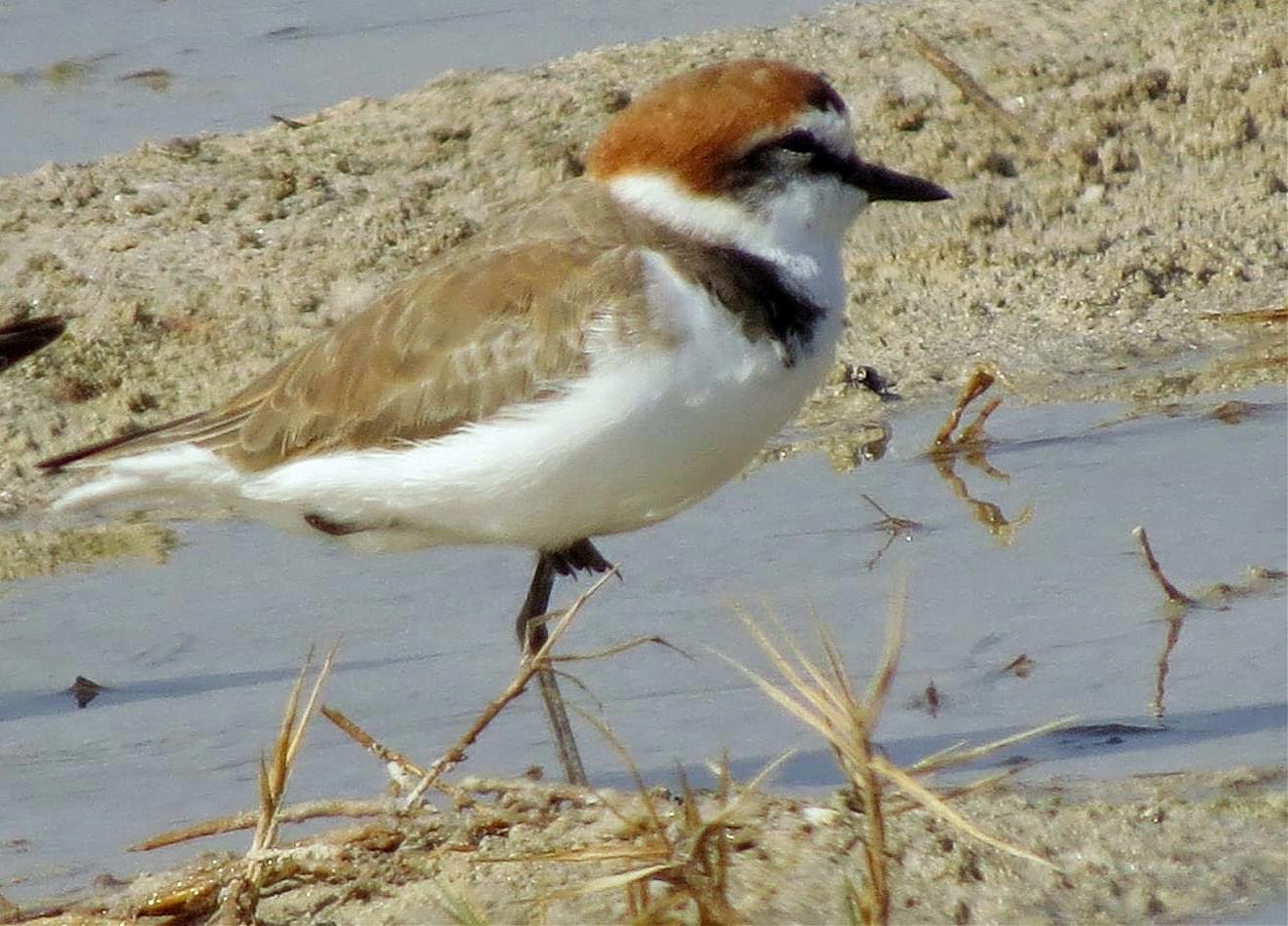
Kentish plover in breeding plumage

Two male Kentish plover were in full breeding plumage. I don't know when the local breeding season for this bird is but I'll look out to see if more change.

frontal view of Kentish plover

Last time I blogged on east Khawr I noticed how a curlew sandpiper was adrift from the main body of waders. This time I noticed several of them in the wet sand rather than in the shallow water seeking out food. It looks like its normal species behaviour after all.

curlew sandpiper

As I was leaving the khawr to head to Sawnout farm,  I spotted a curlew. Many of the birds we get here are of the eastern sub-species orientalis. It's bill is even longer than most.

Eurasian curlew

In my next blog, I will write about a trip taken on Tuesday to Ayn Hamran.