Showing posts with label tawny pipit. Show all posts

Friday, 21 November 2014

Sawnout farm

Late Monday afternoon, I visited Sawnout farm. It is actually out of bounds for the general public including birders. This is a health measure since it a cattle farm as well as an arable one.

Nevertheless, you can travel round the 6 kilometre perimeter and look inwards. I did this on the east, north and west sides. The main road is to the south.


pied cuckoo in the shade

On the east side there are very few trees on the perimeter but in one I found a pied cuckoo. This was not what expected from this farm visit.

pied cuckoo in the open

It spent a lot of time in the open but the backlighting was very strong. This is the fourth pied cuckoo I have seen in Oman this autumn.

house sparrow

The same tree held ten house sparrow too. These are the first house sparrow I have seen in the city of Salalah.  They looked identical to the ones seen at Mudayy oasis and their habits were the same. They are pale overall and especially a pale rump extends far up. The crown has more extensive grey and hardly any brown on the head.

These birds are not interested in houses and keep to trees. Their habits remind me more of Spanish sparrow and of desert sparrow.

view of the farm from the east side

After the tree I continued round the northern perimeter. This side of the farm is most cut and fallow at the moment. It is attracting species that like drier terrain than the rest of the farm.

It was here I observed my first tawny pipit in Oman. Luckily it was standing on a high stone otherwise it would not have been seen from the perimeter.

tawny pipit

I had only seen one northern wheatear since arriving in Oman but there were four of them visible over the fence on the east side.


northern wheatear

Although I only counted about 150 yellow wagtail from the side, I am sure the farm must have more than a thousand.

yellow wagtail

It would be a major job recording all the different sub-species present.

yellow wagtail (feldegg)

The birds of prey were varied. I saw two greater spotted eagle, an eastern imperial eagle, four marsh harrier and two common kestrel.

kestrel

Many of my observations were necessarily on the fence itself. Two juvenile Turkesten shrike were seen. I always have to remember how red (and not brown) tailed the females and juveniles of red-backed shrike often look in the strong sun of Arabia. It is often difficult  to separate the two species at this age and in this light. Barring on the back of red-backed shrike is often the biggest clue. Failing to be able to get that view relies on a judgement on the colour of the tail which is not a perfect method. 

Turkestan shrike

Still on the east side were a flock of resting blue-cheeked bee-eater.

blue-cheeked bee-eater

Four grey heron were sitting in a recently cut field. Two squacco heron were seen on the west side side fence near a water channel.

squacco heron

I don't know where this was a mating ritual or a young parakeet being fed by a parent. Certainly doves do this as a mating ritual. This action was repeated several times.

rose-ringed parakeet

Tens of barn swallow were observed on the west side.

barn swallow

The only other Asian grey shrike I have seen in Oman before was 130 kilometres north at Al Beed farm. There was one at Sawnout farm. It's beginning to look like a farm bird here.

aucheri  - Asian grey shrike

Unfortunately no sociable lapwing were observed but they must surely come soon. Now Jarziz farm is closed, Sawnout farm is there main wintering option in Dhofar.

grey plover

East Khawr (Khawr Dahariz to those of us who live in Salalah) is very close to Sawnout farm. Before going to the farm I paid my daily visit to the khawr.

I din't notice any radical change again. There was a very nice grey plover among the hundreds of waders.
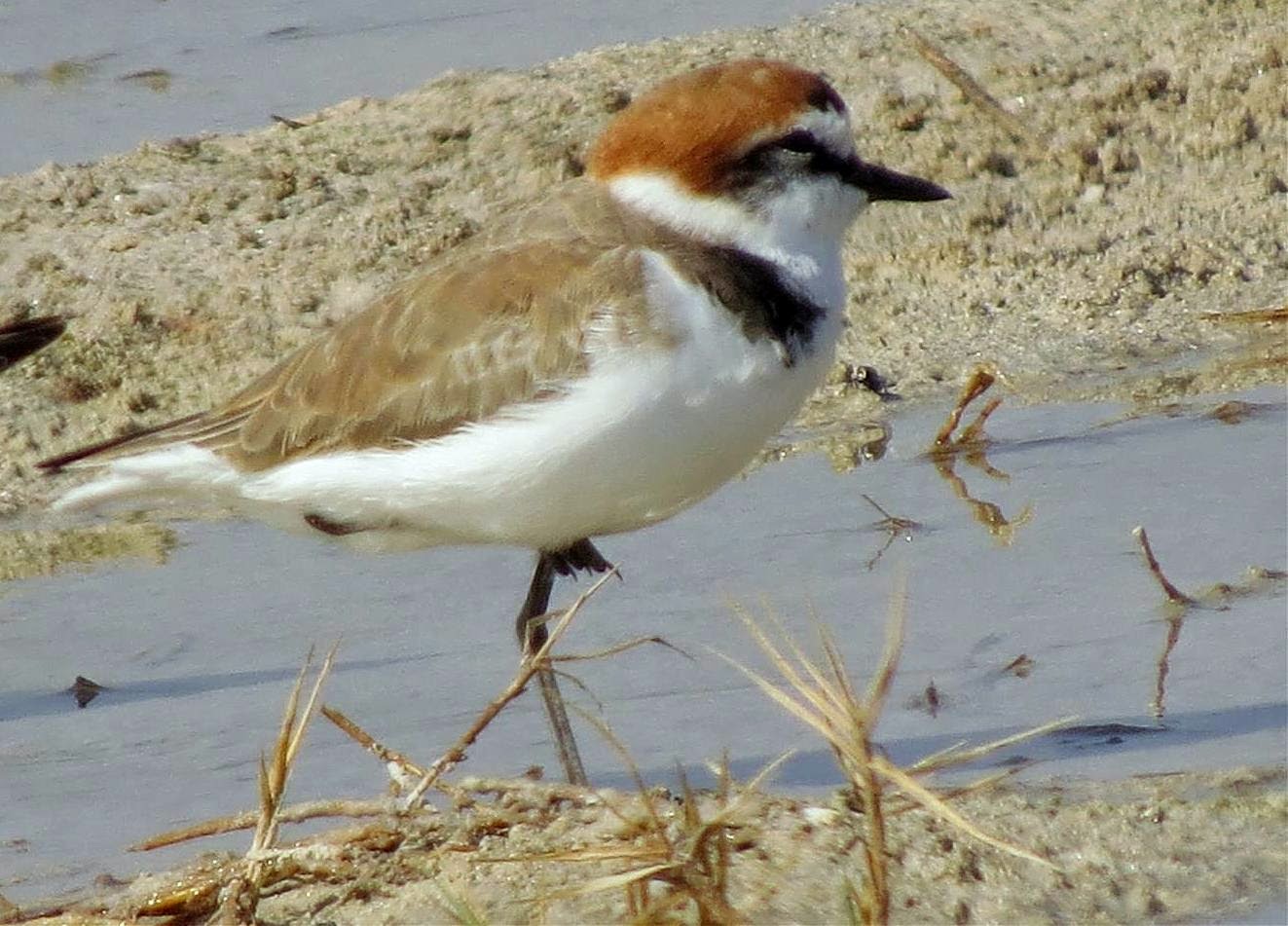
Kentish plover in breeding plumage

Two male Kentish plover were in full breeding plumage. I don't know when the local breeding season for this bird is but I'll look out to see if more change.

frontal view of Kentish plover

Last time I blogged on east Khawr I noticed how a curlew sandpiper was adrift from the main body of waders. This time I noticed several of them in the wet sand rather than in the shallow water seeking out food. It looks like its normal species behaviour after all.

curlew sandpiper

As I was leaving the khawr to head to Sawnout farm,  I spotted a curlew. Many of the birds we get here are of the eastern sub-species orientalis. It's bill is even longer than most.

Eurasian curlew

In my next blog, I will write about a trip taken on Tuesday to Ayn Hamran. 

Sunday, 15 September 2013

Pipits now among migrants

This blog looks at the passage birds seen on my walk to work either side of the weekend. In Saudi Arabia that means Thursday and today which is Sunday.

tree pipit

The passage in autumn is not as concentrated as in spring and changes on the way to work have been slow and subtle. The biggest change over the past two working days have been the arrival of pipits. There was a single red-throated pipit early last week mixed in with yellow wagtail. On Thursday six tree pipit dropped in and this evening I spotted a tawny pipit.  

back view of tree pipit

Tree pipit can be tricky to separate from some red-throated pipit in autumn but notice the weak flank streaks on this bird compared with a red-throated pipit. Tree pipit can also tolerate drier ground like the terrain these birds were on.

tawny pipit

This evening a tawny pipit popped up on the tarmacked road round the farm gardens before retreating to the verge.

second view of tawny pipit

Bee-eaters other than the resident little green bee-eater have been very scarce on the walk compared with spring.

little green bee-eater

On Thursday, a small flock of European bee-eater attempted to land on the tallest tree which was a favourite place in spring.

European bee-eater

They chose the wrong day and the wrong place. Fifteen young rose ringed parakeet were settled there and seemed to have bullied the bee-eaters off. Parakeet numbers had been building all week in the mornings and peaked on Thursday. This morning it was back down to one individual.

four out of fifteen rose ringed parakeet

Eslewhere, the faithful trio of easily seen migrants of wryneck, spotted flycatcher and common whitethroat were all still seen on Thursday. However I think there was no wryneck today.

spotted flycatcher

The wave of shrikes seems to have finally ended with this red-backed shrike the last to go. For the first time in three weeks, there were none of any type this afternoon.

young red-backed shrike

I am finally seeing a little more variety in warblers (other than common whitethroat). There was a lesser whitethroat on Thursday and I caught a fleeting glimpse of an Upcher's warbler this morning.

an anti-social Upcher's warbler

The pool outside the farm continues to change size regularly depending on whether much water is being pumped up from deep underground (for reasons still unknown). I can now clearly see that there are more birds when the pool is shrinking. At high water times, all I seem to get are a few drinking collared dove, house sparrow and crested lark.  

It looks like the muddy banks of a receding water line are more attractive than plain dry earth which edges the pool at high water.

a lone wood sandpiper

The water level was rising on Thursday and is still rising. A lone wood sandpiper was present compared with nine the day before.

yellow wagtail

On Thursday grey wagtail and yellow wagtail were also around. No wagtail was there this morning or afternoon.

young ortolan bunting

I have never thought of ortolan bunting as "water birds" before but all sightings this autumn on my walk have been near the water's edge. I suppose its just that migration is thirsty work for them.

I will continue to walk through the small farm and past the pool for a few weeks yet. 

Temperatures are staying stubbornly high. Its not ideal for me or probably the migration.

Friday, 9 March 2012

Pipits and wagtail at Baha

Do you ever imagine your dream list before you go somewhere birding?  Well, for the pipits of Baha I knew in advance that Tawny pipit was likely as it is known to winter in SW Arabia in numbers. I also knew from my Helms guide that Long billed pipit breeds there along with a very few Richard's pipit though I could't find out from anyone in advance where exactly they were meant to be. Tree pipit and Red throated pipit were a possibility either wintering or on passage. I thought meadow pipit highly unlikely as I was very lucky to see a few south of Riyadh this winter (and photograph one). They don't really come as far south as Baha as far as I know.

tawny pipit

In the end I did see large numbers of tawny pipit. They were very variable and I decided to photograph every one I saw on the off chance I might find a Richard's pipit when wading through the photos on return. Alas, there was no Richard's pipit.

young tawny pipit

The better new was that I saw the first (second, third and fourth) long billed pipit of my life.

long billed pipit

The small flock was in a different place from the tawny pipit just as predicted in my Helms guide to the Middle east. Whereas the the tawny pipit were in the cultivated areas especially in the fallow fields, the long billed pipit were in the more natural, wilder slopes with boulders and some grass. 


second long billed pipit

I didn't find bill length much help in identification. Instead the greyer backs, markings below the throat, stronger rufous- buff colour of the underbelly and cinnamon-grey outer tail feathers were more helpful. Apparently the last two features are special to the SW Arabian populations and make identification easier. They certainly helped me!

I had no luck with red throated pipit or tree pipit and  I suspect this is because I didn't visit any places being watered. I had found them both in Libya on passage in watered places alongside yellow wagtail. So I didn't see yellow wagtail either!

white wagtail

I don't know whether the two pipits and yellow wagtail were there in Baha at that time or whether I just didn't visit wet enough habitat.  On the other hand, white wagtail was everywhere.

The next blog is the last one on Baha and I am calling it "the best of the rest" but that might be a bit insulting to some of the birds. For example it includes a look at a pair of Arabian woodpecker as well as some friendly Tristram's grackle .

Monday, 20 February 2012

A late look at the wintering birds

In contrast to Thursday's windy and sandy weather, Friday was a gloriously sunny day. I returned to my local patch which is Wadi Hanifah near Al Hayer. Here I met up with Clive Temple, the other main expat birder in the region.

Also unlike Thursday, the birds were very active and I probably saw a record number of species for one session in this area.

I want to dedicate this blog to all the wintering birds I saw on the day and throughout the winter. Many will be leaving in the next month.

Turkestan shrike

One of the first wintering birds I saw on Friday was a Turkestan shrike. Both Turkestan shrike and Daurian shrike winter at Al Hayer. Steppe grey shrike and small numbers of masked shrike winter here too though I didn't see either on Friday.

black stork

The skies were active with birds of prey from the large wintering greater spotted eagle to the much smaller resident kestrel. It was while I was looking up at what I initially thought was a bird of prey that I finally got my best sighting of a black stork this winter. A small but loyal group of black stork have been reported to come to the area every winter in the past 20 years.

marsh harrier

Marsh harrier is known to breed in central Arabia so I would expect the birds that have been here all winter to depart sooner or later. The one above allowed closer contact than usual as Clive and I approached it under cover of reeds. The strange moulting pattern made it look a bit like an osprey which I have also seen here in the past few months.

bluethroat

Turning to the smaller birds, one of the most common wintering birds is bluethroat. It's clicking sound has been an ever present in any cover near the water for months. 

female eastern stonechat

Another common one has been stonechat. This bird is often seen a little away from the water on any vantage point whether it is a bush or a pivot arm or simple a mound. 

My observations and those before me have been that eastern stonechat provides more than half the total winter population though European stonechat are not uncommon. I have learned to differentiate them by the greater amount of white/light colour on the lower front, on the upper tail and on the collar. In some cases the females even have an strong, light eyebrow like the one above.  I am still not completely confident in my identifications but this winter has given me lots of practice.

In the past I only looked at the collar size and made many mistakes.


another eastern stonechat

Above I believe is another eastern stonechat. The upper tail has no pattern and its front is very light.

desert wheatear

Two types of wheatears have been around the fields all winter in this area. They are desert wheatear and isabelline wheatear. There numbers seem to be swollen at moment probably with migrants from further south. Its hard to believe they will leave. Don't forget there are also a few mourning wheatear in the drier areas near-by who apparently will also go.

Isabelline wheatear

Very large numbers of white wagtail stay the winter at Al Hayer. A smaller number of tawny pipit are often seen in similar places though they tolerate drier conditions better. 

tawny pipit

It has been a treat to see a small number of citrine wagtail (though none seen on friday)in my local patch too. Strangely I haven't seen a single yellow wagtail in the area all winter even though a few winter in the farms at Kharj some 40 kilometres further south.

white wagtail

It's not long before the cast will change and these birds will be gone for another year.

Friday, 9 December 2011

Introductions to Al Hayer

I introduced Saudi newcomers, Dennis and Brenda Cox, and Clive Temple to Wadi Hanifah south of Al Hayer this morning. 


Those who read this blog regularly will know this is my most common haunt in the Riyadh area. 


It was a relatively quick tour of some of the better spots on a beautiful sunny day.  


In the area we have named "the quarry ponds", there was a typical mix of moorhen in the water, white wagtail , black bush robin on the ground, durian shrike,  house sparrow, collared dove, laughing dove in the trees, chiffchaff, bluethroat in the reeds and bushes and little green bee-eater and marsh harrier in the air.  


A snipe was flushed accidentally near the water which may have been a jack snipe although we couldn't say authoritatively.

common kingfisher at Al Hayer

Also near "the quarry ponds" there were two birds which were new for me in Saudi Arabia. One was teal seen flying overhead with mallard. The other was a common kingfisher which allowed us a very close view from within the car. This was unlike a white throated kingfisher in the neighbourhood who kept his distance today.

Although Abdullah Amrou and other bird photographers have taken several pictures of the bird in the past, this was my first encounter here and first picture of this wintering bird.

tawny pipit

A walk beside three fodder fields showed that the large flock of northern lapwing were still present in the area. A few cattle egret and one great white egret were also seen. A couple of kestrel were once again near-by.

Three types of wheatear were seen around the fields- desert wheatear, Isabelline wheatear and in a rocky place near-by was a Persian wheatear.  A lone stonechat was also perched next to a field. 

Clive suggested I look more closely at the birds on the ground in the fodder fields. From his experience in Dubai, he couldn't believe that there were no tawny pipit around.  It didn't take us more than two minutes looking to find them along with the usual white wagtail! Tawny pipit was the third bird added to my Saudi Arabia list today.


back of tawny pipit

I have learned to take shots of the backs of pipits to help with identification!  I am hopeful we will find a Richard's pipit in the area using Clive's expertise with fodder fields. It should be here.

steppe grey shrike

Once again we saw a steppe grey shrike near fodder fields. This bird is a probable local breeder (note: not southern grey shrike as some books suggest). I  photographed this one just after he had taken off. His wings haven't even opened yet after he has just launched himself.