Showing posts with label spanish sparrow. Show all posts

Saturday, 21 June 2014

Farewell to Al Hayer

The trip to Al Hayer on Friday was my last one for some time. My summer break starts in under a month and I have some more distant trips in Saudi Arabia to undertake before then. 

After the summer, I will be working in Salalah, Oman where the birding promises to be superb. However, I am not done with Saudi Arabia. I fully intend to come back in the future but more than likely to a different geographic location.

So Friday was a farewell to Al Hayer. I was lucky enough to see plenty of summer warblers close up and in prolonged fashion. I blogged about that yesterday. This blog looks at the other birds seen.

Al Hayer in summer is a good place to "exotic" and natural members of the finch family. The pivot fields help supply seeds as food and the water is a scarce necessity in summer.

 It is among the most southerly places on earth that Spanish sparrow breed.

male Spanish sparrow

Of course they are house sparrow too. The other natural finch we sometimes see at Al Hayer is desert finch but I saw none on Friday.
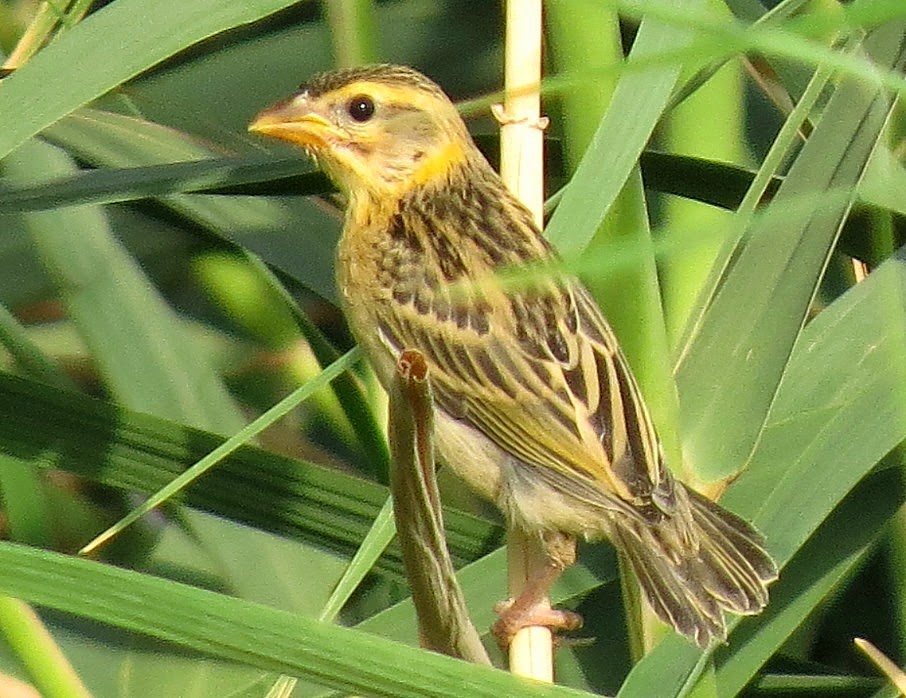
streaked weaver

Streaked weaver must have escaped a generation ago and is thriving despite accidental and planned reed burnings over the years. On Friday there were very many. It has been a good year for them.
 .
male streaked weaver

The other smaller bird escapes which have established themselves are Arabian golden sparrow and red avadavat (though there are a few Ruepells weaver upstream). None were seen on Friday. 

Indian silverbill

Nobody knows where Indian silverbill arrived here by natural range expansion or escapes or both. I did managed to observe them in a couple of places.

white eared bulbul

The white eared bulbul of the area is not the sub species found naturally in eastern province. This wide spread bird is a product of escapes but is expanding west and north far away from the greater Riyadh area. 

river along a field

Darting in and out of cover all morning were plenty of moorhen which is a very shy bird in Saudi Arabia.

adult moorhen

Most of the birds now are adults or juveniles. The fledglings of two or three months ago have grown up.

juvenile moorhen

black winged stilt

Several black winged stilt and a couple of mallard were spotted near the water near some of the moorhen. Both birds breed at Al Hayer.

juvenile black winged stilt

There are always large numbers of doves all year round. Eurasian collared dove, laughing dove and Namaqua dove were all observed in large numbers.

adult male Namaqua dove

Namaqua dove is active even in the fiercest heat but equally it needs to drink more and is most easily seen doing just that.

juvenile Namaqua dove

They have finished breeding here for this year too.

juvenile black crowned night heron

Some of the heron family are at Al Hayer in summer. I saw more little bittern than any other but failed to produce a useful photograph.

I suspect from past observations, the most common heron at this time of year is actually black crowned night heron but they roost deep these days. Five were seen flying at various times including a juvenile.

purple heron

The other two herons sighted were purple heron and squacco heron.

black bush robin

Both black bush robin and rufous bush robin were seen. The former is resident.

The only other birds not previously mentioned but spotted were little green bee-eater and white throated kingfisher.

red eared slider

I have often seen other fauna at Al Hayer even including baboons! This time the most exotic was an aged red eared slider.


The 25 species seen at Al Hayer on Friday

Mallard
Crested lark
Little bittern
Pale crag martin
Black crowned night heron
Barn swallow
Squacco heron
Graceful prinia
Purple heron
Eastern olivaceous warbler
Moorhen
Eurasian reed warbler
Namaqua dove
Rufous bush robin
Eurasian collared dove
Black bush robin
Laughing dove
Spanish sparrow
Hoopoe
House sparrow
White throated kingfisher
Indian silverbill
Little green bee-eater
Streaked weaver
White eared bulbul


Friday, 30 March 2012

A huge Spanish sparrow flock

I didn't see my first Spanish sparrow at al hayer until October 27th and he was in a mixed group of house sparrow and a couple of streaked weaver. However from November at least four or five flocks of them were often about in the area.

Since the beginning of March I had n't noticed any until Wednesday. Then I stumbled on the biggest flock of them I have ever seen.


two males detached for a moment from the main flock

At a conservative estimate there were 600 birds. it appears that several of the flocks I had be seeing had merged into a single mega flock. The reason I had seen any in March was probably that it was all or nothing.


distance shot of part of the flock on a tree

In the guides it says there often migrate in a dense flock but how many people have been lucky enough to to be at the start point when they are forming up, ready for the migration?

distance shot of part of the flock moving position

I didnt manage to get a photograph with all the birds in it. Part of the reason was they wouldn't allow me anywhere near close. Remember there were 600 pairs of eyes.


distance shot of part of the flock on a couple of bushes

They would split and reform like a shoal of fish.  I managed to get good photos of the two males at the top of the blog taking advantage when a few split off for a moment but every time they re-formed. 

My best guess is the flock is now along way north and out of Saudi Arabia.

Friday, 16 December 2011

A day in the fields

Thursday was a long day in the field. Clive Temple and I spent eight hours birding the fodder fields south of Al Hayer. This was an intensive effort to unlock more of the secrets of this habitat in the Riyadh area.

tawny pipit

One of our goals today was to look closely at the pipits in the fields. Certainly the most common pipit was tawny pipit. We counted seeing 70 birds during the day. However we saw 4 birds which could easily have been long billed pipit.

candidate for long billed pipit

The general look of the birds were not like "typical" tawny pipit. The legs are shorter, the white supercilium is longer and the breast has some streaking.

second view of probable long billed pipit

A new set of records by Per Anders Bertilsson of Sweden who was in the Riyadh area from 1998-2001 has just been released. It is excellent.

Per has some interesting comments on long billed pipit. He says At Thumamah (farm north of Riyadh) , "in December 1999 and March 2000, I saw and heard 2-3 individuals that resembled Long-billed Pipits, but they were never positively identified".  We have reached a similar position today!

white wagtail

We also saw two birds which were either tree pipit or meadow pipit. Meadow pipit is a known but previously designated rare winterer in central Arabia.

However three water pipit were definitely identified in a sodden field. This bird was been recorded as a rare winterer here too.

White wagtail was the other member of the wagtail and pipit family seen.

crested lark

Crested lark was the other small bird seen in great numbers on the fields.

Of the larger birds, northern lapwing and collared dove were still numerous.

brown necked raven

A little more excitingly, a flock of at least 12 brown necked raven also came into one field.

raven mobbing a marsh harrier

At one stage several of the raven mobbed a marsh harrier which wasn't allowed in "their" field.

greater spotted eagle

Marsh harrier wasn't the only bird of prey on the fodder fields. Two greater spotted eagle made an appearance.

kestrel on a pivot sprinkler

Kestrel were ever present and briefly we saw a ring tailed harrier. With some many birds of prey near-by, the smaller birds (and even the lapwings) were regularly panicked into flying off.

desert wheatear

On the areas adjacent to the watered fields were both desert wheatear and Isabelline wheatear as usual.

Asian desert warbler

However there were also several Asian desert warbler which I had over-looked before and a small number of desert lesser whitethroat. I confess that desert warbler is a lifer for me. Desert lesser whitethroat is a noisy rattling bird which gives its presence away all the time!

grey heron in a field

Even though we weren't birding the near-by Riyadh river on Thursday, there were a few water birds in the fields. Three grey heron were seen.

black winged stilt

A couple of the fields are so close to the river that they sometimes become waterlogged by it. On Thursday, one of the waterlogged places held two black winged stilt. 

However by far the most numerous "water bird" seen in the fields were common snipe. I had seen very few in the Al Hayer area but I have been looking in the wet fringes of the river. It hadn't occurred to me that they could be so numerous in the fields.

female stonechat

Towards the end of the afternoon, we saw more stonechat although we had been picking up ones and twos all day.

spanish sparrow

Also late in the afternoon we met a very large mixed flock of spanish sparrow, house sparrow and streaked weaver. The spanish sparrow pre-dominated. I knew that historical observers in the area had said spanish sparrow is at least a winter visitor but this was the first time I had proof positive.

part of the flock

The last birding I did as the light began to fail was to follow a large weaver I glimpsed for a moment. It was not a streaked weaver which is the common weaver in the area!

bluethroat

Although I lost sight of the weaver, I noticed a bluethroat foraging on the ground. It was so interested in food that it let me get much closer than usual. This was a fitting end to a great day.