Showing posts with label streaked weaver. Show all posts

Saturday, 21 June 2014

Farewell to Al Hayer

The trip to Al Hayer on Friday was my last one for some time. My summer break starts in under a month and I have some more distant trips in Saudi Arabia to undertake before then. 

After the summer, I will be working in Salalah, Oman where the birding promises to be superb. However, I am not done with Saudi Arabia. I fully intend to come back in the future but more than likely to a different geographic location.

So Friday was a farewell to Al Hayer. I was lucky enough to see plenty of summer warblers close up and in prolonged fashion. I blogged about that yesterday. This blog looks at the other birds seen.

Al Hayer in summer is a good place to "exotic" and natural members of the finch family. The pivot fields help supply seeds as food and the water is a scarce necessity in summer.

 It is among the most southerly places on earth that Spanish sparrow breed.

male Spanish sparrow

Of course they are house sparrow too. The other natural finch we sometimes see at Al Hayer is desert finch but I saw none on Friday.
streaked weaver

Streaked weaver must have escaped a generation ago and is thriving despite accidental and planned reed burnings over the years. On Friday there were very many. It has been a good year for them.
 .
male streaked weaver

The other smaller bird escapes which have established themselves are Arabian golden sparrow and red avadavat (though there are a few Ruepells weaver upstream). None were seen on Friday. 

Indian silverbill

Nobody knows where Indian silverbill arrived here by natural range expansion or escapes or both. I did managed to observe them in a couple of places.

white eared bulbul

The white eared bulbul of the area is not the sub species found naturally in eastern province. This wide spread bird is a product of escapes but is expanding west and north far away from the greater Riyadh area. 

river along a field

Darting in and out of cover all morning were plenty of moorhen which is a very shy bird in Saudi Arabia.

adult moorhen

Most of the birds now are adults or juveniles. The fledglings of two or three months ago have grown up.

juvenile moorhen

black winged stilt

Several black winged stilt and a couple of mallard were spotted near the water near some of the moorhen. Both birds breed at Al Hayer.

juvenile black winged stilt

There are always large numbers of doves all year round. Eurasian collared dove, laughing dove and Namaqua dove were all observed in large numbers.

adult male Namaqua dove

Namaqua dove is active even in the fiercest heat but equally it needs to drink more and is most easily seen doing just that.

juvenile Namaqua dove

They have finished breeding here for this year too.

juvenile black crowned night heron

Some of the heron family are at Al Hayer in summer. I saw more little bittern than any other but failed to produce a useful photograph.

I suspect from past observations, the most common heron at this time of year is actually black crowned night heron but they roost deep these days. Five were seen flying at various times including a juvenile.

purple heron

The other two herons sighted were purple heron and squacco heron.

black bush robin

Both black bush robin and rufous bush robin were seen. The former is resident.

The only other birds not previously mentioned but spotted were little green bee-eater and white throated kingfisher.

red eared slider

I have often seen other fauna at Al Hayer even including baboons! This time the most exotic was an aged red eared slider.


The 25 species seen at Al Hayer on Friday

Mallard
Crested lark
Little bittern
Pale crag martin
Black crowned night heron
Barn swallow
Squacco heron
Graceful prinia
Purple heron
Eastern olivaceous warbler
Moorhen
Eurasian reed warbler
Namaqua dove
Rufous bush robin
Eurasian collared dove
Black bush robin
Laughing dove
Spanish sparrow
Hoopoe
House sparrow
White throated kingfisher
Indian silverbill
Little green bee-eater
Streaked weaver
White eared bulbul


Wednesday, 2 April 2014

North of Hayer part one

On Saturday, I visited a section of the Riyadh river along Wadi Hanifah that I haven't been to for a long time. This is a section north of Al Hayer town. In part I chose to go there because there is so much disruption south of Al Hayer at the moment caused by the building of a leisure area along the river.

This northern stretch of the river gave me so many species and photographs I am splitting the write-up into two. This one looks at what I saw in the morning. The next one will look after midday.

graceful prinia

I remember visiting this northern area a few times in my first year in Saudi Arabia and I don't really understand why I stopped. One memory I have is of easily seeing graceful prinia. This was before I realised how common they are and in so many habitats in Saudi Arabia.

another angle on the graceful prinia

As you can see they gave me good views once again.

pied wheatear

However the first bird of any note that I saw on Saturday morning was a pied wheatear.  Ironically this was the first bird Bernard Bracken and I saw on Friday morning when we visited east Salbukh wetland. The co-incidence didn't end there. In both cases, it was the only pied wheatear seen all day.

laughing dove

As I descended into the valley I kept an eye out for birds on the slopes. Most were lone laughing dove or collared dove sitting out. 

sand partridge

However, one wasn't. It was a sand partridge.  Indeed I remember them when I used to visit.

second view of the sand partridge

I was a bit concerned that this was just a single bird.

brown-necked raven

Flying across the valley early on were two brown necked raven.

Turkestan shrike

Another early sighting was a male Turkestan shrike.

streaked weaver

Down in the wadi itself, there are clearings in the reeds and a few places where the water spills out.  In one such place I stopped for half an hour and stood still to see what would happen.  

I noticed a newly constructed streaked weaver nest. The male in full breeding plumage was around and seemed to be attracting female visitors.

common snipe

I must have been well hidden in some reeds because a common snipe flew in and landed two metres in front of me. Being well hidden also meant I couldn't get a full picture through the reeds either. 

red avadavat

Both red avadavat and Indian silverbill visited the same place though I only managed to photograph the former. Unlike the weavers, the avadavats strangely breed in November (or at least that's when I have seen them in breeding plumage). I believe the photographed bird is non breeding male by the grey appearance below.

white-eared bulbul

White eared bulbul as usual along Wadi Hanifah was common in many habitats. A single white spectacled bulbul was also observed. 

tree pipit

In among newly planted palms were two of only a few passage birds seen all day. There were two tree pipit.


Siberian stonechat

During the morning I moved slowly down towards the Al Hayer dam.  Birds seen near-by included a male Siberian stonechat. 

At the dam itself was a white throated kingfisher, an osprey and a marsh harrier.  The marsh harrier would not tolerate the osprey and chased it off.

the river by the dam

All the reeds have been totally cleared north of the dam. It looks like another leisure project.

little green bee-eater

Even in this denuded area, some extra species for the day were seen. These were little green bee-eater, barn swallow and pale crag martin.


common moorhen

Further upstream, the reeds are intact. Here is an area with many moorhen. 

grey heron

There were also eight grey heron near-by mostly spending their time on the valley's slopes rather than by the water.


juvenile moorhen

At one point along the river, I came across six juvenile moorhen feeding together. They must all have been recently fully fledged and chose to spend time together. This was a new observation for me.

This observation occurred just before noon. The next blog continues the report on the area with what was seen in the afternoon.


Saturday, 7 September 2013

Newbie to Saudi birding shown Al Hayer and Mansouriyah

Lou Regenmorter and I were joined today by Bernard Bracken who birds in Europe but has started working in Saudi Arabia.  

He has little experience of Middle Eastern birding yet so this must have been a lot to take in!

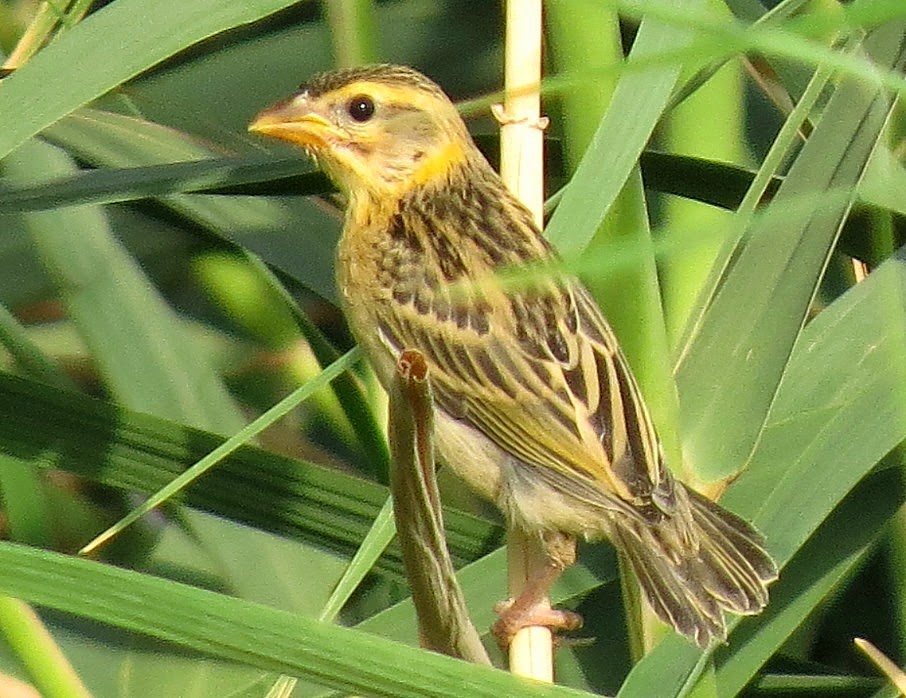
juvenile streaked weaver

We took Bernard to Al Hayer first. 

Virtually the first bird we saw was asleep though it was way past dawn. It also allowed us such close approach we thought it might have been an escape. 

I had trouble identifying it. The main regional guide describes non-breeding male and female streaked weaver but not the juvenile. Both the adults have streaks on breast and flanks. I assumed the juvenile would too and so started to investigate other species. However pictures from India showed me that the juvenile is unstreaked and that is what this sleepy bird was.

graceful prinia

We took a tour around the fields close to the road which still had hundreds of Spanish sparrow and the exotic finch trio of streaked weaver, red avadavat and Indian silverbill. This time there was no European roller on the pivot bar though there were still some blue-cheeked bee-eater and a white throated kingfisher. At this point Bernard confessed that nearly every bird he had seen so far had been a lifer.

Graceful prinia were everywhere again. Some common whitethroat still have the ability to confuse me. The females and immatures of the main eastern sub species have little contrast between the wing and mantle.

common whitethroat

Lou and Bernard soon made their way to the field where I had seen so many collared pratincole yesterday.

collared pratincole in a field

I made myself busy by checking the underwing and other features of as many as possible to check there were no black winged pratincole among them.

collared pratincole stretching

Unlike in my trip to Buraydah last spring, this was apparently not a mixed flock though I didnt check them all.

collared pratincole taking off

There were more barn swallow and yellow wagtail in this field than even the numbers yesterday.

plenty of barn swallows

Next to the bank swallow resting on a pivot bar was a red backed shrike, a bird not seen yesterday.

red backed shrike

Further along were two brown necked raven.

brown necked raven

Another bird not seen yesterday was rufous bush robin. To be honest I hadn't seen one for over a week and was beginning to think all of them had migrated south by now.

rufous bush robin

Near the bush robin was one of several hoopoe seen today. 

hoopoe

After leaving Al Hayer and before it got too hot, we headed back towards the city. However we stopped off for half an hour or so at Mansouriyah.

bluethroat

Here fleetingly we observed the first bluethroat of the "winter". They winter in very large numbers down the Riyadh "river".

young Ruepells weaver

Mansouriyah is the only real strong hold in central Arabia for Ruepells weaver though I have observed it in one other place. It has been reported there for many years but the population remains small. We didn't have much trouble finding it today.

I am giving weavers a lot of attention at the moment. Historical observers have all seen Baya weaver but it has alluded me and I cant believe it has died out. I just think I haven't been careful enough searching among the hundreds of sparrows and weavers.

I hope Bernard enjoyed today and I look forward to birding with him again soon.

List of 38 species species seen today

Mallard
Little bittern
Black crowned night heron
Grey heron
Purple heron
Cattle egret
Squacco heron
Common moorhen
Collared pratincole
Rock pigeon
Namaqua dove
Laughing dove
Collared dove
Barn swallow
Sand martin
Hoopoe
White throated kingfisher
Little green bee-eater
Blue cheeked bee-eater
Woodchat shrike
Red backed shrike
Lesser grey shrike
Asian grey shrike (aucheri)
White-eared bulbul
Crested lark
Graceful prinia
Great reed warbler
Common whitethroat
Common myna
Black bush robin
Rufous bush robin
Bluethroat
Isabelline wheatear
House sparrow
Spanish sparrow
Streaked weaver

Ruepells weaver
Indian silverbill
Yellow wagtail

Saturday, 26 May 2012

The local patch in summer

Birding in central Arabia at this time of year is like birding inside an oven. So when Lou and I went birding on Friday in the al Hair area, starting early, we expected the worse.

The good news is that it was less hot than usual for this time of year. The bad news is it still reached 37C by mid afternoon.

Most birding in the centre winds down for June to mid August. Furthermore, the main reason while people brave mid August is because the autumn passage begins. 

red-backed shrike

The spring passage is virtually over now. However, we saw three very late passage birds. One was the female red-backed shrike (above) which was perched on a water pivot arm. 

little stint

The second was a lone little stint gingerly walking and eating on a mud crust over the Riyadh river.

The third was a willow warbler deep in a group of tamarisk bushes.

male streaked weaver

One of the most obvious activities of the birds which are staying was nest building. The streaked weaver are in the process of building their nests. I hope they have more success than last year when a fire destroyed many of them.

one of two nesting sites we saw for streaked weaver

We saw two nesting sites both in reeds next to water.

female streaked weaver

Although I saw a huge flock of spanish sparrow in late April which looked like they were preparing to migrate north, its obvious a very large number stay in the area to breed.

spanish sparrow with food

In one area, also close to the water, there are tens if not hundreds of spanish sparrow nests being built. 

spanish sparrow nests

The spanish sparrow are sharing some of the bushes with white cheeked bulbul. A small minority of the nests have a top cover with a hole in the side.I can't find any reference to either spanish sparrow or white cheeked bulbul making nests like this.


spanish sparrow 

This must be one of the furthest south locations for spanish sparrow breeding in the world and frequent trips are made to the water to cool off.

Other local breeders include purple heron, squacco heron, black crowned night heron, little bittern and probably cattle egret and grey heron. All these species were seen yesterday.

eastern olivaceous wabler

Among the breeding warblers eastern olivaceous warbler, European reed warbler and graceful prinia were clearly heard and seen in numbers.

graceful prinia

We searched long and hard for sedge warbler and moustached warbler but saw neither. Both look good prospects for breeding locally. One difficulty for them and us is the amount of disturbance to the short reeds and sedge created by Friday fishermen.

two of the many moorhen

Other definite breeders are the hundreds of moorhen which line the river along its whole course. Of the other water birds, one mallard was also seen flying over.

little ringed plover

The only wader which definitely breeds at al Hair is little ringed plover. We saw nothing on Friday to change  that understanding.

white throated kingfisher

It was good to see a white throated kingfisher again. They are here all round and were photographed with young last summer by local photographers. The place I thought there would breed from this summer has turned out not to be. I haven't found this year's spot (s). However there numbers are still small and successful breeding again this year would help consolidate their position.


brown necked raven

We didn't notice a single bird of prey on Friday not even the normally ubiquitous kestrel. However a flock of brown necked raven came onto a pivot field seemingly to take their place.

rufous bush robin

Of the other birds there were rufous bush robin, black bush robin, laughing dove and collared dove in several places. We were on the look out for turtle dove but once again failed to see any. It is clearly in serious decline here as in many other places through the world. My old, first edition of "Birds of the Middle East" has it breeding here. I doubt it does now.