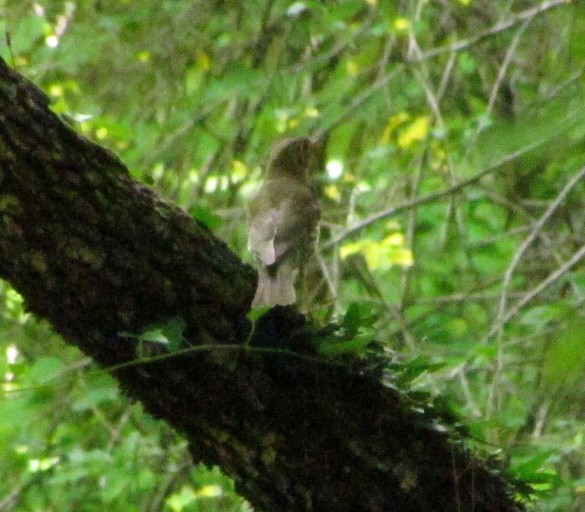
On one of my days in Tirana I had decided to bird the botanical gardens which are a taxi journey (5 euro) away from my hotel. I always enjoy botanical gardens and have personal favourites- Baku, Azeribaijan for scientific interest and faded grandeur but especially Oxford, England for sentimental reasons. I do understand why Kew is an attraction too!
However, I was disappointed in Tirana's botanical gardens. They are part of the grounds of a university and well, felt like typical grounds of a university!
In fairness, it was a very hot day, my hottest day while in Tirana, and it made me restless. It made the birds restful! and there was very little activity I could see.
And so it was because of my lack of interest in Tirana's botanical garden that I took up an idea given to me at my hotel by Derek Crane. Derek is arguably the foremost British expert on Albanian travel having been involved in the country since the start of the revolution. Luckily for me he was having breakfast at my hotel and he gave me a tip. He had suggested using the cable car and going up Dajti mountain and its surrounding national park.
Dajti - travel to and from
So two days after hearing Derek's suggestion, I took his advice. It was at short notice since I had lost two hours of the morning getting to and visiting the botanical gardens.
I took a taxi directly from the gardens to the bottom of the cable car lift in a Tirana suburb. A taxi costs about the equivalent of 4 to 5 euro from the centre to the cable car station. It cost me 6 euro because I had started a little further away, at the gardens.
Its unlikely your taxi driver will speak English but he will understand the word "teleferik" which is the local name for cable car.
A return ticket can be bought at a booth for 700 leke (5 euro). You are also given three or four marketing sheets which I dint understand at the time but keep them - you'll see why.
You may have to wait up to a quarter of an hour for a car to arrive. In the meantime there is a ultra modern good cafe there.
Dajti cable car: picture from Dajti ekspres company
Climate
The journey takes about 10 or 15 minutes before arriving at about 1050 metres altitude. Now central Tirana is 110 metres above sea level. This makes the temperatures about 6 degrees centigrade lower. It was a welcome relief just stepping out.
It was 31C in the shade when I left Tirana and 25C up at the top cable station. Clustered around the cable station is a small and fairly discrete complex of hotel, bar and restaurant.
This temperature difference is normal between the two places. It can hardly be described as alpine though because even in January, Tirana averages 12C and the cable station 6C. However, snow is possible towards the peak at 1625 metres in mid winter. This fact was of course far from my thoughts when I visited on a hot June day.
Eating here and around Tirana
Before I get onto the birding I must tell you it was punctuated by a visit half way though to to restaurant called "Balkoni Dajti" which was very civilised. Its actually one of the most expensive restaurants in the capital district and probably in the country. Yet you can have a 2 course meal for 12 euro provided you kept all those marketing sheets you were given at the cable car ticket office. One of them gives you a 15% discount.
The food was decent and the view of the city was wonderful.
Actually, it was only one of three restaurants I used while in the capital. Each one though represented a typical member of up market (this one) , mid range and cheap restaurants.
.
There are tens and tens of mid range and cheap restaurants to chose from because as I have said Tirana is very much a cafe society. I chose the Manhattan restaurant some times and an unnamed cheap restaurant at other times. Both because they were close to the hotel Nobel and recommended by the staff. Manhattan specialised in pizzas which are very popular. The other had traditional Albanian food of various meats with salads. Manhatten usually cost about 7-8 euro including a beer and the local restaurant about 3-4 euro. Be aware that Albanians eat late both for lunch and for dinner. I was often the only one eating at 7.30 in the evening!
view of Tirana from Balkoni Dajti restaurant on a hazy day
Habitat and birding
Returning to the birding: the habitat around the upper cable station was mostly oak forest with a few meadows. in these clearances there were usually a few shrubs. I could see that further up the mountainside there was more beech and a few Balkan pines. Sadly I didn't have time to go up there. I learnt later that the fauna further up includes a sizeable population of bears and wolves.
woodland around the top cable car station at Dajti
Now for a health warning: I was conscious that I had missed the best part of the birding day with my abortive start at the botanical gardens and I didn't avoid the temptation to stop to eat at lunch time either. So the birding was restricted timewise and geographically. The birds seen are only be a favour of what the area has to offer.
I would recommend an early start here or even to stay at the hotel up at Dajti and explore the higher regions. I think it would need one or two full days and I only gave it three or four hours.
The first birds I saw when I got off the cable car were in the station gardens were chaffinch though house sparrow were near by.
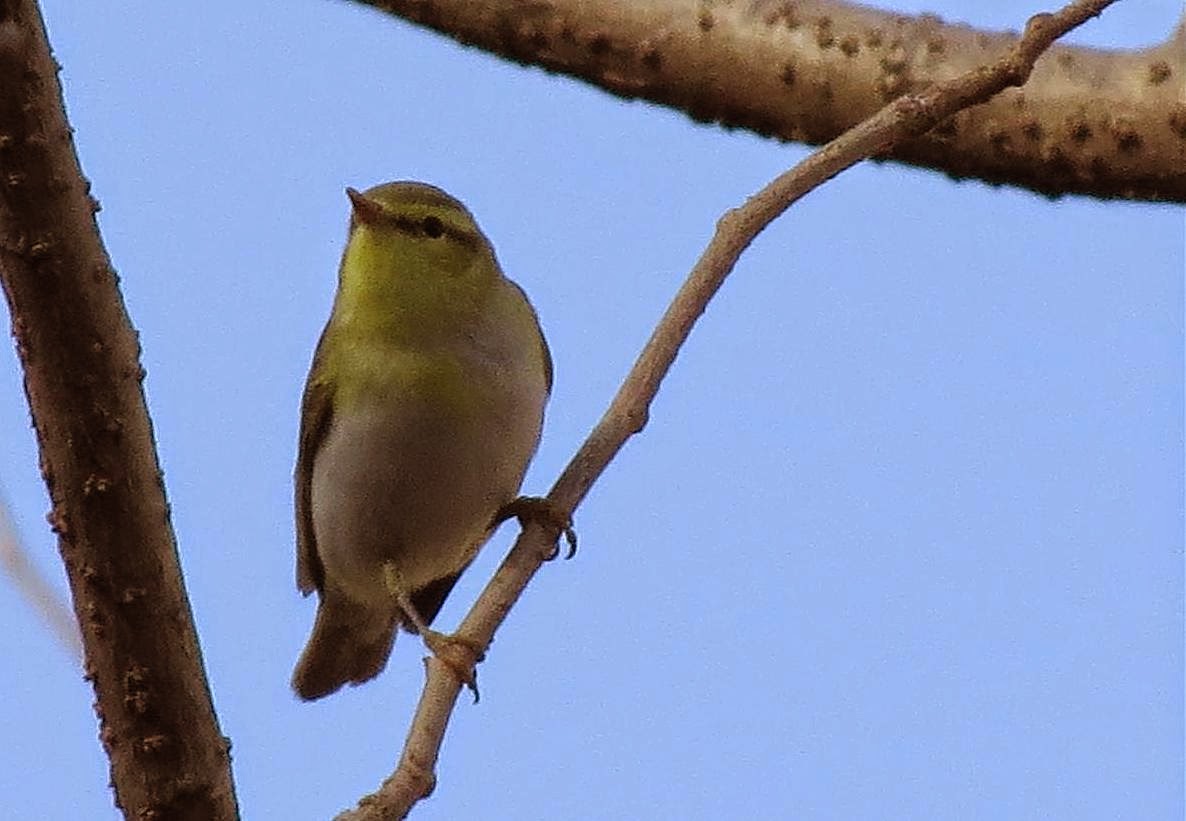
Although I am told that the occasional birding tours does come to this area, I am fairly confident it has not been scientifically birded. I saw wood warbler like the one in my picture below.
wood warbler at Dajti
Neither the "Collins guide of Europe" nor the "Birds of the Mediterranean" show wood warbler breeding in Albania on their distribution maps. I was'nt surprised to see it. In more southerly places like in Bulgaria it is found in highland areas which have a very similar summer climate to Dajti. Now if wood warbler is here and is not in the main guide books then I am pretty sure other birds are missing too. My guess is that Albania is under-reported, not as much as Libya but under-reported nevertheless.
robin at Dajti
Once again like other southern European woodland areas especially with some altitude, there were plenty of robin.
great tit
Once again I came across great tit. The Balkans must be full of them. They were tamer here than in Bulgaria.
probably a very young great tit
I found the bird above difficult to identify. This bird was in the tree next to the other great tit. I assume it is also a great tit but that is so young that no black bib has formed yet. Even in the guide book they show some sort of bib for a juvenile so it leaves me in some doubt.
wood nuthatch
Not the greatest of photographs of a wood nuthatch but I'm pleased to capture it anyway. It was one of at least two together who were in one of the darker parts of the wood and were quite shy. Even though the photo is poor you can see its characteristic behaviour of its head facing more down than up.
song thrush
There were a lot fewer nightingale up at Dajti than in the city. Obviously this is partly because the woodland is thicker and nightingale doesn't like dense woodland. However if anything there are more blackbird and definitely more song thrush.
red backed shrike
One peculiarity of my visit to Albania is that the only place I saw red backed shrike was in the clearings up Dajti. It is common here too. Yet I didn't see one in the lowland Tirana area, Shkoder or Durres.
bird of prey
As I was leaving to head back towards the cable car I very briefly caught sight of a bird of prey. I don't want to force an identification but it was mostly light below and conceivably a buzzard. Moments later I heard what sounded like small arms fire. I do hope that the two incidents were not related. So far I had had every indication that birds were tamer and less persecuted in Albania than in many of its neighbours but this gave me some doubt.
If I had had more time I would have loved to have studied this area more. I know I only scratched the surface. Nevertheless I made the hard decision to visit the lakes of Shkoder for my final full day. That is the subject of the fourth and final part of my Albanian trip report to follow soon.