On my final day in Albania, I visited Lake Shkoder following a tip from Derek Crane. Derek you may recall from earlier in this trip report is among foremost British experts on Albanian travel. I had a chance encounter at breakfast in my hotel and hence the tip off.
I wanted a wetland which was easy to reach and which was accessible at short notice so Lake Shkoder was recommended.
If I have any regrets about my tour of Albania it is that I didn't visit Divjake National Park. It contains a wetland and it is half the distance from Tirana than Shkoder. However it is not near a town and would have been tricky to reach. I say why I regret not going there later.
Getting to Shkoder
There are regular buses and minibuses to Shkoder throughout the day from Tirana even though they depart from a different place to those for Durres. Remember Tirana doesn't have bus station. Instead it has five or six locations where buses depart from the side of the road. Each location serves a different region of the country.
The buses for Shkoder actually depart from a location which is barely 5 minutes walk from the place where others depart for Durres but you won't find it without a guide first time. Derek actually walked me there from the hotel!
The bus leaves on the hour and I took the 9am bus. As predicted it arrived in Shkoder after an uneventful journey just under two hours later.
The bus arrives in the town centre. You don't need a taxi to get to the lake. You ask for the "old bridge", get directions and walk across it. After 10 minutes you are at the lake.
It's massive and two thirds of it is in Montenegro rather than Albania. I was restricted of course to the part near the town but it served my purpose.
view of the part of the lake I birded
Birding
The opposite side from the walk is the wilder side and must contain hundreds of birds but it is not easily accessible (or at all). The walking side however does have sufficient cover for much bird activity and you can see plenty of the far side using binoculars.
The only hassle for me was a herd of cows which shared the centre of my neighbourhood.
view as the lake widens as it heads north towards Montenegro
One of the most obvious birds you see straight away is pygmy cormorant. They occupied both sides of the water while I was there so afforded good views. they were in full breeding plumage. Some guides say they have a baby face but I think they look quiet sour.
pygmy cormorant at Shkoder
Two other large water birds frequented my side of the water while I was there. One was a squacco heron. It first tried to hide from me but then slowly walked away in the undergrowth.
squacco heron hiding in the long grass
I have a small amount of video footage of the same bird.
short clip of same squacco heron
There were a few little egret on my side too. Most were in breeding plumage. They even had the narrow purple surround to the eye which they retain for only a short time.
little egret in breeding plumage
In the water all the time I was there were varying numbers of great crested grebe.
great crested grebe
Patrolling up and down the side of the lake endlessly were several whiskered tern. they look so different in summer than the birds I saw wintering in Libya.
one of several whiskered tern
On the far side viewable by the naked eye but better with binoculars was clearly plenty of action. A scope would have been useful here. At one moment a little bittern flew out and returned at another moment a bittern did the same thing. With all my endeavours I couldn't trace where the bittern had re-landed even though I tracked him going back into the edge of the reeds.
coot and pygmy cormorant
There were many coot clustered around the far bank too as well as grey heron. Unfortunately there was no sign of dalmatian pelican which are known to visit here. I don't have information as to whether they breed here too.
And this is where my regret about not having visited Divjake National Park comes in. There is a large breeding colony there.
local great reed warbler
We shouldn't forget the smaller birds present at Shkoder. This great reed warbler has improvised on its perch. Yellow wagtail are plentiful around the water's edge and several times goldfinch flew over me brighting up my day.
As I rushed back to catch the 3pm bus I mused that two more days and I would then have started to do justice to Albania's bird life - one extra day at Divjake National Park and one day in the deep south to see more birds of drier country. Perhaps one day I'll be back.
On one of my days in Tirana I had decided to bird the botanical gardens which are a taxi journey (5 euro) away from my hotel. I always enjoy botanical gardens and have personal favourites- Baku, Azeribaijan for scientific interest and faded grandeur but especially Oxford, England for sentimental reasons. I do understand why Kew is an attraction too!
However, I was disappointed in Tirana's botanical gardens. They are part of the grounds of a university and well, felt like typical grounds of a university!
In fairness, it was a very hot day, my hottest day while in Tirana, and it made me restless. It made the birds restful! and there was very little activity I could see.
And so it was because of my lack of interest in Tirana's botanical garden that I took up an idea given to me at my hotel by Derek Crane. Derek is arguably the foremost British expert on Albanian travel having been involved in the country since the start of the revolution. Luckily for me he was having breakfast at my hotel and he gave me a tip. He had suggested using the cable car and going up Dajti mountain and its surrounding national park.
Dajti - travel to and from So two days after hearing Derek's suggestion, I took his advice. It was at short notice since I had lost two hours of the morning getting to and visiting the botanical gardens.
I took a taxi directly from the gardens to the bottom of the cable car lift in a Tirana suburb. A taxi costs about the equivalent of 4 to 5 euro from the centre to the cable car station. It cost me 6 euro because I had started a little further away, at the gardens.
Its unlikely your taxi driver will speak English but he will understand the word "teleferik" which is the local name for cable car.
A return ticket can be bought at a booth for 700 leke (5 euro). You are also given three or four marketing sheets which I dint understand at the time but keep them - you'll see why.
You may have to wait up to a quarter of an hour for a car to arrive. In the meantime there is a ultra modern good cafe there.
Dajti cable car: picture from Dajti ekspres company
Climate
The journey takes about 10 or 15 minutes before arriving at about 1050 metres altitude. Now central Tirana is 110 metres above sea level. This makes the temperatures about 6 degrees centigrade lower. It was a welcome relief just stepping out.
It was 31C in the shade when I left Tirana and 25C up at the top cable station. Clustered around the cable station is a small and fairly discrete complex of hotel, bar and restaurant.
This temperature difference is normal between the two places. It can hardly be described as alpine though because even in January, Tirana averages 12C and the cable station 6C. However, snow is possible towards the peak at 1625 metres in mid winter. This fact was of course far from my thoughts when I visited on a hot June day.
Eating here and around Tirana
Before I get onto the birding I must tell you it was punctuated by a visit half way though to to restaurant called "Balkoni Dajti" which was very civilised. Its actually one of the most expensive restaurants in the capital district and probably in the country. Yet you can have a 2 course meal for 12 euro provided you kept all those marketing sheets you were given at the cable car ticket office. One of them gives you a 15% discount.
The food was decent and the view of the city was wonderful.
Actually, it was only one of three restaurants I used while in the capital. Each one though represented a typical member of up market (this one) , mid range and cheap restaurants.
.
There are tens and tens of mid range and cheap restaurants to chose from because as I have said Tirana is very much a cafe society. I chose the Manhattan restaurant some times and an unnamed cheap restaurant at other times. Both because they were close to the hotel Nobel and recommended by the staff. Manhattan specialised in pizzas which are very popular. The other had traditional Albanian food of various meats with salads. Manhatten usually cost about 7-8 euro including a beer and the local restaurant about 3-4 euro. Be aware that Albanians eat late both for lunch and for dinner. I was often the only one eating at 7.30 in the evening!
view of Tirana from Balkoni Dajti restaurant on a hazy day
Habitat and birding
Returning to the birding: the habitat around the upper cable station was mostly oak forest with a few meadows. in these clearances there were usually a few shrubs. I could see that further up the mountainside there was more beech and a few Balkan pines. Sadly I didn't have time to go up there. I learnt later that the fauna further up includes a sizeable population of bears and wolves.
woodland around the top cable car station at Dajti
Now for a health warning: I was conscious that I had missed the best part of the birding day with my abortive start at the botanical gardens and I didn't avoid the temptation to stop to eat at lunch time either. So the birding was restricted timewise and geographically. The birds seen are only be a favour of what the area has to offer.
I would recommend an early start here or even to stay at the hotel up at Dajti and explore the higher regions. I think it would need one or two full days and I only gave it three or four hours.
The first birds I saw when I got off the cable car were in the station gardens were chaffinch though house sparrow were near by.
Although I am told that the occasional birding tours does come to this area, I am fairly confident it has not been scientifically birded. I saw wood warbler like the one in my picture below.
wood warbler at Dajti
Neither the "Collins guide of Europe" nor the "Birds of the Mediterranean" show wood warbler breeding in Albania on their distribution maps. I was'nt surprised to see it. In more southerly places like in Bulgaria it is found in highland areas which have a very similar summer climate to Dajti. Now if wood warbler is here and is not in the main guide books then I am pretty sure other birds are missing too. My guess is that Albania is under-reported, not as much as Libya but under-reported nevertheless.
robin at Dajti
Once again like other southern European woodland areas especially with some altitude, there were plenty of robin.
great tit
Once again I came across great tit. The Balkans must be full of them. They were tamer here than in Bulgaria.
probably a very young great tit
I found the bird above difficult to identify. This bird was in the tree next to the other great tit. I assume it is also a great tit but that is so young that no black bib has formed yet. Even in the guide book they show some sort of bib for a juvenile so it leaves me in some doubt.
wood nuthatch
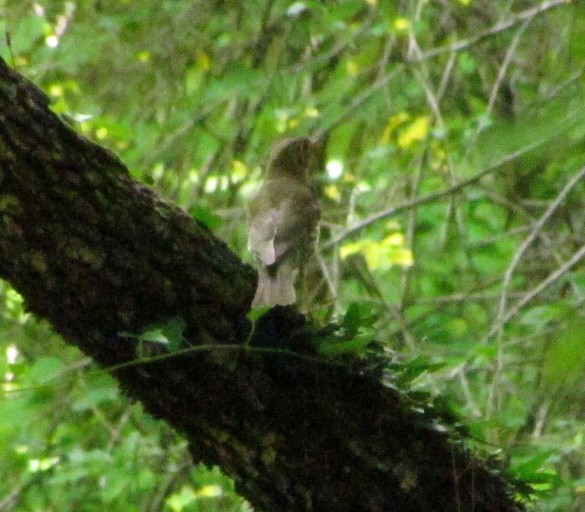
Not the greatest of photographs of a wood nuthatch but I'm pleased to capture it anyway. It was one of at least two together who were in one of the darker parts of the wood and were quite shy. Even though the photo is poor you can see its characteristic behaviour of its head facing more down than up.
song thrush
There were a lot fewer nightingale up at Dajti than in the city. Obviously this is partly because the woodland is thicker and nightingale doesn't like dense woodland. However if anything there are more blackbird and definitely more song thrush.
red backed shrike
One peculiarity of my visit to Albania is that the only place I saw red backed shrike was in the clearings up Dajti. It is common here too. Yet I didn't see one in the lowland Tirana area, Shkoder or Durres.
bird of prey
As I was leaving to head back towards the cable car I very briefly caught sight of a bird of prey. I don't want to force an identification but it was mostly light below and conceivably a buzzard. Moments later I heard what sounded like small arms fire. I do hope that the two incidents were not related. So far I had had every indication that birds were tamer and less persecuted in Albania than in many of its neighbours but this gave me some doubt.
If I had had more time I would have loved to have studied this area more. I know I only scratched the surface. Nevertheless I made the hard decision to visit the lakes of Shkoder for my final full day. That is the subject of the fourth and final part of my Albanian trip report to follow soon.
On two days of my Albanian trip I stayed in Durres. It is a coastal resort near Tirana. The location gave me a chance to do some garrigue birding along the coast.
The city
Durres is a city of about 200,000 and is the second largest in Albania. It has a port which is surrounded on both north and south sides by beaches and associated hotels. It doesn't have the best beaches in Albania but it is the most popular resort. I think there are two main reasons for this. The first one is that many of the holidaymakers are ethnic Albanians from Kosova and Macedonia and it happens to be the closest seaside resort to their homes. Two, it is close to Tirana and attracts holidaymakers particularly at the weekend from the capital city.
Like Tirana it has many cafes. It possibly has more hotels despite its smaller size. I think its main attraction for holidaymakers is the sea and sand. Unlike Tirana I was aware there were very few non-Albanians there and I was a bit of a novelty.
Getting there
When I took the international bus from Skopje (Macedonia) to Tirana it passed through Durres. Even at 3.30 in the morning I was aware that many passengers got off here. I now know they were ethnic Albanians from Macedonia on holiday. Likewise most international buses into Albania from the north or east pass through Durres before reaching Tirana.
Just as many people reach Durres having been to Tirana first. You have a choice of four ways to get there. Minibuses go every half hour and buses go every hour for just under a euro. A taxi will cost you the equivalent of about 20 euro and the train about 60 euro cent! but it is the slowest method. In short, Durres is well connected with Tirana. You biggest problem is finding where the relevant start points are for each mode since bus stations don't exist. The train stations do exist but most foreigners forgo this "experience". I did.
Don't even think about car hire. The driving is the worst in Europe and I have been to Azeribaijan to compare it!
Choice of hotel
With a couple of exceptions most hotels are around two star. I didn't book in advance and chose my hotel "Ferrara" on one basis only. It was on the northern edge of the coast and was the nearest one to the coastal garrigue. I am pretty sure no one else has used this criterion before. Indeed by the reaction of the staff having a foreigner there was quite rare. Nevertheless I was happy with my choice. It cost 25 euro a night and was in a pleasant aspect near the yacht club. I was able to walk out of the hotel and start birding in the countryside after no more than one hundred metres.
The centre of Durres tourist quarter
The birding
I birded by literally walking out of the hotel and walking along the coast northward. Like Grand Park in Tirana and unlike Shkoder and Dajti (my other birded places in Albania) this walk is not a recognised birders venue. It's definitely off the beaten track and was arguably more fun because of this.
The first day I birded from 11am until 5.30 and saw very little! The second day I birded from 8am until 12 and then again from 5.30 until 7. Then I saw tonnes. The moral is that many garrigue and marquis birds don't venture out in the heat.
view from part of my walk
What follows is an account of what I saw but it is not in chronological order. I'll start with the most shocking sighting first.
helmeted guineafowl near Durres
At about 9am on the second day when it was still relatively cool, I saw a sight straight out of Africa. Two helmeted guineafowl were browsing in an area of long grass. They didnt seem too bothered about me and behaved just like the birds I had seen in Botswana and Namibia. I was gobsmacked. I thought they were only wild north of the Sahara in Morocco and also introduced in southern France. Nobody told me to expect this.
Trembling, I sent SMS messages to two friends. Both responded quickly. One suggested I record the sighting officially and the other told me it had been introduced into Albania just like it had been in southern France. The latter text message sobered me up but since coming back I still haven't found any reference to their introduction to Albania on-line. Certainly for example, the BirdLife International monograph doesn't mention it.
house martins on a wire
One of the few birds out in the middle of the day was house martin and there were tonnes of them along with a few red rumped swallow and even fewer barn swallow. This trio never seems to worry about the heat wherever in the world I see them. Three other birds were obvious all day long whereas all the rest were more picky about there activity. Magpie and house sparrow were once again prevalent just like in Tirana. The third "heat tolerant" bird was much more interesting. There is a colony of lesser kestrel up high in the cliffs above the coastal path. They seemed to be giving the newly fledged house martin a hard time although I've never heard birders talk about lesser kestrel showing interest in such fast birds.
Until mid- morning and again late in the evening the warblers come out "to play" (or more likely eat).
sardinian warbler
I am fairly confident that the most common warbler in the area is my old friend the sardinian warbler. This bird reminds me of Libya were it is much more common than any guide book gives it credit in summer as well as winter. I was very pleased about getting this picture because I took it blind into the shrubbery, having lost sight of him a few seconds before. I knew it was somewhere around but couldn't see it. I shot and then scanned the picture and there he was!
eastern oliveaceous warbler
Now I have to make a confession. Birding is a relatively new if intensive hobby for me and I have never seen an eastern oliveaceous warbler before. The books say it is quite common near my Bulgarian home but as luck would have it my first sighting was 3 metres in from the sea at Durres, Albania.
black eared wheatear
Very near to this place I saw a black eared wheatear. Actually this area was a purple patch because the helmeted guineafowl was also found very close too. When I see black and white wheatears I try to see their backs and fronts. The ears aren't that important to me. If the back is all pale then its a black eared wheatear.
second "more traditional" view of a black eared wheatear.
In Libya near Tripoli some of these birds breed but most pass through. In Benghazi all pass through.I can't help thinking this bird passed through Libya since Albania is directly north of my old stamping ground.
white wagtail
White wagtail are also very numerous in Libya in winter and the bird above probably wintered there but this one summers just north of Durres, Albania. He was seen just as it was getting cooler one evening and was a greenfinch.
collared dove
I have noticed many collared dove close to Albanian settlements of any size and this was certainly again the case along my coastal walk. Have you ever realised how much the eyes of a collared dove can look like a drop of blood! I hadn't until I took this picture.
yellow legged gull
Finally from a birding perspective, I was reminded from time to time that I was at the seaside when the occasional yellow legged gull would fly past.
very large locusts
I just want to finish by writing a few words about the other fauna along the coast. First I can say I observed some of the largest locusts I have ever seen. My mind started boggling at what sort of birds should have been around and would enjoy this meal. I suspect they are the main part of the diet of the lesser kestrel which probably has much more success with the locusts than with young house martin.
And finally from all perspectives, a kind thank you to the goats, sheep and cattle which kept me company during my walks. They were every where! Shame about the shepherds' dogs which also intruded every now and again
The next four blogs will be written like a trip report since they will report on my visit to Albania.
The country, people and birds
Albania is visited by relatively few tourists and if you asked the average Briton (or American for that matter) where it was, they probably couldn't tell you.
It should be visited by many more people because it has a blessed climate, extremely friendly people and a wonderful café society. It is a green version of Greece which is its southern neighbour. It's also a less expensive place to visit than Greece by a factor of about 2. Furthermore, it is a Mediterranean country with the full variety of Mediterranean birds and should see more bird watchers too. Birders rave about Spain as a warblers paradise but I bet there are more warblers per square inch in Albania than Spain. Come and visit it NOW!
central Tirana
Getting there and accommodation
I took a busman's holiday there last week. I went by bus via Sofia and Skopje in Macedonia. The round trip cost me a meagre 120 euro in bus fares but this mode of transport is not for the faint hearted. Each way took 24 hours and I didn't stop over in Skopje.
Northern Europeans and Americans might wish to fly there. The good news is the low cost Italian airline "Belleair" now flies in and out of Tirana to Italy, Greece and the UK.
I stayed three nights in the Hotel Nobel in central Tirana then two nights in the Hotel Ferara in Durres on the coast and one final night back at the Hotel Nobel.
The Hotel Nobel has rave reviews with trip advisor and Lonely Planet and it deserves them. They treated me well beyond what I could have expected.
I had planned to get into Tirana bus station at the timetabled time of 5.30am and wait in the waiting room before checking in early at the hotel for the next day. Things went wrong! The bus arrived early at 4.00 am and Tirana doesn't have a bus station (no really it doesn't - not bad for a city where nearly every one uses buses to get around there and the rest of the country - more about this later).
At the moment I realised my problem at being in a foreign city in the early hours like a homeless person, I began to curse the whole idea of the trip. However I took a taxi to Hotel Nobel and woke up the nightwatchman who happened to be the owner.
What wonderful help! He understood my problem. He didn't have a twin room for single occupancy which I had booked for the next two nights. I feared he didn't have a room at all. However he had one free and it was the biggest. He gave me the biggest room in the hotel for the single rate of 44 euro. Furthermore, the hotel said I could stay in the same room for my further nights too at the low rate. This rate includes breakfast by the way.
Birding plan
The birding schedule which evolved was quite simple.
In the Tirana area, I birded the Grand Park with its huge wooded grounds and lake. I also looked at the botanical gardens and when it got too hot one day, I took the cable car (teleferik) up to Dajti for some mountain birding. I understand that Dajti is a recognised birding location where organised trips go whereas the park isn't. Well more fool the birding tour companies! The birding in the park was first rate.
On other days I stayed over at Durres which is a near-by coastal resort to do some garrigue birding.
And on the final day, I took an inter-city bus north to Shkoder on the border with Montenegro. The fresh water lakes here are also on the list of most birders who visit the country.
I'll say more about getting to and from these other locations and of course about the birds in later blogs. I'll also say a bit about eating out in Tirana too.
Meanwhile this blog will concentrate only on what I saw on two long visits on separate days to Grand Park,Tirana. Its only 20 minutes walk from the main tourist area and my hotel so no transport costs and once again my budget wasn't threatened.
part of Grand Park, Tirana
First thing to notice about the Park is that it is big. It covers 55 hectares (139 acres). It is a mix of broad leaf trees and (less) pines with a lake thrown in. Its easy even on Saturday to avoid the crowds and cafés if you want to and get down to some serious birding.
I am sure that many visitors only notice the house sparrow and magpie which are almost everywhere. I wonder why some goshawk hasn't taken advantage of the huge magpie population? It would get very fat.
You only have to look a bit more closely and you realise there is much more to the park.
Warning, the events that follow are not in strict chronological order.
One of my prize sightings were some strange looking birds eating among the sparrow so close to many people. In fact at first I overlooked them. There was a family of very tame wryneck.
very confiding wryneck in Tirana Grand Park
The wryneck family allowed me to get within two metres. I could probably have got closer still if I had wanted to push it.
wryneck really do look like a piece of wood bark!
I presume they are so tame because they are so used to people and those people don't disturb them. I can't find anything in books about it being so easy to approach and I have always had trouble before.
video footage of wrynecks in Tirana Grand Park
They even allowed me to video them eating ants from the ground at close quarters. I will savour this memory.
another wryneck elsewhere in the park
While strolling aimlessly about 100 metres from where I saw the family of wryneck, I heard the tapping of a woodpecker. I headed towards the sound. Just before I reached the area, I looked up in a young tree next to the path. I couldn't believe it but there was another family of wryneck this time allowing me to view them from under.
syrian woodpecker
Clearly the park keepers knew about the woodpecker because they have put some plastic tape across one path to stop people going too close. Its ironic that they have noticed the woodpecker but failed to protect the wryneck which I guess they missed.
The woodpecker gave me a good display from my vantage point behind the tape anyway. It was a Syrian woodpecker. Normally I look at the face marking to decide between it and greater spotted woodpecker but the light on the neck was unclear. However its very long beak and its (only) pale red vent area mark it out as Syrian.
short toed treecreeper in the park
The woodpecker was near a place where two days before I had sat down on one of the many tree stumps that the park has made into seats to quench my thirst. I had drunk a huge bottle of water and I suddenly became aware of a buzzing noise on a near-by tree. It was a short toedtreecreeper - so close to a main path! I have studied this photo several times and I still can't decide whether the short toedtreecreeper is actually feeding very small young with their mouths wide open. Am I imagining it or are there two or three young there?
I am 95% confident it is a short toed treecreeper not treecreeper which is a shame since I've already got a picture of short toed treecreeper near my Bulgarian home where it is the only summer species. Both birds ranges overlap in Albania but my shaky confidence is based on its call, the fact it was on a broad leaved tree (not conifer) and that its supercilium is not very white.
great tit in the park
Of course there were more "ordinary " birds in the park too. One of the more common ones seems to be great tit. They too are quite tame compared with those I have seen in other countries including Bulgaria.
One of the things wrong with the Collins guide in my opinion is its description of both song thrush and blackbird as confiding birds. Well they may be in British gardens where they have been give free food for centuries but not in many other countries especially when they are more woodland birds.
very young song thrush
There were plenty of thrush family members - nightingale, blackbird and song thrush in the more bushy parts of the park. Most were quiet but the one above was very noisy presumably begging for food. Its another tricky ID too between juvenile song thrush and juvenile blackbird. In the end with advice from a friend I'm going for song thrush.
house sparrow
There were no such problems with the ID of the two commonest birds in the park - house sparrow and magpie.
magpie in the park
Throughout Albania I was struck how common the collared dove is. Each settlement seemed to have a group of them. The park had several.
collared dove in the park
The park descends and at the bottom is a lake originally man made which is rather pretty in places with a couple of lakeside cafes but rather trashed in other places. However overall it is natural enough to satisfy a different set of bird species from the more wooded areas.
a view of part of the park's lake
The swallow family were numerously hawking the skies and water for insects. all three main species from the area were present - red rumped swallow, barnswallow and house martin. I was incredibly lucky to get one photo with one representative from each three species resting at the same time on the same branch.
one of each- barn swallow, house martin and red rumped swallow
The cover around the lake is not very tall but is obviously good enough for little grebe to breed. I was privileged to see a hatchling on the back of its mother. I have never seen this before. It was quite a sweet sighting.
little grebe mother and hatchling
The whole family is together in the next shot.
mother, hatchling and probably father
Where there is water in the balkans there are wagtails. Here were several yellow wagtail. Like in Bulgaria there are of the sub species fledegg. I had to walk all the way round the lake to the far side for these. The cover is higher on the far side and things are quieter. Its a little muddy in places so it doesn't get many people visiting but was ideal for my purposes.
fledegg - yellow wagtail
Lots of signs of local breeding of this bird here. Not least were the number of fledglings around.
yellow wagtail fledgling
Some new birders mistake a yellow wagtail fledgling for a grey wagtail. The irony is that the yellow wagtail fledgling is greyer than a grey wagtail. The moral is don't read too much into a name.
white wagtail
One or two white wagtail were present too. There didn't seem to mind being a bit closer to people and were mostly on the peopled side of the lake.
On my first day at the lake a couple of local people tried to strike up conversation. They could see I was a bird watcher and used their three words of English and ten words of Russian (they can speak it about as well as I can - poorly) to tell me a pelican which thankfully is same word in most languages was seen there the day before.
In summer this can only mean a dalmatian pelican in these parts.
Needless to say it didn't turn up on either of the two days I visited the lake. However two large water birds did arrive when I was there on the second day. They were on the secluded side of the lake where the men had said the pelican had been.
one of two cormorant at the lake
Two cormorant and two grey heron waited patiently to fish in the well- stocked waters. Its lovely to see such birds in the middle of a city of 750,000 people. They didn't seem phased by it all.
one of the grey heron
I wasn't expecting many large water birds in a public park in the city so they were a real treat. However I saw many more of the heron and cormorant family at Shkoder which is the subject of a later blog. Stay tuned.
While I hadn't really expected wetland birds I had expected more warblers. My sightings were restricted to a sardinian warbler in the scrub at the non-peopled side of the lake. However my visit to other parts of Albania more than made up for this including one "lifer" warbler for me. Again I'll report on these in another blog or two.
Sharing the scrub in the general area of the sardinian warbler were a small number of stonechat which were once again very tame allowing me close proximity.
stonechat in Grand Park, Tirana
In the next blog which will be part 2 of the trip report, I'll take you to Durres on the coast for some garrigue birding. Here I saw a "lifer" in the shape of a hippolais warbler. The blog is called "What are helmeted guinea fowl doing here? You'll have to read it to find out why.