Sunday, 6 July 2014

Azizah before nine

I visited the Abha area once again with Bernard Bracken over the weekend. Its one of the few places where birding is still a pleasant activity in summer in Saudi Arabia.  This is because it is at around 2450 metres and so a lot cooler than most of the rest of the country.

We birded a new area for us on Friday. This is Azizah, a long and wide valley a few kilometres north west of Wadi Talea which we have visited twice in the past with some considerable success.

We birded from 5.45 am until 3.30 pm along the valley at Azizah. The trip was so long I have divided the report into two blogs. This one reports on what we saw before 9 am.

We started out in the village of Azizah and elected to walk downstream.

male African stonechat

One piece of good news was that we came across several African stonechat which is a new species for me in Saudi Arabia. This is my 331st species in Saudi Arabia using the conservative Clements count.

It turned out to be locally common especially in the lushest areas near the few small corn fields in the very bottom of the valley.

The male is markedly different looking than European and Siberian stonechats which we get in Saudi Arabia in winter. Its mantle and face are almost jet black. Its undersides are pure white with a small orange-red bib.

female African stonechat

The female is also dark on the mantle but the undersides are mostly rusty orange. It looks vaguely similar to male European and Siberian stonechats. 

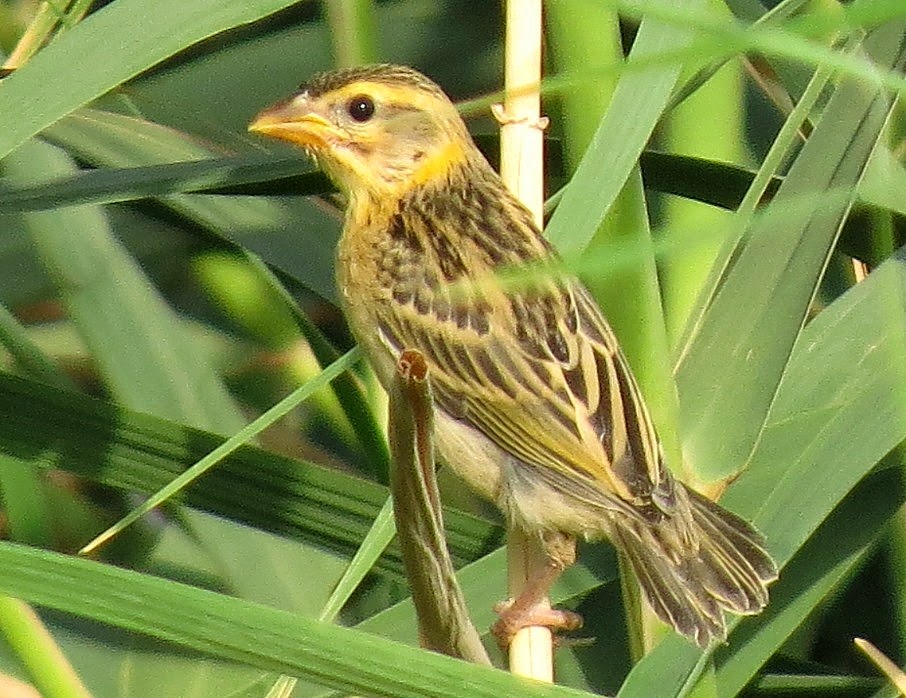
juvenile African stonechat

There was plenty of evidence of breeding. Several juveniles were seen and in one case a female was observed feeding a young bird.

a view from the bottom of Azizah valley

The bottom of the valley was teeming with other birds too. There were many Ruepell's weaver nests and it was clearly part of the breeding season.

Ruepell's weaver

In some parts of the valley, Yemen linnet was also common. 

young Yemen linnet

We found Gambaga flycatcher is extremely common in summer.

Gambaga flycatcher

Cinnamon breasted bunting was mostly found on the rocky slopes at the side of this wide valley. It was heard more often than seen too, However at least two made it down to the bottom for us to get close views. 

Cinnamon breasted bunting

I can never see too many little rock thrush but it was as abundant here as anywhere I have been in the south west.


Little rock thrush

There is a mix of terracing and flat short grassland either side of the pit of the valley in many places. Both south Arabian wheatear and red breasted wheatear were easily seen here. The former is more common.

Red breasted wheatear

On the  flat short grassland, I was surprised to see so many long billed pipit

Long billed pipit

I find their grey backs and pinky yellow legs are two of the easiest features to help recognise them.

Violet backed starling

Four violet backed starling were observed. As with the sightings in Wadi Talea in May. they are well above the altitude that the main regional guides suggests they can usually be found. Actually the inaccuracy of the altitude data in the guide is a recurring theme for so many birds. Generally the book underestimates how high a given species can regularly be found. In this case the guide says mainly between 500 and 2000 metres. We spent the day between 2450 and 2550 metres.

Bruce's green pigeon

The valley was full of doves. The most abundant was probably Bruce's green pigeon. Plenty of fig trees which is its favourite food were growing here.

Dusky turtle dove

Dusky turtle dove and laughing dove were the other doves. Once again, like Wadi Talea in May no African collared dove was seen.

Laughing dove

The next blog looks mostly at what was seen after nine a.m.  While most of the species spotted in the early morning were seen again, there were some interesting extras. Some other species were also seen before nine but are reported in the next blog as there was more opportunity to look at them then or simply because I didn't get a photo until later.

Monday, 30 June 2014

Farewell to Sebkhet Al Fasl

At Sebkhet Al Fasl on Friday, after visiting the flooded salt pan immediately south of the golf course, Bernard Bracken and I took a wider look at the Sebkhet.

Where the fresh water and reeds meet the flooded salt pan many of the birds were the same the area next to the golf course. This means a preponderance of terns, Kentish plover and black winged stilt.

greater sand plover

However there were several moorhen spilling out from the fresh water areas onto the beach in places. Two greater sand plover were also seen. There were over a dozen western reef heron around too.

little tern

In the fresh water reed beds and pools, only one tern was seen. This was little tern. However there were 60 resting in one place. They made up for lack of diversity with numbers.

Purple swamphen were present but mostly well hidden. A few Coot and little grebe ventured out into the larger lakes. A spotted crake flashed into the open and then back into the reeds. Despite our best endeavours we failed to see it again. The main regional guide says they breed in this part of the east coast.

In the reeds, there was noise suggesting the continued presence of Eurasian reed warbler but only one was seen.

yellow wagtail

Yellow wagtail was once reported to have breed opportunistically near Kharj in central Saudi Arabia and it wouldn't be a surprise to know it breeds at Sebkhet Al Fasl from time to time. Both Bernard and I saw the bird above. Bernard also saw an adult male feldegg yellow wagtail (also called black headed wagtail).

breeding little bittern

Very young little bittern were observed and this adult little bittern even has the red bill seen only during the peak mating period. There is little doubt that little bittern breeds here in Jubail.

non breeding curlew sandpiper

A lone curlew sandpiper was sighted in an inland saline pool. It's plumage was strange. It wasn't a juvenile yet there was no sign of breeding summer plumage. This is presumably what no- breeding second calendar birds look like in summer. I don't know why it never decided to go north.

curlew sandpiper

Soon after spotting the curlew sandpiper, a very good bird was seen. An Egyptian nightjar was flushed which then settled under a bush but with long grass between us and it. Bernard bracken managed a photo in focus which he has kindly allowed me to post.

Egyptian nightjar

There has been discussion by Jem Babbington and others as to why Egyptian nightjar are being seen increasingly in the summer months in Jubail area and especially Sebkhet Al Fasl. Until 10 years ago it was only perceived as a scarce passage bird here. One possibility is that it now breeds here from time to time. This artificial terrain (where cleaned waste water meets natural marshland and sea inlet) has much greenery around the edges. This is similar to true habitat in southern Iraq and Iran where it definitely breeds.

After this, we made one last fleeting visit to the area south of the golf course. still looking for the elusive red wattled lapwing. The only different bird from earlier was a little stint in breeding plumage. Although there are thousands around in winter, they are uncommonly seen in  summer plumage.  

And as a final treat, as we drove away round the back of the wetland, we came across the over summering greater spotted eagle that others have reported this year.

little stint

As I am leaving Saudi Arabia for at least a year in the next two or three weeks, this was my last visit to Sebket Al Fasl for some time. It is certainly in the top five places for birding in the kingdom and will be missed.

The 36 species seen at Sebkhet Al Fasl on Friday:


Little grebe
Red-necked phalarope
Greater flamingo
Gull billed tern
Little bittern
Common tern
Squacco heron
White cheeked tern
Western reef heron
Little tern
Greater spotted eagle
Feral pigeon
Spotted crake
Eurasian collared dove
Moorhen
Namaqua dove
Purple swamphen
Egyptian nightjar
Eurasian coot
Black crowned sparrow lark
Black winged stilt
Crested lark
Kentish plover
Barn swallow
Greater sand plover
Graceful prinia
Curlew sandpiper
Eurasian reed warbler
Little stint
Common myna
Dunlin
House sparrow
Ruddy turnstone
Yellow wagtail


Sunday, 29 June 2014

Sebkhet Al Fasl, Jubail in late June

I made the very long day trip with Bernard Bracken to Sebkhet Al Fasl, Jubail on Friday. Part of the reason was to see if the red-wattled lapwing reported a couple of times by Jem Babbington was still there.

It wasn't and we looked extensively three times during the day in the area it had been. However the mudflats are so extensive it would only have had to move on 300 metres and we would have missed it.

There was some compensation for it not being in the area just south of the golf course. Among the many waders, that were there, were three red necked phalarope.


red necked phalarope with Kentish plover by Bernard Bracken

Two of the three were still in breeding plumage. They are presumed to be females which went to the arctic to breed, laid eggs and came south almost immediately to leave the males to the rearing. This is typical female red necked phalarope behaviour though late June is a little early for the return passage.

three red necked phalarope

Bernard Bracken has kindly allowed me to post two of his pictures which were better than mine.

Kentish plover

Over ninety percent of all the other waders in this part of the flooded Sebkhet were of two species: Kentish plover and black winged stilt.

Black winged stilt

There were plenty of juveniles of both species.

Dunlin

There were a small number of other waders which may well not have been in perfect health and so not made the spring travel further north. A dunlin was among them.

common tern among other terns

There were at least four types of tern: white cheeked tern, little tern, gull billed tern and a small number of common tern.

three white cheeked tern

White cheeked tern and common tern are very similar. At this time of year, the bill of white cheeked tern is almost black compared with mid red for common tern. The bill of white cheeked tern is more slender and it curves downwards which is well seen in the above photograph.

flamingo

Out in the deeper water were at least five hundred flamingo.  I have seen ten times that number in winter but clearly plenty over-summer.

The next blog looks at the birds seen elsewhere in the Sebkhet including the fresh water areas.

Saturday, 21 June 2014

Farewell to Al Hayer

The trip to Al Hayer on Friday was my last one for some time. My summer break starts in under a month and I have some more distant trips in Saudi Arabia to undertake before then. 

After the summer, I will be working in Salalah, Oman where the birding promises to be superb. However, I am not done with Saudi Arabia. I fully intend to come back in the future but more than likely to a different geographic location.

So Friday was a farewell to Al Hayer. I was lucky enough to see plenty of summer warblers close up and in prolonged fashion. I blogged about that yesterday. This blog looks at the other birds seen.

Al Hayer in summer is a good place to "exotic" and natural members of the finch family. The pivot fields help supply seeds as food and the water is a scarce necessity in summer.

 It is among the most southerly places on earth that Spanish sparrow breed.

male Spanish sparrow

Of course they are house sparrow too. The other natural finch we sometimes see at Al Hayer is desert finch but I saw none on Friday.

streaked weaver

Streaked weaver must have escaped a generation ago and is thriving despite accidental and planned reed burnings over the years. On Friday there were very many. It has been a good year for them.
 .
male streaked weaver

The other smaller bird escapes which have established themselves are Arabian golden sparrow and red avadavat (though there are a few Ruepells weaver upstream). None were seen on Friday. 

Indian silverbill

Nobody knows where Indian silverbill arrived here by natural range expansion or escapes or both. I did managed to observe them in a couple of places.

white eared bulbul

The white eared bulbul of the area is not the sub species found naturally in eastern province. This wide spread bird is a product of escapes but is expanding west and north far away from the greater Riyadh area. 

river along a field

Darting in and out of cover all morning were plenty of moorhen which is a very shy bird in Saudi Arabia.

adult moorhen

Most of the birds now are adults or juveniles. The fledglings of two or three months ago have grown up.

juvenile moorhen

black winged stilt

Several black winged stilt and a couple of mallard were spotted near the water near some of the moorhen. Both birds breed at Al Hayer.

juvenile black winged stilt

There are always large numbers of doves all year round. Eurasian collared dove, laughing dove and Namaqua dove were all observed in large numbers.

adult male Namaqua dove

Namaqua dove is active even in the fiercest heat but equally it needs to drink more and is most easily seen doing just that.

juvenile Namaqua dove

They have finished breeding here for this year too.

juvenile black crowned night heron

Some of the heron family are at Al Hayer in summer. I saw more little bittern than any other but failed to produce a useful photograph.

I suspect from past observations, the most common heron at this time of year is actually black crowned night heron but they roost deep these days. Five were seen flying at various times including a juvenile.

purple heron

The other two herons sighted were purple heron and squacco heron.

black bush robin

Both black bush robin and rufous bush robin were seen. The former is resident.

The only other birds not previously mentioned but spotted were little green bee-eater and white throated kingfisher.

red eared slider

I have often seen other fauna at Al Hayer even including baboons! This time the most exotic was an aged red eared slider.


The 25 species seen at Al Hayer on Friday

Mallard
Crested lark
Little bittern
Pale crag martin
Black crowned night heron
Barn swallow
Squacco heron
Graceful prinia
Purple heron
Eastern olivaceous warbler
Moorhen
Eurasian reed warbler
Namaqua dove
Rufous bush robin
Eurasian collared dove
Black bush robin
Laughing dove
Spanish sparrow
Hoopoe
House sparrow
White throated kingfisher
Indian silverbill
Little green bee-eater
Streaked weaver
White eared bulbul