Showing posts with label common sandpiper. Show all posts

Sunday, 18 March 2012

Water loving birds

Today's blog looks at the birds with an affinity to water which Lou and I saw on Thursday on the Riyadh river south of Al Hayer.  


I have been surprised how few waders that have been seen this spring. Little ringed plover have been observed recently for the first time since November and green sandpiper has been seen almost every visit. On Thursday a common sandpiper made an appearance. It was clearly very tired and allowed close contact. We assumed it was a passage bird which had recently arrived.

common sandpiper

Bluethroat are still present but surely they must travel north soon. The best place to see them is usually near the water's edge. They are being very bold at the moment.

bluethroat and common sandpiper

Every time since I arrived in Saudi Arabia I have seen grey heron and purple heron in the area. There are often other herons and egrets too. This time we saw both a little egret and a great egret.

little egret

After a break of a few weeks, one of the white throated kingfisher seems to be regularly exposed.  

white throated kingfisher

Last week there was an osprey in the area. This was the first time since three birds stayed a while during mid-winter. This bird is presumably on passage.

osprey

The next blog will look at my return on Friday to the "Birds (sic) ringing centre". One passage bird in particular made me very happy to see. 

Monday, 5 December 2011

A snapshot from May

Its mid week here in Saudi Arabia and I can only really go birding at the weekends (Thursday and Friday) during these shorter winter days. I have to work during the day!

So I asked the wildlife photographer, Abdullah Amrou, if he could provide any more pictures from his collection for my blog. He has sent some from the Al Hayer area dating from late spring this year.

little bittern

The first picture is of a little bittern which breeds in the Al Hayer area. A few stay all winter too which is apparently unusual in the Middle East.

white throated kingfisher

I have posted several pictures of white throated kingfisher but I am not ashamed of posting another of this beautiful bird. As discussed before in the blog, it is resident and breeding at Al Hayer.

common sandpiper

I am confused by the local status of  common sandpiper. Tom Tarrant says he saw it from March to October in this area.  However I have seen it at Al Hayer all through November and had assumed it was a passage and wintering bird here. I had also assumed his report had a typo error and that it should have read "October to March" not "March to October"!

Yet the above picture was taken in late spring and another one was taken by  Abdullah in September (which I have previously blogged). I am beginning to wonder if there wasn't a typo after all.

To the contrary, though, the Sandgrouse article in 2004 called "breeding birds of central  Arabia 1978-2003", doesn't even mention the possibility of it being a breeding bird. If it is a summer resident (present March to October) then I think it might be the furtherest south breeding spot in the world!


Isabelline wheatear

There is total agreement with Tom on isabelline wheatear! He says "Common visitor to the Riyadh area, many remaining on cultivated areas through the summer, but no evidence of breeding seen" Well I have seen it since I arrived in late September and Adbullah has pictures like the one above throughout the year.

Also the Helms guide "Birds of the Middle East" and the Sandgrouse article don't have it as a breeding bird.

It is something to look out for this summer though.

Tuesday, 29 November 2011

Flashback to September - the waders

Abdullah Amrou has once again released some of his photos for the blog. This time they were taken in September and early October in Al Hayer, central Saudi Arabia. This is, of course, the main autumn passage time. I will show a selection of these photos over the next two blogs.  


Please visit Abdullah's flickr account for more birds:  http://www.flickr.com/photos/amrou_a/


Today's blog covers the waders that Abdullah photographed. The first bird is a ruff.  Tom Tarrant who birded here in the early 1990s says he saw the bird in every month except January, February, June and July. This data is consistent with it being a passage bird which doesn't stay through mid winter. It is known to winter in south west Arabia and the Oman coast. Al Hayer, Wadi Hanifah is en route to both of these places.  


ruff at Al Hayer presumed on passage

Abdullah's next two birds are apparently common on passage but evidence suggests (including my own observations) that a minority of these birds stay all winter.  These are common sandpiper and common snipe.  You may remember that Abdullah and I have seen both birds over the last ten days or so.

common sandpiper

From my own experience common snipe is only found in an exposed position like in Abdullah's photograph when it is on passage or having just arrived at its wintering grounds.

common snipe

Apart from black winged stilt, little ringed plover is the only "wader" which is absolutely proven to currently breed along Wadi Hanifah. They have been seen all year round too and it is assumed the local breeders are resident.  

little ringed plover


Saturday, 29 October 2011

Finding new birds in the lagoons of Al Hayer

On Thursday, after visiting the area around the dam at Al Hayer, Tony and I moved on a few kilometres south east to a regular haunt. This was near the bird ringing project sign in the wadi hanifah valley.This is the only area I have found yet in the southern part of the valley which doesn't have total coverage by reed beds next to the water channels. There are several lagoons around here.

great white egret

As we approached the first lagoon (where I had seen a dunlin last week) we saw a great white egret on the water bank. This is the first time I have seen one here and it has previously been recorded as quite rare here.  Time will tell whether this is still the case.


little egret

Near-by, offering a good comparison, was a single little egret.

common sandpiper

The ever present moorhen scurried into the undergrowth but the lagoon kept up its record of providing me with a wader every time I visit. This time we saw a common sandpiper.


cattle egret with camel

A few metres away the local flock of cattle egret had found a herd of camel to associate with. Since there are no cattle in this area then clearly camels will do nicely.

adult night heron

Two or three weeks ago I had seen twenty or so juvenile black crowned night heron on a northern stretch of the river near the city outskirts. Here some 20 or 30 kilometres south we stumbled upon a dozen or so adults with a couple of first winter birds accompanying them. I think we may have woken them up as we searched a gully.

masked shrike

Shrikes were among the most prominent of the land birds in the area. I saw my first and later my second ever masked shrike. This is a bird  I failed to see during trips from my house in north east Bulgaria to southern Bulgaria where it spends the summer. This was my fourth lifer of the day.

Isabelline (durian) shrike

Both Isabelline shrike and Turkestan shrike are looking more common  than masked shrike at this time of year . Isabelline shrike  is probably the most common.  I am still waiting to see any lesser grey shrike or steppe grey shrike which have been reported from here in winter.

marsh harrier

Finally I can't leave writing about the lagoon area without mentioning the birds of prey. There were a small number of greater spotted eagle and possibly one other type. I thought one marsh harrier was very brave to try to mob one of the spotted eagle all on his own.

Saturday, 18 December 2010

All change at Al Thama

I never knew Al Thama in north east Benghazi when it was an urban wetland. It arguably used to be a natural wetland or an unsightly, polluted tip depending on your perspective.   


When I arrived in Benghazi in May it was already being re-landscaped and tidied up.


By then,most of the natural vegetation had been removed along with the rubbish. However one island was still natural. In May I found breeding black winged stilt, kentish plover and little tern there.


The island has since been re-landscaped too. 

black-headed gull, Al Thama

I am an optimist by nature and I am pretty sure there will be winners and losers among the bird species once the re-development is finished. I am not one of those birders who thinks all re-development is bad news.  

I understand that there will be up to seven lakes in the area replacing the existing two main ones.  

Kentish plover is a great adaptor and I saw them during my visit on Friday morning. I expect them to stay.  However the black winged stilt and little tern won't breed in this area again unless new cover grows.

The area is in transition at the moment so its hard to know which species will benefit and which will lose out. During the UN winter bird count in 2005 over 1,250 waders were reported. I don't think the new scheme will be so amenable to as many waders.

one of the new lakes at Al Thama

Much will depend on the type of landscaping which will be introduced. If its like near-by Buduzeera (very good balance between human recreational needs and the wildlife's needs) there will be tall reeds, trees and grass.

On Friday the largest number of birds at Al Thama were black-headed gull and cormorant. There were tens of the latter on one artificial island. I would expect them to be very comfortable in the new environment. It also seems highly probable there will be more herons and egrets as well as reed warblers in the future if Buduzeera is any thing to go by.

Al Thama by the UN water count team 2005

The picture above shows how degraded the land was.

some of the banking today at Al Thama 

Obviously the area will be very different. 

In this time of transition there were some surprising birds about. I saw several common sandpiper in the various building ditches.

There are more green sandpiper in winter in Libya followed by equal numbers of wood sandpiper and common sandpiper. The presence of the latter two north of the Sahara shocks some people but they are here.

common sandpiper, Al Thama

I have a working rule of thumb as to which sandpiper I am likely to see in which habitat. If the area smells it will be green sandpiper. They don't seem to mind run-off ditches and sewage works. At the other end of the spectrum common sand piper like cleaner water. Wood sandpiper is in between.

kingfisher, Al Thama

The other surprising bird at Al Thama was kingfisher. There were several despite the lack of green cover. Maybe the earth mounds achieved the same trick for them.

I look forward to the completion of the project. It could be an very interesting place. Time will tell.  

Thursday, 9 December 2010

Winter waders at Garyounis

During much of the year there are three main waders at the wetland near Garyounis, Benghazi. These are breeding kentish plover, black winged stilt and even common redshank. The latter surprises some people because it is one of its most southerly breeding places.


In winter there are higher numbers of these birds so there must be some net immigration. 


kentish plover with dunlin, Garyounis, December 7th

The three birds are joined in winter by a significant number of other species, some of which I have blogged about before (see previous blogs). On Tuesday  I saw a couple of common sandpiper there (and not as  usual - green sandpiper).  

common sandpiper, near beach at Garyounis

This common sandpiper was very tired. My guess is that it had just arrived having decided its previous wintering quarters further north were no longer satisfactory.  He was lucky he chose a beach this far west.  In the far east of the country there is a greater hunting tradition (like in Egypt) targeting tired birds on the beaches even though it is illegal.

Common sandpiper is documented in the new Collins guide map as wintering in sub- Saharan Africa and virtually all the north African coast except Cyrenaica. This is another case of under-reporting. It is here (Cyreniaca) just as much as it is every where else on the southern Mediterranean coast.


common redshank

The common redshank was difficult to photograph. For most of the time they made their usual screaming noise as soon as I got anywhere near. In the end they relaxed and allowed some shots.

black winged stilt

Another noisy bird which is also resident is black winged stilt. Once again Collins guide has this as only a passage bird in the country whereas in reality it is a common breeder along both the north west and particularly the north east coasts.

Much quieter than both common redshank and black winged stilt is common snipe. I have reported this bird here earlier this winter and is is still here. After all the weather has hardly changed. It simply hasn't got cold yet this winter. 

I will tell you in my next blog about a duck which has arrived at Garyounis which only comes to us when Europe has a big freeze. It has arrived!  


Saturday, 31 July 2010

Autumn arrivals in July!

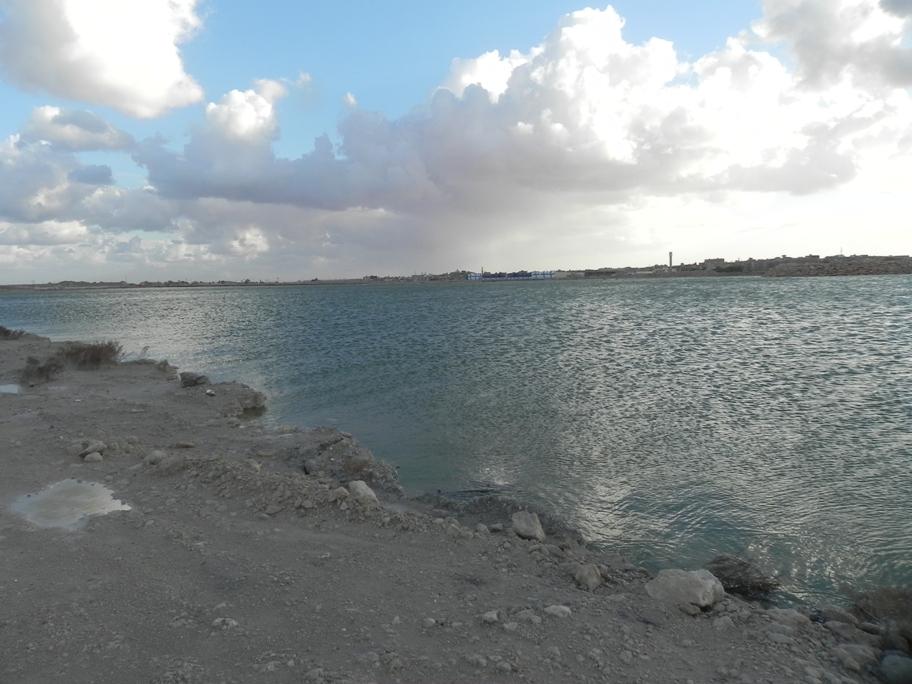
Omar Mukhtar reservoir - Saluq - end July

Yesterday I visited Omar Mukhdar reservoir. It supplies water for the whole of the Benghazi area. It is claimed to be the largest man made reservoir in the world. It is truely massive.

Imagine you are a bird and you want to cross the Sahara. You see 100,000 cubic metres of fresh water just before the desert. I think you would stop. Prehaps you wouldn't go any further particularly as its warm all winter.

The drawback is there is precious little cover on the banks of the reservoir although bushes are being grown around the sides.

I was given permission by the police to stay there for 90 minutes. This was much appreciated. 

The first impression is that it is stark and deserted but after a minute or two you realise your mistake. I saw barn swallow skimming the edges for insects. Then one by one I noticed various flocks of waders which had been well hidden at the rocky sides round the lake.  The most obvious bird and most common wader was kentish plover.

However my attention was drawn to darker, slightly larger wader which at first I thought was wood sandpiper. 


Mostly green sandpipers - Omar Mukhdar reservoir - end July

It took me sometime to work out it was actually green sandpiper. This ID problem was a classic example of what I am up against in Libya. The Collins guide shows wood sandpiper as a passage bird though here. It doesn't show green sandpiper in Cyrenaica at all. You have to trust your judgement and have the confidence to go against the book's distribution maps.

The birds I saw were darker and more robust than wood sandpiper.

closer picture of green sandpipers - Omar Mukhtar reservoir - end July

There were about twelve birds.  But they were at least partially mixing with other waders. So I kept to the text book techinque of concentating on the bird and following it through. Its no good watching one bird on the land and another in flight. 

I noticed more detail. These birds had greyish green (green) not yellowish green (wood) legs.


Green sand pipers with kentish plovers in foreground - end July

The main bird they were mixing with were kentish plover (see foreground). This is an easy bird to seperate although I will show later than at least one other sandpiper was present.

Kentish plover and green sandpiper in flight - end July

One of the green sandpiper took off with a kentish plover. It was very dark in flight and the white tail contrasted brilliantly. Shame about my photo. The tail bars were distinct. Don't let the photo lead you astray. 

Two more green sandpipers take off

Above is another picture taken seconds later when the rest of the green sandpiper decided to take off too.


common sandpipers - Omar Mukhtar reservoir - end July

I supect the green sandpipers may stay until next spring. They mostly winter around the Mediterranean. However the other wader that I positively identified will probably not. It winters south of the Sahara normally. It is the common sandpiper.

There were several of these there too. I have read reports that they have been sighted at Eilat, southern Israel in the past week. This is obviously one of the very earliest autumn migrants.


grey heron and little egret - Omar Mukhdar reservoir - end July

The waders didn't have the reservoir to themselves. It is well stocked with fish. So it has naturally attracted grey heron and little egret. These birds are rapidly being known to be more common in summer in Libya than any one had previously thought.


Finally I want to say a few words about the bushes near the reservoir. These are being watered regularly on a sprinkler system and will make fine heath land soon. The shrubs are all natural species and are beginning to attract birds. I saw goldfinch, great grey shrike, turtle dove and my first ever eastern olivaceous warbler.  I think the bushes are going to make a good migrant trap this autumn.

goldfinch - Omar Mukhtar reservoir - end July