Showing posts with label greater short toed lark. Show all posts

Sunday, 26 March 2017

Around Nouakchott in mid March

A week ago Saturday, Mohamed Vall and I returned to local birding.We visited three sites in the city area. The first was south of the fisherman's market.


mostly lesser black-backed gull (courtesy of Mohamed Vall)

The lesser black-backed gull were still there in large numbers. However there were notably less Mediterranean gull and Audouin gull. A few more terns had arrived too as spring advances.

sandwich tern with lesser black backed gull

Most of the new terns were either sandwich tern or more Caspian tern which have swelled the winter numbers of the latter.

Caspian tern diving (courtesy of Mohamed Vall)

The big change has not yet happened. I am keen to find out what the summer diversity there is on the coast. Is it too much to ask for the odd roseate tern and bridled tern to add to my country list.

Elsewhere we looked closely at many of the crested lark once again for any thekla lark which have been ocassionally reported but which I am a little cynical.

young crested lark

We did find a very short billed lark which is one of the realtive characteristics of thekla lark compared to crested lark. Unfortunately the bird was clearly very young. It had a yellow gape and many feathers were fringed pale buff.

The fisherman's rubbish dump did not yield the hoped-for red-throated pipit though yellow wagtail numbers were up and two white wagtail are lingering.

After the fishing port, we headed south to the water company site in the Riyadh district. The factory produces a small river which lasts 50 metres. 

African silverbill and red-billed quelea

We were hampered in our observations by easterly winds bringing a dust storm off the Sahara. This was the closest to Nouakchott that I had seen red-billed quelea. African silverbill are also present in lesser numbers. The two sometimes form mixed flocks though the red-billed quelea numbers are so much larger.


white wagtail

Once again my main target was red-throated pipit though there were other possibilities since the main passage season has just begun.

The pipit's cousins were present. These were namely white wagtail and yellow wagtail.

yellow wagtail

A pipit was briefly seen. However I am confident it was a tree pipit. In spring they are easily separated. In autumn it is more difficult as the red throat and face have usually gone.

sudanese golden sparrow

House sparrow and a few sudanese golden sparrow added to the density of birds at the site.  I considered a petronia for the sparrow above but couldn't make it fit!

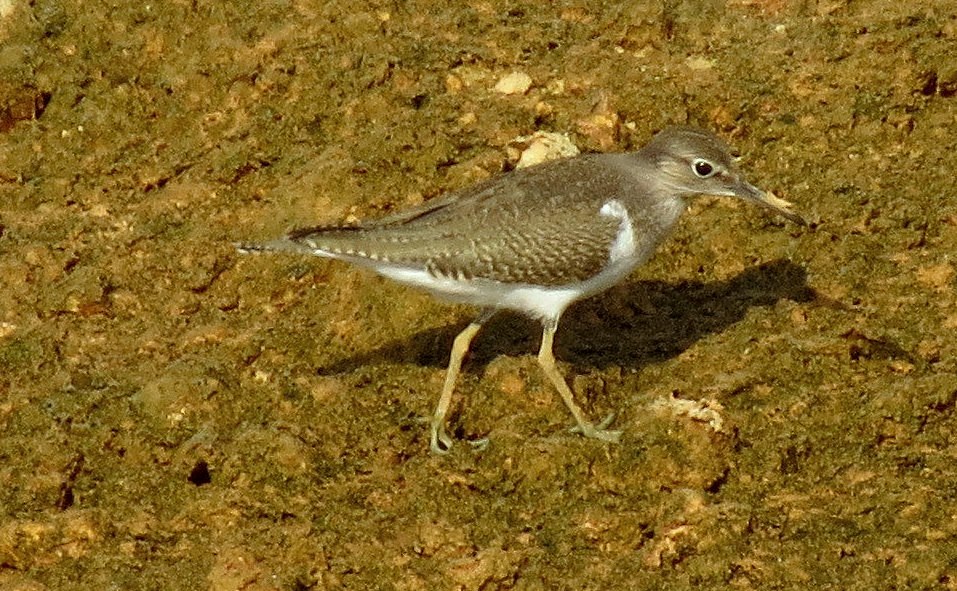
greater short toed lark (courtesy of Mohamed Vall)

The rarest bird, at least in the Nouakchott area was greater short toed lark. Indeed two of them kept returning to the water bank to drink. 

It always pays to stay alert when birding. Plenty of female black-crowned sparrow lark came to drink too and these two short toed lark could easily have been over-looked.

greater short toed lark (courtesy of Mohamed Vall)

Our last call was to North Noaukchott Lake. Sadly the trash had continued to gather but the birds have not yet vacated.

speckled pigeon

This place must be visited regularly. It always produces at least 30 species. However the mix has not changed radically for spring yet. The ducks have gone but small numbers of the black-headed gull, Mediterranean gull and black-backed gull remain.

yellow wagtail

Yet another look for red-throated pipit proved fruitless. Once again both yellow wagtail and white wagtail were present. The pipit is becoming a nemesis bird for me in Mauritania.

common snipe

Wader numbers are peaking though once again no new species have been seen.

40 barn swallow (courtesy of Mohamed Vall)

There was a big influx of barn swallow that day. We counted 65 which prompted E-bird to describe it as a rare occurance and required an explanation.  

closer view of some barn swallow

I am pretty much confined to Nouakchott for a while. I hope the city can provide a good mix this spring.

This weekend, at least the variety and numbers of terns has improved the mix. I will blog about that next.

Monday, 21 November 2016

Back to the fish market

I didn't have too much expectation before my visit to the lagoons south of the fish market yesterday. These small man-made lagoons have no vegetation and are fed with saline water pumped out from the near-by areas of the city. It is hardly Banc d'Arguin. Nevertheless it has previously exceeded my expectations with a variety of waders as well as a chance to seawatch albeit without a headland.

Once again I came away more satisfied than expected. The last few minutes provided arguably the highlight but more about that later.

My main plan was to observe as many gulls as possible looking out for common gull, sabine gull and grey-hooded gull which are all much rarer than the others I have seen so far.

northern gannet diving

This meant looking out to sea for part of the time as gulls moved backwards and forwards from the coast to ocean.

As I was doing this on one occasion, an immature northern gannet flew across and dived.

northern gannet rising

The young birds can look very similar to young brown booby. The streaks on the breast are one of the features that separates them.

black-headed gull (l) and Mediterranean gull

My gull watching did not pay dividends this time. The medium sizes gulls were all slender-billed gull, Mediterranean gull or black-headed gull. Many of them were in moult. Most large gulls were lesser black-backed gull with a small number of yellow-legged gull.

Caspian tern

This was a little disappointing. I was also slightly disppointed only to see Caspian tern. The number of tern has decreased steadily since my first visit in September.

On the other hand, I hadn't expected to see any ducks in the lagoons.

pintail

However there were seven northern pintail and one northern shoveller. These have proved to be the two common ducks in Nouakchott at other water bodies so far this winter.

shoveller

Whimbrel have been present on every visit.

whimbrel (l) with grey plover

Nine grey plover were counted this time.

seven grey plover

Other waders included several little stint, many common ringed plover and a few greenshank, green sandpiper, wood sandpiper and common sandpiper. I really don't understand why I have yet to see marsh sandpiper in Mauritania.

little stint

Two sanderling were on site of which one spent most of its time sleeping.

resting sanderling

Walking round the sandy and barren edges to the lagoons were two yellow wagtail. These are late migrants and the place is unsuitable for them other than as a one day stop over.

yellow wagtail

The most ironic part of this birding session came when I had run out of time and starting walking back to where a car was waiting to pick me up.

I had not added any new bird to my country list.

Then I noticed a lonely lark flying high above me and away. I wasn't going to let this opportunity go. I tracked it in my binoculars to see it land. It landed over 50 metres from me and hid in a very low bush.

I slowly walked towards it and luckily it walked into the open. 

greater short-toed lark 1

It was a lone greater short-toed lark. More to the point it was my first in Mauritania.

greater-short toed lark 2

I had gone to the coast to seek sea birds and had ended up with a lark.

In some ways this is a metaphor for why I love birding.

Sunday, 12 October 2014

Qitbeet and back

Yesterday, as a last fling of my Eid holiday, I drove the furthest out of  Salalah in a day trip since coming to the country. I drove to the Qitbeet rest area and back. Qitbeet is 300 kilometres north of Salalah and it the journey was in desert or semi-desert after the first 50 kilometres.

male spotted sandgrouse

I was very happy to see spotted sandgrouse at two places on the trip. One was on a side road about 110 kilometres outside Salalah. These was a group of nine birds. The second time, two birds were sitting next to a lay-by on the main road. This bird is a lifer.

female spotted sandgrouse

In the driest areas only black-crowned sparrow lark and hoopoe lark were also seen.

black-crowned sparrow lark

However there were three other places I stopped off at which were much greener. The first was on the way out and was a small garden on the edge of a developmental farm which hadn't been developed yet.

small garden in the desert

I suspected it might be a migrant trap when I spied it from the main road. 

golden oriole

There were two European roller, two golden oriole, fifteen house sparrow, a spotted flycatcher, a red-backed shrike, a Turkestan shrike and an unidentified warbler all in this small cluster.The golden oriole were quite a surprise.

spotted flycatcher

Spotted flycatcher is extraordinarily common in southern Oman at the moment.

red-backed shrike

After this break, I drove hard to make Qitbeet rest area (also called Qitbeet motel in some trip reports).

European roller

This is one of a string of rest areas on the Muscat to Salalah. This one is a well watered if a little run-down light woodland. 

Although it was much larger than the garden I had stopped off earlier the species were very similar. This was a little disappointing though seeing six European roller in one tree was a spectacle.

There were no golden oriole but hoopoe partly compensated.


hoopoe

My final port of call was Al Beed farm some 160 kilometres outside Salalah. it is a quiet, unassuming farm with four or so pivot fields. However it is a known hotspot for bird trips to Oman and I can see why. Indeed I wish I had cut out the 40% of the journey that took me on to Qitbeet and instead stopped at Al Beed. This is of course hindsight.

marsh harrier

In one field there was a female marsh harrier over head.

Asian grey shrike (aucheri)

However the closest field to the entrance gave me most joy. I was pleased to see my first Asian grey shrike (aucheri) in Oman. It is quite smoky-grey in its underparts and darker grey on its mantle than many in the grey shrike complex. 

Asian grey shrike (aucheri)

E-bird (and Clements) where I put my data still classifies it as southern grey shrike. However recent DNA studies have completely dismantled the species "southern grey shrike" through splits and transfers.

rear of Asian grey shrike (aucheri)

Al Beed has been described as a remote place where almost anything can pop up. Though, I wasn't expecting six Pacific golden plover 160 kilometres inland.

three Pacific golden plover

If you over-shoot the green area around Salalah this is one of very few options for this bird.
Pacific golden plover

I didn't leave enough time to be at Al Beed. There were Turkestan shrike, house sparrow, desert wheatear, Isabelline wheatear, black crowned sparrow lark, hoopoe lark and spotted flycatcher but probably lots of small passerines that I didn't identify in the longer grass and wet areas. 

There was one I did get though and thanks to BirdForum for helping me identify it.  It was tentatively a greater short toed lark. I had a mental block even considering that they could be down this far south and so soon that I hadn't considered it. I am still checking whether lesser short toed lark can be ruled out.


greater short toed lark

Wednesday, 11 September 2013

Changes at the pool

I haven't blogged for a couple of days because the migrant birds on the small farm have been almost the same each day. I have been seeing 3-4 spotted flycatcher, 4-6 common whitethroat and 1-2 wryneck each and everyday.

There have also been the odd shrike and wheatear but its almost like time is on-hold. No new birds arrive and none seem to leave. Its probably something to do with easterly wind or the continued very hot weather or both?

wood sandpiper

Luckily the situation is different at the pool just outside the farm and which is also on the way to work. Two grey wagtail have been faithful all week and the resident collared dove, laughing dove and crested lark are frequent visitors to it. 

However a few varied passage birds have been coming and going. This afternoon, it was the turn of nine wood sandpiper and one common sandpiper to make an appearance.

six of the nine wood sandpipers

I am pretty sure they were exhausted because they just ignored me in plain sight.

apparently different sized wood sandpipers

I was fooled for a while because they appeared to be in two sizes which made me question their identity. However I have now put this down to posture.

common sandpiper

At the beginning of the week for a couple of days, a greater short toed lark was frequenting the edges of the pool. I have never seen one of these within the city before.

greater short toed lark

Yellow wagtail have come and gone. There have been 5  sub-species, the latest two were flava.


flava yellow wagtail

I am not sure how long the grey wagtail will stay. It depends on whether the pool runs dry. Its created by some sort of dewatering project and water flow is not regular.

grey wagtail

In the farm's gardens, the only new bird for this season that I managed to photograph was a red-backed shrike though a Daurian shrike was present yesterday afternoon.

young or female red-backed shrike

I have been amazed both in spring and autumn how popular the place is with wryneck. However I have shown plenty of photographs already.

another spotted flycatcher

I would expect other warblers and chats to start arriving in the next few days along with a couple more types of pipit (to go with one red throated pipit seen last week). Let's see if I am right.

early morning common whitethroat

Among the resident birds,  one small development has been the sudden increase in sightings and numbers of rose ringed parakeet.

desert wheatear

Yesterday I saw three in one tree and five in flight over the farm. This morning seven flew over.

young or female rose ringed parakeet

However I would rather see more migrants. Surely, its only a matter of time.