Showing posts with label wood sandpiper. Show all posts

Thursday, 11 September 2014

Ever changing cast at East Khawr

During the week when my birding is necessarily limited to late afternoon, East Khawr is my closest option.

Luckily for me its bird cast has changed each time I have visited and I am still finding birds there for the first time since starting in Oman.

Yesterday afternoon, there were four more such species.

Temminck's stint

Well in from the sea, at the side of some reeds, was a group of six Temminck's stint. One in particular interested me because it was still in summer plumage. As far as I can tell it is a juvenile. I can't recall seeing a Temminck's stint in summer plumage before and the main regional guide doesn't bother to illustrate it.

second view of Temminck's stint

All the other stints were mostly or totally in winter plumage.

Two Temminck's stint

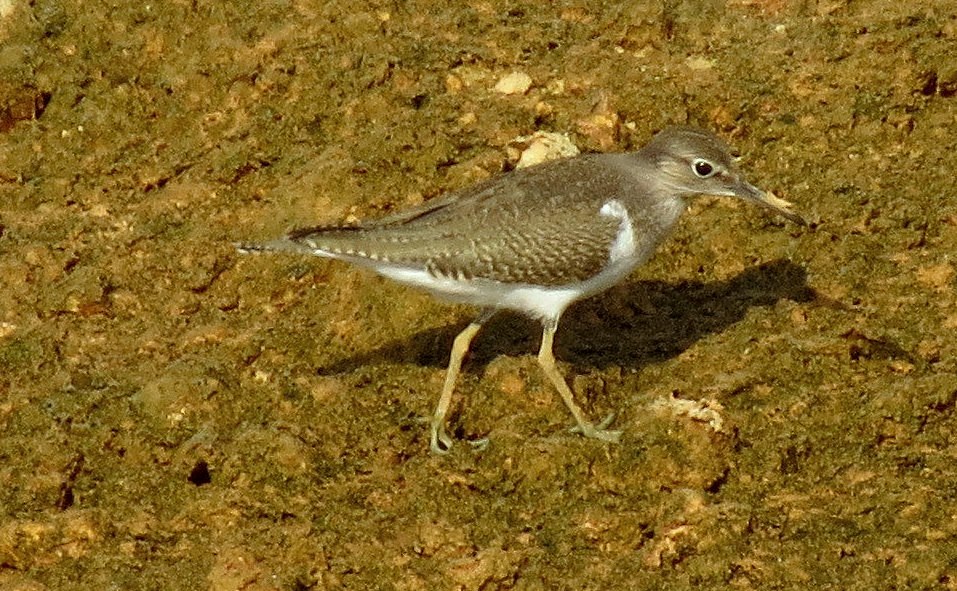
The second new find for me in Oman was a group of five wood sandpiper very near to the stints.

redshank with wood sandpiper

Much closer to the sea and on an island in the lagoon were two cattle egret along side some grey heron in the island's trees.

(western) cattle egret

Once again this was a new sighting for me in Oman on my eleventh day in the country.

The fourth new sighting was a common teal in with a group of garganey.

flock of glossy ibis

In other news form East Khawr, the spoonbills and the African sacred ibis have left the site. However the flock of glossy ibis which were missing two days before have returned suggesting only local movements.

common moorhen

Once again the common moorhen were out in the open and I have great hopes for seeing crakes in a month or two.

spotted flycatcher

Two nice views on the walk to the khawr were a spotted flycatcher and the resident little green bee-eater

little green bee-eater

Today being the start of the weekend here, I am venturing further afield. I am trying my luck in the closest hills to Salalah.

Friday, 13 September 2013

Unexpected birds in the fields

Today, I birded around the pivot fields at Al Hayer and then moved on to the farming district of Dirab.

Sadly, all the collared pratincole seen last week have gone from the fields. However the passage has a long way to go. 

There were again plenty of blue-cheeked bee-eater. 

Blue-cheeked bee-eater

In spring they are out numbered 4 or 5 to one by European bee-eater yet this autumn so far these ratios have been reversed. Indeed today I didn't see any.

grey heron

It's difficult to know which members of the heron family are passage, wintering and resident since we get all three categories for most of the heron family. Indeed only great white egret and European bittern of the common members don't breed here. 

Today, I saw several purple heron, grey heron, squacco heron, black crowned night heron and a single cattle egret at Al Hayer. Most were first seen just after dawn when there is a lot of short distance movement among them.

a flock of mallard

On the fields, the most unexpected feature was the degree of grazing by our resident mallard duck. They have been noticed in small numbers in the fields early in the morning for the past couple of weeks. Today I counted 30 in two separate fields (the ones with tall growth).  I think the mallards have worked out that they are unlikely to be shot at on this private ground.  I wonder if other ducks will do this in the winter?

squacco heron

Squacco heron were found in the same places.

greater short toed lark

Joining the house sparrow, Spanish sparrow, streaked weaver, crested lark  and Indian silverbill in the shorter fields today were about 100 greater short toed lark and similar numbers of yellow wagtail.

barn swallow

Alongside the barn swallow over the fields today were at least three common swift. I didn't see a single sand martin today in stark contrast to last weekend.

white throated kingfisher

There is no doubt in my mind that the population of white throated kingfisher has increased in my two and a bit years visiting Al Hayer. There are now much more readily seen on pivot bars.

lesser grey shrike

A passing lesser grey shrike was also seen on a bar. A masked shrike and Daurian shrike were observed in near-by trees and bushes.

great reed warbler

I am still not seeing large numbers and variety of warblers. Today there were plenty of graceful prinia as usual. One eastern olivaceous warbler gave a good show in an acacia and the above great reed warbler was observed. It let me see it for so long because it was pre-occupied with shaking off soot it had accumulated.  Let me explain...

Friday morning, Al Hayer is especially popular with fishermen. Many of them only have one day off so I can't begrudge them their hobby even though birding the water front is pretty much impossible then. There is always Saturday to do that. However, some of the fishermen are clumsy with fire especially when they cook their catch.  

Two significant fires last weekend destroyed large tracts of tamarisk and acacia near the pivot fields. The great reed warbler I saw must have ventured into the sooty remains. I am sure this one will be all right so long as it doesn't keep going it.

rufous bush robin

I was pleasantly surprised to spot two rufous bush robin at Al Hayer. I thought they all might have left by now. We have summer breeders and passage birds here.

pallid harrier at dawn

There is still no sign of the winter's eagles yet. The same old female marsh harrier was patrolling the fields as last week. However almost the first sighting at dawn this morning were two pallid harrier. My best guess is that they roosted over-night and are continuing south since that was the last I saw of them.

ruff

Just before I left for Dirab I spotted a lone ruff next to the car  in the same place as one seen two weeks ago.

Namaqua dove at Al Hayer

En route to Dirab, I stopped briefly outside an agricultural research centre to look at a row of trees which have been the roost for many tens of black kite for the past two winters. As expected none were to be seen. However a lone brown necked raven was perched on one of the trees.

brown necked raven

The stop at Dirab was necessarily short as the weather was hotting up towards midday and that still meant 40C today.

cattle egret, little egret and hoopoe at Dirab

My fairly random choice of field to investigate turned out quite interesting. The watering technique here was totally different to that at Al Hayer. In this field the pivot bars move extremely slowly and so the filed is completely waterlogged next to the pivot.  It was like a very narrow moving paddyfield.

It proved popular with cattle egret and a single little egret. There were no streaked weaver or Spanish sparrow here but very large numbers of house sparrow.

kestrel at Dirab

Yellow wagtail were fully expected in this habitat but wood sandpiper were not. Alone with the mallards at Al Hayer, this was my second unexpected bird in a field today.

some of the 25 wood sandpiper at Dirab

I counted 25 wood sandpiper in the wet land next to the pivot.

yellow wagtail at Dirab

This was quite an interesting end to the day. This field will be worth more visits if the same watering technique continues to be used.

List of birds seen today (46 species)   D = Dirab, H = Al Hayer 
Mallard  H
Black crowned night heron  H
Grey heron  H
Purple heron  H
Cattle egret  H,D

Little egret D
Squacco heron  H
Common moorhen  H

Kestrel  D
Marsh harrier  H
Pallid harrier  H
Common quail  H
Ruff  H
Wood sandpiper  D
Rock pigeon  H,D
Namaqua dove  H,D
Laughing dove  H,D
Collared dove  H,D
Barn swallow  H,D
Plae crag martin  H
Common swift  H
Hoopoe  H,D
White throated kingfisher  H
Little green bee-eater  H,D

Blue cheeked bee-eater  H,D
Masked shrike  H
Lesser grey shrike  H
Asian grey shrike (aucheri)  H
Daurian shrike  H
Brown necked raven  D
White-eared bulbul  H,D
Crested lark  H,D
Greater short toed lark  H,D
Graceful prinia  H,D
Great reed warbler  H
Eastern olivaceous warbler  H

Common myna  H,D
Black bush robin  H,D
Rufous bush robin  H
Blackstart  H,D
Isabelline wheatear H
House sparrow  H,D
Spanish sparrow  H
Streaked weaver  H
Indian silverbill  H
Yellow wagtail  H,D
Ortolan bunting  H

Wednesday, 11 September 2013

Changes at the pool

I haven't blogged for a couple of days because the migrant birds on the small farm have been almost the same each day. I have been seeing 3-4 spotted flycatcher, 4-6 common whitethroat and 1-2 wryneck each and everyday.

There have also been the odd shrike and wheatear but its almost like time is on-hold. No new birds arrive and none seem to leave. Its probably something to do with easterly wind or the continued very hot weather or both?

wood sandpiper

Luckily the situation is different at the pool just outside the farm and which is also on the way to work. Two grey wagtail have been faithful all week and the resident collared dove, laughing dove and crested lark are frequent visitors to it. 

However a few varied passage birds have been coming and going. This afternoon, it was the turn of nine wood sandpiper and one common sandpiper to make an appearance.

six of the nine wood sandpipers

I am pretty sure they were exhausted because they just ignored me in plain sight.

apparently different sized wood sandpipers

I was fooled for a while because they appeared to be in two sizes which made me question their identity. However I have now put this down to posture.

common sandpiper

At the beginning of the week for a couple of days, a greater short toed lark was frequenting the edges of the pool. I have never seen one of these within the city before.

greater short toed lark

Yellow wagtail have come and gone. There have been 5  sub-species, the latest two were flava.


flava yellow wagtail

I am not sure how long the grey wagtail will stay. It depends on whether the pool runs dry. Its created by some sort of dewatering project and water flow is not regular.

grey wagtail

In the farm's gardens, the only new bird for this season that I managed to photograph was a red-backed shrike though a Daurian shrike was present yesterday afternoon.

young or female red-backed shrike

I have been amazed both in spring and autumn how popular the place is with wryneck. However I have shown plenty of photographs already.

another spotted flycatcher

I would expect other warblers and chats to start arriving in the next few days along with a couple more types of pipit (to go with one red throated pipit seen last week). Let's see if I am right.

early morning common whitethroat

Among the resident birds,  one small development has been the sudden increase in sightings and numbers of rose ringed parakeet.

desert wheatear

Yesterday I saw three in one tree and five in flight over the farm. This morning seven flew over.

young or female rose ringed parakeet

However I would rather see more migrants. Surely, its only a matter of time.

Tuesday, 7 February 2012

River bed at Najran

Part of the plan while in Najran was to visit the dam which although unlikely to have had much water at this time of year, has a small park. 


However as is often the case in this part of the world my guide didn't remember or know that it was only open from 9 until 11 in the morning, and it was 2.30 in the afternoon!  Not to worry, we stopped off at the river bed just downstream of the dam instead.

yellow vented bulbul

What struck me immediately was how wide the river valley is. It certainly looked like, at some time in the year, it holds a mighty river. However in early February I think we were lucky there was even a trickle. Most of the rain, which incidentally falls on the mountain tops not on the eastern side, is in early summer. This area actually catches the very edge of the so called "Indian" monsoon.

What ever rain is channelled down here is enough to allow verdant vegetation in the wide and shallow river valley all year round. The bushes and trees were thronging with the sound of yellow vented bulbul and graceful prinia. 

the river bed

However close to the river there was a different habitat and a different set of birds - not much vegetation but plenty of mud flats. 

wood sandpiper

This helped me boost my list of Najran bird species by two. All down the trickle of a river were small numbers of wood sandpiper and green sandpiper.

green sandpiper

The odd white wagtail made an appearance too.

white wagtail

Meanwhile back on drier land among the trees, I spotted a couple of  Isabelline shrike. This is obviously another place, along with Riyadh, in Saudi Arabia where they winter. The Collins guide to birds of Britain and Europe maps them as passage only. This is another victim of under-reporting in the Kingdom.

Lots of little green bee-eater were in the trees too.

Isabelline shrike

More prosaically there were plenty of crested lark on the ground. Most were in pairs so the breeding season can't be far way.
  
crested lark

The valley housed other fauna too. I came across a lizard which I can't identify despite researching and a butterfly which I can.

Saudi lizard

The butterfly is a plain tiger. It is a relative of the monarch butterfly which my American readers will know. Apparently the plain tiger is only found on the wing in Arabia between October and April. In the summer months the butterfly is literally cocooned. 

Plain tiger butterfly

Finally I can't finish the blog without re-assuring people that there are indeed plenty of camels in Najran. However I think that just as many end up as food  as beasts of burden.


dark camels


Monday, 26 December 2011

Lagoons at Wadi Thulaymah

On Friday, Abdullah Amrou took Clive Temple and me to Wadi Thulymah outside Al Kharj. This was one of three venues we visited in an action-packed day.


In recent years, two new waste water treatment works have been in operation in central Arabia. They have produced new "rivers" similar in many ways to the "Riyadh river" which flows through Wadi Hanifah. One of these new water courses flows through Wadi Thulaymah. 

Though Wadi Hanifah near Al Hayer has been extensively birded by the few birders who make it to central Arabia, Wadi Thulaymah is pretty much virgin birding territory. 

We started our birding at the far downstream end of the new Kharj river. Here the water has collected into about five crystal clear lagoons.  Indeed all the water in this wadi looks clear. I suspect the treatment works are ultra modern. 

Anyway,the lagoon habitat doesn't exist at Wadi Hanifah (though old records show something similar used to be present before the wadi evolved further). 
The good news is that the lagoons at Wadi Thulaymah were teaming with waders.


However even before we saw any waders, a long legged buzzard flew over head and "welcomed" us to the area. 

wood sandpiper

There are a few waders at Al Hayer. However Wadi Thulaymah's lagoons are ideal for them and the density of waders is much higher.  The lagoons held common sandpiper, green sandpiper, wood sandpiper and marsh sandpiper.

marsh sandpiper

This was the first time I have seen marsh sandpiper in Saudi Arabia.

ruff

There was more than just sandpipers. There were also a small number of ruff. Again this was the first time I have seen this bird in Saudi Arabia too. However it has been recorded in huge numbers at Al Safi dairy farm in the past. The front entrance to Al Safi farm is very close to these new lagoons so ruff is not a surprise. 

black winged stilt

Black winged stilt are resident birds in central Arabia and its must be highly probable that they will be at the lagoons all year even after the waders have gone.

little stint

The most abundant bird on the day was little stint. We counted at least 80 of them. When we looked carefully there were at least three temminck's stint among them and one dunlin. At least one ringed plover and two kentish plover were also present.


Temminck's stint

Later on in the day (very nearly dusk) we visited an area a few kilometres upstream of the lagoons. It was too late to bird properly but there is obviously a large clear lake. Although, we couldn't find a good vantage point because of extensive reed beds and a lack of time, we could see a high concentration of ducks. 

The majority were shoveler but there were also tufted duck and at least two pochard. These were the first tufted duck and pochard I have seen in Saudi Arabia.

Clearly, Wadi Thulaymah is worth more visits.