Showing posts with label citrine wagtail. Show all posts

Friday, 24 October 2014

Raysut treated water lake revisited

Yesterday late afternoon, I visited Raysut treated water lake for the second time. The water level was higher but still incredibly clean. The treatment plant must be working to very high standards.

This does of course mean there are very few reeds which need more nutrients and less flies than most plants!

However there were still a good variety of birds and it was a pleasure to bird in such a clean environment.

I have very mixed emotions about my visit. I thought I glimpsed a long-tailed shrike which is a vagrant to these parts but never saw it long enough or got a photo. I searched very hard for it again but failed. I won't claim this sighting but I will go back as soon as I can to look again.

Blue-cheeked bee-eater

As partial compensation, I came across five blue-cheeked bee-eater.  This was the first sighting by me of them in Oman. I have yet to see a European bee-eater here.

Two blue-cheeked bee-eater

In the same tree as a blue-cheeked bee-eater at one stage were a few Tristram's starling. The lake is popular with house crow too.

Tristram's starling

Other land birds included Ruepell's weaver and African silverbill.

The lake

The African silverbill were spending much of their time preening.

African silverbill

Nearer the water's edge, several citrine wagtail were seen. The numbers have increased since last time.

citrine wagtail

Some were moulting. I assume from juvenile monochrome into brighter colours.

white stork in the sky

Large numbers of white stork spend the winter at the near-by Salalah lagoons and Raysut rubbish tip so it wasn't surprising that 45 or so passed over the far end of the lake at one stage. Three steppe eagle were with them.

black winged stilt

Waders included several black-winged stilt, grey heron, squacco heron and a single glossy ibis. 

green sandpiper

All of trio: wood sandpiper, common sandpiper and green sandpiper were there.

wood sandpiper

The far end looks good terrain for collared pratincole but non seen so far. Lets see what the winter brings.

Monday, 20 October 2014

Wadi Darbat revisited

On Friday afternoon, I went to Wadi Darbat for only the second time since starting in Oman.

Though the monsoon season is over, it was still quite green and the river flows all year.

The birds hadn't changed much since my last visit. The grey headed kingfisher are still here. Indeed I counted five.

grey headed kingfisher

The temperatures are actually higher in October than in September or November. Birding is quite difficult in the day even up in the hills. More to the point birding activity will rise substantially as temperatures cool in about two weeks time.

wadi darbat

Not too many migrants are here yet. Tree pipit is one of them and can be seen in the wooded areas where there is some shade.

tree pipit

A grey heron alerted me to another migrant. I was walking along the river when I had a scream from a heron.

grey heron

I turned round to look in its direction to see a booted eagle flying right up the river. I don't think booted eagle is a threat to grey heron (unlike Bonelli's eagle) but I was grateful for the alarm anyway.

distant shot of a booted eagle

The booted eagle was a pale morph and the first of its species I had seen in Oman.

litte egret

Otherwise things were a little quite. A single little egret was in the western area by the picnickers and next to the floating vegetation. This is the place where jananas and rarer birds such as watercock are occasionally spotted in winter. I am sure this must be in early morning when there is less disturbance from people.

Common sandpiper can be readily seen all down the river.


citrine wagtail

The most common wagtail is citrine wagtail though a few yellow wagtail and the odd grey wagtail are around. I have yet to see a white wagtail in the country.

At first all the citrines were first years but over the past ten days more adults are among them.

My next blog is taken from Ayn Hamran where the highlight was some very interesting feeding behaviour.

Tuesday, 30 September 2014

Raysut treated water lake

I finally made it to Raysut treated water lake on Saturday, a day later than originally planned.

It was not what I expected. The water was very clean so the sewage works is almost certainly state-of-the art.

This meant the lake held clean water and reeds were none existent. Flies were few as well. All this didn't mean there were no birds it just meant they were different than anticipated.

Furthermore, although it is inland the sea is barely a kilometre away and so coastal birds were present.

Little grebe

Nevertheless one of the first birds seen was little grebe. There appears to be a reasonable population there including young birds (see picture above).

The Raysut treated water lake

Black winged stilt was also seen right at the start.

black winged stilts

White cheeked tern was there showing how close to the sea the site is.


white cheeked tern

There was one clump of trees which Indian house crow were claiming for themselves.

Indian house crows

This was yet another water body in the Salalah area with glossy ibis.

glossy ibis

There are a few small pools at the edge of the main water body.

pools at the side of the lake

Temminck's stint was quite common at these.

Temminck's stint

The pools and the sides of the main water were teeming with citrine wagtail. I also saw two yellow wagtail.

citrine wagtail

Although there were a small number of white cheeked tern, the main tern was white winged black tern.

juvenile white winged black tern

Gulls were far more numerous still. Indeed there were well over 150 sooty gull in the area and probably 20 or so Heuglin's gull. It was difficult to assess the exact number because they spent much of their time within the treatment plant out of sight of the general public.

Steppe gull

I was looking out for other gulls. One or two of the large white headed gulls were too pale for Heuglin's gull.The one above was identified with the help of BirdForum as a Steppe gull. This was my first addition to my Oman list of the day.

stained grey heron

A stained grey heron caught my attention and at one stage I thought I may have found a vagrant black-headed heron.

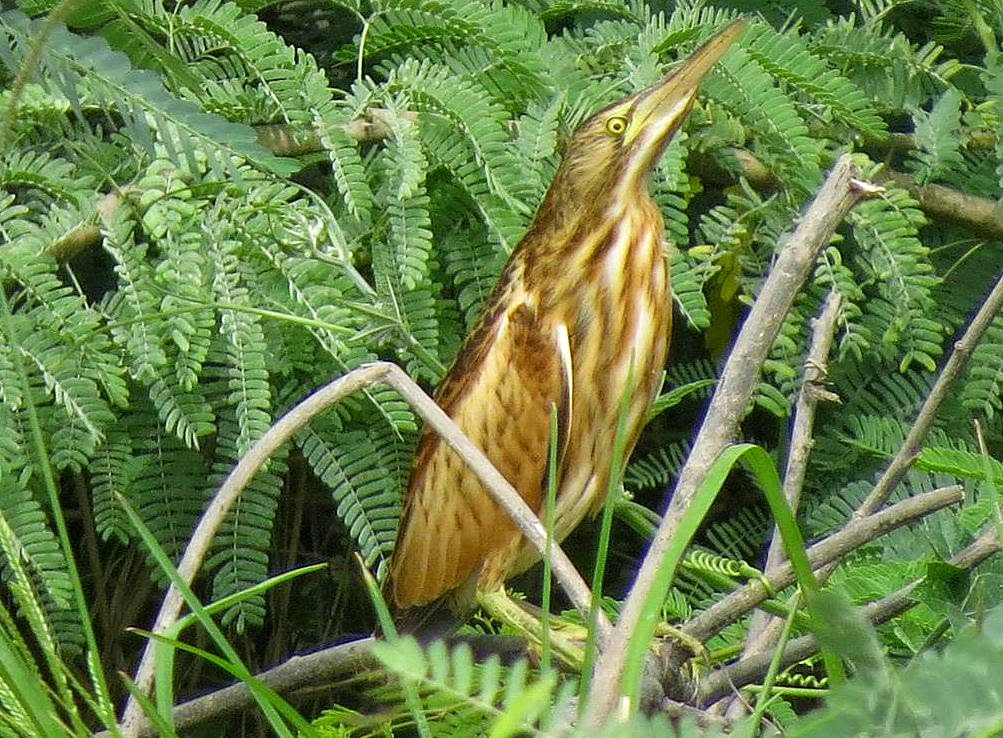
adult little bittern

I had been glimpsing a small bittern all session when I accidentally flushed a juvenile bird over to the far bank. To my surprise when I scanned where it had gone, an adult bird flew straight into view. It was an adult little bittern.

juvenile little bittern

It disappeared from view, only for the juvenile to come straight out into the open giving me better views than the adult.

second pose of juvenile little bittern

I was a little disappointed it wasn't a yellow bittern but that will surely come now i am based in Salalah.

black crowned night heron

Soon after the views of the little bittern, I saw the second addition to my Oman list of the day. Two men were walking in the wadi who flushed a juvenile black crowned night heron. I just  managed a photograph before it disappeared.

I worked hard at the water all day and only got good rewards towards the end. 

However before I left the area completely, I chose to cross the road and spend a few minutes in the dry part of the wadi.


spotted thick-knee

I seem to have the knack of stumbling across spotted thick-knee. This time there were at least three and probably four birds.

two spotted thick-knees

My tip for seeing this bird, is get out of your car and walk. They are unlikely to be seen from a car unless they are within 3 metres of your window. Even then you could miss them.

Tuesday, 14 January 2014

Wadi Haly, Muhayil

A few kilometres west of Muhayil and north of the main road is Wadi Haly. This is a wadi with running fresh water and an excellent birding venue.   

There were many wadis in the south west like this in the past but the call on water for the growing population and farming needs has made them quite rare. They are especially rare at this low altitude.

Thanks are due to Shane Naghere's friend Mark who pointed me to it. Without the local knowledge of these people I would never have found it.

Shane joined me to bird the area. It may have been his first ever birding experience and it was a good one! We started at the upper end of the wadi where the water is very shallow and moved slowly downstream as the stream became stronger and stronger.

first hamerkop

One of the first birds we saw was a Hamerkop. 

Hamerkop was my number one nemesis bird in Saudi Arabia. I have spent so much time looking for it at water bodies in the south west with no success. Yet here it was standing out in the open.

Hamerkop is the 318th bird on my Saudi list.

another hamerkop

In fact this was the first of eight hamerkop seen along the stream. There are probably more but the stream was so long we never managed to see how and where it ends. This will make a very exciting birding trip for the future. I shall certainly return.


the upper end of the valley

One of the main features of the birding was the variety of water liking birds.

cattle egret and cattle

A large flock of cattle egret were spending time with a herd of cattle.

little egret

Three little egret were in the same general area though they were detached most of the time from the cattle egret flock.


squacco heron

There was a single squacco heron and at least two grey heron.


grey heron

There were plenty of waders present. At the upper end of the stream nearly all were green sandpiper.

common sandpiper

However as we moved down stream there was more variety. First we started seeing common sandpiper as well as green sandpiper. Then  there were also two wood sandpiper.

wood sandpiper

In the more rocky areas there were a small number of little ringed plover and a Temminck's stint.

little ringed plover and Temminck's stint

Any water in Saudi Arabia in winter attracts white wagtail.

white wagtail

However citrine wagtail are much less commonly seen. There were two at Wadi Haly. 

citrine wagtail

The wadi lacked bushes next to the stream probably because of grazing. However the area above the low valley was sandy with scattered bushes. This meant that non-water birds were present too.

a rocky stage of the stream

African collared dove descended to drink.

African collared dove

Namaqua dove was equally as common here.

Namaqua dove

Daurian shrike made use of any bushes that did exist.

Daurian shrike

Some birds don't need vegetative cover.

desert lark

Desert lark was the only lark seen.


Striolated bunting was heard among the rocky sides to the valley a long time before it was seen. A single cinnamon breasted bunting was observed at the top of a side slope too.

I would like to return to this wadi in other seasons and also to go further down stream to see what the end looks like be it lake or marshland.

In the next blog, I will write about some birding on the edge of Muhayil.