Friday, 8 August 2014

Tanjaro river revisited

July 27th was a sightseeing day in Erbil but I resumed some birding on the morning of July 28th before it got too hot.

I revisted the Tanjaro river in Sulaimani. This proved to be a good decsion as birds were more numerous that the previous visit and I added 7 species to my new Kurdistan list.


white stork, black winged stilt and red wattled lapwing

I chose to walk downstream from Pak City whre I was staying. Some of the first birds to be seen included a single white stork (the same one as last time?) and a flock of red wattled lapwing

red wattled lapwing

However there were far more waders about including several black-winged stilt.

flock of black-winged stilt

There were a few juveniles among them and I suspect local breeding.

more black- winged stilt

Once again there were plenty of green sandpiper around and once again the e-bird data base didn't like my entry when I tried to input their sighting. E-bird obviously believes they shouldn't be around in mid summer 

green sandpiper

On the other hand, the sighting of two wood sandpiper was accepted.

wood sandpiper

Common sandpiper were also present again but little ringed plover wasn't seen on my previous visit.

little ringed plover

 As might be expected little ringed plover was seen in the more pebbly areas.

juvenile yellow wagtail

Both white wagtail and yellow wagtail were seen. The yellow wagtail breeding species here is black headed wagtail. However I didn't see any males and the views were directly into sunlight so I couldn't identify the sub-species I saw.
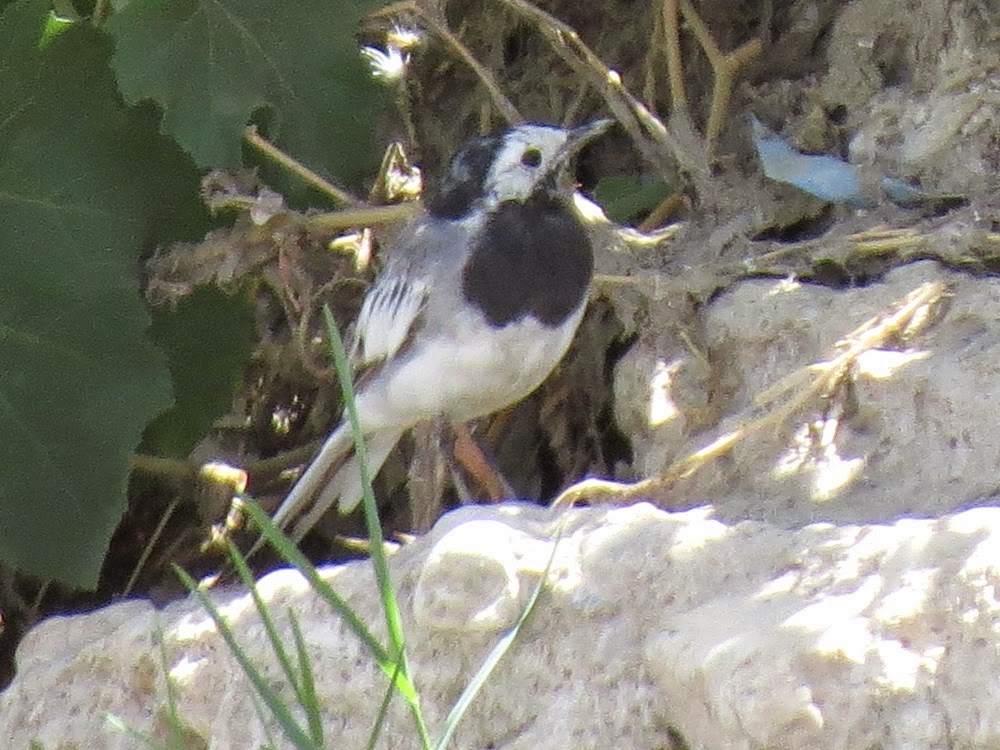
white wagtail

Aweay from the river banks, I got to see my first Kurdistan rufous bush robin.  


 Rufous bush robin

However sightings of two separate see-see partridge in different palces down the river was a bigger highlight since this was a lifer for me.

female-type see-see partridge

Needless to say, crested lark turned up.  I see this bird everywhere I bird in the Middle East and north Africa. It tolerates so many different habitats.


crested lark

There was plenty of food for herons but surprisngly I didn't see a single one here or elsewhere on my trip.

frog


In the next and final blog on Kurdistan, I will write about my session on Gouizha heights where the cross section of birds was a little different.

Birds seen by the Tanjaro river on July 28th 
I = addition to Iraqi list, L = lifer

See-see partridge  I,L
White stork
Moorhen   I
Black-winged stilt  I
Red-wattled lapwing
Little ringed plover  I
Green sandpiper
Common sandpiper
Wood sandpiper   I
Feral pigeon
Collared dove
Laughing dove
Magpie
Crested lark
Barn swallow
Eastern olivaceous warbler
Rufous bush robin   I
House sparrow
Yellow  wagtail  I
White wagtail

Sunday, 3 August 2014

Dukan

The Dukan area is about 60 minutes drive outside Sulaimani. Features include a very large lake with hydro electirc plant. Down stream there is an ice cold river runnig through Dukan town. I only had time to bird the town area. Thanks to my non-birding friend Steve K for accompanying me.

The lake area is actually well recorded and has some very interesting birds. If I ever return to Kurdistan that would be my first stopping point next time round.

However on July 26th we birded the town area. 

large white headed gull

One of the first birds seen was very difficult. It was a large white headed gull and I couldn't identify it properly.  The photos aren't the best but the default gull in this part of the country at this time of year suggested Armenian gull

The eye is very dark for a yellow legged gull which would be a very rare over-summering bird. Similarly the gonys (red patch on the bill) is very large for a Caspian gull which would also need to be over-summering.

I placed it on the birdforum identification forum and the consensus is that it is indeed an Armenian gullIt has a very weak black sub-teminal band while most Armenian gull have a strong one. However this apparantly can often disappear with age. 

River at Dukan

The water in the river was cold producing a natural cooling effect in the valley. It was not surprising then that I saw so many northerly species close to the river particualrly in the shade.


goldfinch

When I sat inside a small glade chasing golden oriole, I managed to photograph resting goldfinch and great tit. For an hour beforehand I had failed to photograph the goldfinch out in the open as they flitted back and forth into the shade. 

great tit

I didn't see a great tit in the open at all.

blackbird crossing the river

Some of the best birding results were achived by watching birds break cover to rapidly cross the river from one side to the other. I saw blackbird and jackdaw this way.

Upstream from the bridge in the town were some of the best birds but the photogrpahic possiblitites were poor as I was looking directly into the sun. There were red rumped swallow hawking over the river for insects most of the day. Briefly a few barn swallow joined them but moved on.

Mid morning,a mixed flock of blue cheeked bee-eater and European bee-eater visited. At the same time the only bird of prey seen on the whole trip soared above. it was a short toded eagle.

white eared bulbul

Although many of the psecies here were northerly birds at the southern edge of the range. Two species were the other way round. That is to say southerly species towards the north of their range. These were white eared bulbul and graceful prinia.

graceful prinia


While I was photographing the graceful prinia, a single European reed warbler flushed out of the small clump of bull rushes near-by. You just see one of the rush stems in the photo.

Other notable birds were a single white throated kingfisher seen flying upstream and two pied kingfisher spotted at different times and oplaces along the river. Unfortunately none of the three birds stopped to perch.

The next blog looks at my second visit to Tanjaro river in Sulaymani where I found the second lifer of my visit to Kurdistan.


Species seen at Dukan  I = addition to my Iraqi list

Short toed eagle I
Armenian gull  I
Feral pigeon
Collared dove
Laughing dove
White throated kingfisher I
Pied kingfisher  I
Blue-cheeked bee-eater  I
European bee-eater  I
Golden oriole  I
Magpie
Jackdaw  I
Northern raven
White eared bulbul  I
Great tit   I
Crested lark
Red rumped swallow  I
Barn swallow
Graceful prinia
European reed warbler  I
Blackbird   I
House sparrow
Golfinch I

Saturday, 2 August 2014

Tanjaro river, Sulaimani

The Tanjaro river runs through Sulaimani, Kurdistan. It flows with a mix of natural water from the mountains and waste water from the city. In July it is mostly this second type of water.

I visited there the first time in late afternoon on July 25th , it being very close to where I was staying. My expectations weren't high as I had been warned that birds were few.

However I was pleasantly surprised even though the visit was relatively short.


white stork

The most obvious fact was the very large number of magpie present. The congregation was over 20 before I gave up counting. As I was counting a single white stork flew overhead going downstream and out of view.

Magpie

My attention was soon attracted to a lapwing among the magpie which flew off towards a ploughed field. I followed it and found it again with five others shaded under bushes on the edge of the field. This was a red wattled lapwing. This was the first lifer of the trip and a rare visitor to Saudi Arabia that I had failed to see in my three years there. 


red wattled lapwing

There were several waders in the stretch of water visited. Most were green sandpiper although at leasty two were common sandpiper.

common sandpiper

When I input the data on the e-bird database it says that green sandpiper is rare presumably meaning at this time of year. 

crested lark

Crested lark is one of the most ubiquitous birds in the whole Middle East and it was no saurpise to see it.

northern raven

In the distance, in the sky just as we were about to leave I spotted two northern raven which later proved to be a common bird in these parts.

So after two leisurely birding sessions either side of a fiercely hot day my Kurdish list had begun.


Birds seen by Tanjaro river on the evening of July 25th

White stork
Red wattled lapwing
Green sandpiper
Common sandpiper
Feral pigeon
Collared dove
Laughing dove
Magpie
Northern raven
Crested lark
House sparrow

Friday, 1 August 2014

Azadi Park, Sulaimani

On the morning of July 25th, I started my birding in Kurdistan. The start was low key with a visit to the local park in Sulaimani called Azadi. It's actually quite large but still being developed.

In this introduction to Kurdistan birding, only 10 species were seen but it gave me a first feel of what to expect in the region.

greenfinch

One of the most surprising finds for me was a greenfinch. According to my regional guide's map there is an isolated community of this northern bird around Sulaimani. It seems I found it. 

Eastern olivaeous warbler

Before that I spent some time trying to identify the relatively large number of warblers in the park. It didn't take me too long to wok out that they were all of two types. 

Eastern olivaceous warbler was extremely common. 


Menetries's warbler

Menetries's warbler was restricted to areas with low bushes. However this was still the most concentrated group of them I have ever seen. Unlike the more northerly sub species this one is quite bland especially the females. 


second view of Menetries's warbler

I had been told that white wagtail could be found at the park and so it proved. I came across a family of 2 adults and 2 juveniles next to one of the three artifical lakes. The adults were very worn.

White wagtail

The juveniles were still young enough to be begging for food. White wagtail doesn't breed much further south than this.

juvenile white wagtail

Incidentally the lakes attracted a few hawking barn swallow.

collared dove

The park's most obvious residents are the doves: collared dove, laughing dove and feral pigeon. Unfortunately there was no sign of turtle dove. The latter bird is in serious trouble throughout its range.

Laughing dove

The main problem with birding in Kurdistan at this time of year is the temperature. It reached 42C on July 26th. Birding became increasingly difficult after 9am as we walked round the park. 

hoopoe

House sparrow was everywhere as expected. Hoopoe was the only other bird seen.

house sparrow


Thanks are due to my non-birding friend Steve K who lives and works in Kuridstan and who came out on this visit with me.

After returning to Steve's place mid morning, at 4pm as the temperatures began to drop, I resumed birding in another part of the city. Still with low key birding, another seven species were added to my embryonic Kurdistan list including a lifer.

Species seen in Azadi park
Feral pigeon
Collared dove
Laughing dove
Hoopoe
Barn swallow
Eastern olivaceous warbler
Menetries’s warbler
House sparrow
White wagtail
Greenfinch