Showing posts with label steppe gull. Show all posts

Tuesday, 30 September 2014

Raysut treated water lake

I finally made it to Raysut treated water lake on Saturday, a day later than originally planned.

It was not what I expected. The water was very clean so the sewage works is almost certainly state-of-the art.

This meant the lake held clean water and reeds were none existent. Flies were few as well. All this didn't mean there were no birds it just meant they were different than anticipated.

Furthermore, although it is inland the sea is barely a kilometre away and so coastal birds were present.

Little grebe

Nevertheless one of the first birds seen was little grebe. There appears to be a reasonable population there including young birds (see picture above).

The Raysut treated water lake

Black winged stilt was also seen right at the start.

black winged stilts

White cheeked tern was there showing how close to the sea the site is.


white cheeked tern

There was one clump of trees which Indian house crow were claiming for themselves.

Indian house crows

This was yet another water body in the Salalah area with glossy ibis.

glossy ibis

There are a few small pools at the edge of the main water body.

pools at the side of the lake

Temminck's stint was quite common at these.

Temminck's stint

The pools and the sides of the main water were teeming with citrine wagtail. I also saw two yellow wagtail.

citrine wagtail

Although there were a small number of white cheeked tern, the main tern was white winged black tern.

juvenile white winged black tern

Gulls were far more numerous still. Indeed there were well over 150 sooty gull in the area and probably 20 or so Heuglin's gull. It was difficult to assess the exact number because they spent much of their time within the treatment plant out of sight of the general public.

Steppe gull

I was looking out for other gulls. One or two of the large white headed gulls were too pale for Heuglin's gull.The one above was identified with the help of BirdForum as a Steppe gull. This was my first addition to my Oman list of the day.

stained grey heron

A stained grey heron caught my attention and at one stage I thought I may have found a vagrant black-headed heron.

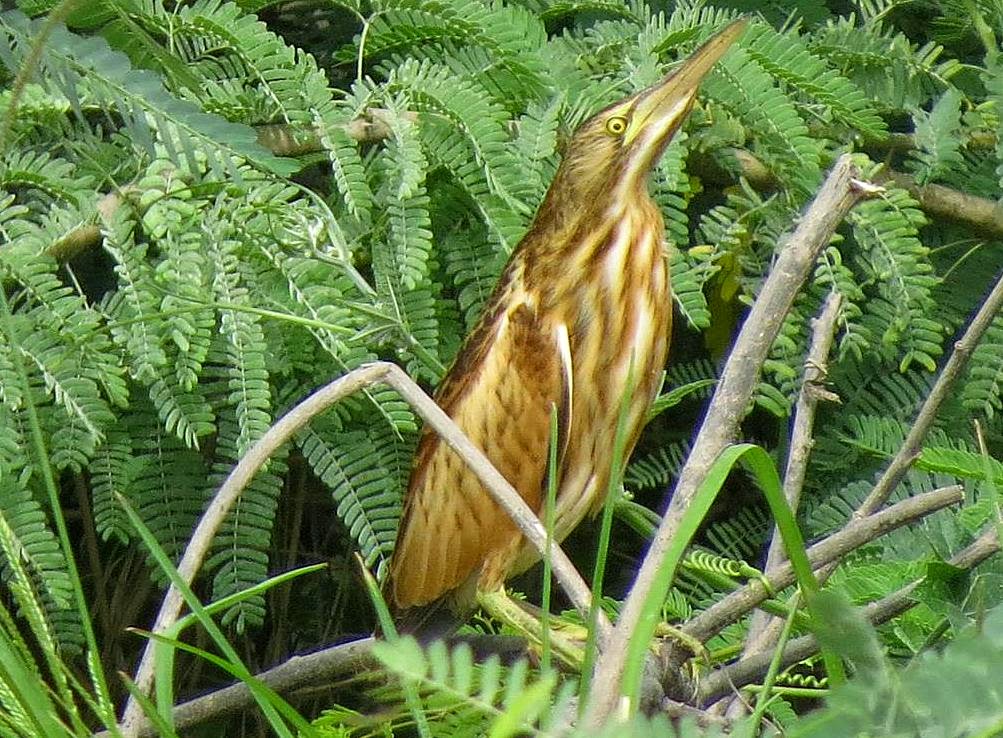
adult little bittern

I had been glimpsing a small bittern all session when I accidentally flushed a juvenile bird over to the far bank. To my surprise when I scanned where it had gone, an adult bird flew straight into view. It was an adult little bittern.

juvenile little bittern

It disappeared from view, only for the juvenile to come straight out into the open giving me better views than the adult.

second pose of juvenile little bittern

I was a little disappointed it wasn't a yellow bittern but that will surely come now i am based in Salalah.

black crowned night heron

Soon after the views of the little bittern, I saw the second addition to my Oman list of the day. Two men were walking in the wadi who flushed a juvenile black crowned night heron. I just  managed a photograph before it disappeared.

I worked hard at the water all day and only got good rewards towards the end. 

However before I left the area completely, I chose to cross the road and spend a few minutes in the dry part of the wadi.


spotted thick-knee

I seem to have the knack of stumbling across spotted thick-knee. This time there were at least three and probably four birds.

two spotted thick-knees

My tip for seeing this bird, is get out of your car and walk. They are unlikely to be seen from a car unless they are within 3 metres of your window. Even then you could miss them.

Thursday, 31 October 2013

The coast inside Yanbu city

Brian James and I finished our tour of the Yanbu area last Saturday afternoon with a journey down the coast within Yanbu city heading southward. 

The density of sea birds here was much higher than the area north of the city which had spend several hours observing. Indeed we saw every sea bird in Yanbu that we had seen over many kilometres of coast line further north with the exception of a single common tern.

So in future I would drop the trip to the north of the city and concentrate on the city coast and further south.

There are mangroves on the southern trip and within the city which adds to its attraction. Furthermore on part of the route there is a grassed and bushy southern corniche which acts as a magnet for land birds.

It's shame we had little time to do it justice.

Flamingo

This blog concentrates on the extra species seen within the city not seen on the northern coast up to the cement works.

Flamingo was a good start.

crab plover

Crab plover and ruddy turnstone were also seen in the city bit not north of it.

European spoonbill

Three European spoonbill were also present near an area with a large number (over 10) of grey heron.

Caspian gull

Again the main gulls were slender-billed gull, sooty gull and a few Caspian gull.

Steppe gull

Here though we also observed three steppe gull with their deep yellow legs and bills but darker mantle than yellow legged gull


close up of the face of a steppe gull

One was also seen here last spring on our previous visit. This species is not shown on the regional guides distribution map for the Red Sea coast. Please also note that many steppe gull that Saudi Arabia gets in winter do not have the more typical dark eye.

house crow

The grassed south corniche was slowly driven past rather than thoroughly birded because of time constraints. Even by driving past, we could see, it was teeming with birds from doves to house crow as well as warblers, shrikes and common redstart in the bushes.  

House crow now seems to have colonised the whole eastern red sea coast all the way from Jizan in the south west to Haql on the Jordanian border.

female blackcap

We didn't get a chance to look at warblers on the corniche but we had seen some bushes on the outskirts of the city before the main trip down the coast. 

Here we saw the phenomenon of large numbers of blackcap travelling as a flock. I had first observed this in spring in the Riyadh area where one tree had 21 blackcap and there were 35 altogether in the small wadi.

Likewise at Yanbu where four bushes close to each other which housed at least 7 or 8 blackcap each.  

blackcaps in a bush


Overall the trip to Yanbu was a success. We saw over 100 species over the weekend but with some adjustments to the routes in the hills and along the coast, we could make it even better next time.

Monday, 18 March 2013

The coast near Yanbu

On Friday morning Brian James, Dan, Alice and I birded more places in the Yanbu area. We started at Sharma Yanbu which is a two pronged sea inlet. The northern prong was most productive with more varied landscape including a small plot of mangrove.

It was near the water line here that we had two tricky identification issues. First we came across two larks which we eventually identified as skylark. They took so long to identify mostly because they were 300 kilometres south of their mapped range in the main regional guide. This made us very cautious and precise.

Actually there were at least half a dozen birds we saw on the trip which were beyond their mapped range. It would appear that the maps are least accurate in the Yanbu area than even anywhere else in Saudi Arabia. I suspect the birding has been most limited there.

 steppe gull

A case in point was with the second tricky identification issue very close to the skylark.

We came across three large white headed gulls. One of them had bright yellow legs and a light coloured eye. With these and other features including seeing it in flight we presumed it might be a yellow legged gull.

 back of steppe gull

The only problem with that is that the map doesn't show it any closer than 700 kilometres north at the top end of the Red Sea.

 steppe gull in flight

I presented the pictures to BirdForum for the experts to look at. There was discussion around whether it was yellow legged gull, Hueglins gull or steppe gull. There are more problems here because the map shows steppe gull no closer than Yemen over 1000 kilometres way and Hueglins gull also in Yemen  and in the top end of the Red Sea 700 kilometres away (next to the yellow legged gull).

 Heuglins gull
The conclusion was that, among other features, the mantle was too dark for yellow legged gull (especially when compared with the adjacent gull which is definitively a third calendar year Heuglins gull. So the mystery adult gull was suggested to be a steppe gull with a light eye (very common among Arabian peninsula wintering steppe gull apparently).

The maps show only Caspian gull and Baltic gull in Yanbu and indeed all the Red Sea coast (and certainly they are the most commonly seen). However to say they are the only large white headed gulls there is surely very wrong. We need some real gull experts to do some survey work here. The maps are a mess.

 mixed gulls and oystercatcher

The picture above shows a more common selection of local gulls with oystercatcher. I can see a Baltic gull, Caspian gull, black headed gull and slender billed gull.

Another notable bird seen in the small amount of mangroves here was common kingfisher.

 black-eared wheatear

The land near Sharma Yanbu held birds other than water birds. In particular we picked up several wheatears including a couple of black eared wheatear.

 purple heron

After finishing with Sharma Yanbu we headed down the coast along Yanbu's corniche towards the mangroves which have been designated IBA (Important Bird Area).

The corniche probably deserved more time but we had to pass through quickly en route towards the mangroves. On passing we stopped for a heron since goliath heron has been reported at Yanbu in the past. It turned out to be a purple heron.

 crab plover and a curlew

Plenty of crab plover were seen in the area as well.

Eurasian spoonbill

The IBA was a bit of a disappointment. According to BirdLife International, it consists of three separate plots of mangroves.  We found the most northerly plot was surrounded by new development though separated by a wall and a canal. From our quick scan we didn't see any thing of interest though it was high tide. The second conservation area was more accessible though it was close to a refinery where photography was banned. We were careful to photograph away from the refinery. We saw Eurasian spoonbill and western reef heron.

 western reef heron

We never did find the third and largest set of mangroves. We believe they were between a refinery and a desalination plant and completely out of bounds for the general public. So if goliath heron is still around then it is not going to be seen by bird watchers.

 Marsh harrier

From noon onwards we started travelling back south towards Thuwal. We tried hard to hug the coast using whatever minor roads and tracks were available. We were on the look out for any mangroves.

The most eventful part of this journey was the number of marsh harrier (and to a lesser extent pallid harrier) we saw. We presumed all were on passage. Unfortunately, there was no sign of a Montagu's harrier which I still haven't seen in Saudi Arabia but which I am told is not uncommon on the west coast at this time of year.

One plot of mangrove was found at a wadi entrance but was the wrong side of extensive mud flats and therefore inaccessible.

 common kestrel

Two other birds of prey seen were common kestrel and osprey.


 osprey

As we went south we passed through another area full of larks (as we did on the way up) with the same species.

 yellow wagtail
This time we also spotted tens of yellow wagtail and a few tawny pipit as well.

 black crowned sparrow lark

There were very few trees and bushes. Those that there were often held chiffchaff or willow warbler.  

willow warbler

We stopped hugging the coast near Rabigh and the sightings there have been reported in a previous blog.

It was an eventful weekend overall with two additions to my Saudi list. 118 species were seen in all. This is even more than during my visits to Jizan in the south west and a record for me over a weekend.

List of birds seen in the Rabigh and Yanbu area


Common quail
Hoopoe
Black stork
Common kingfisher
Eurasian spoonbill
Little green bee-eater
Little bittern
Woodchat shrike
Cattle egret
Masked shrike
Little egret
Daurian shrike
Squacco heron
Turkestan shrike
Grey heron
Asian grey shrike (aucheri)
Purple heron
Arabian babbler
Western reef heron
House crow
Osprey
Brown necked raven
Black kite
Fan tailed raven
Marsh harrier
Yellow vented bulbul
Pallid harrier
Black crowned sparrow lark
Long legged buzzard
Hoopoe lark
Steppe buzzard
Crested lark
Steppe eagle
Skylark
Kestrel
Greater short toed lark
Moorhen
Lesser short toed lark
Cream coloured courser
Desert lark
Eurasian oystercatcher
Eurasian crag martin
Black winged stilt
Pale crag martin
Crab plover
Sand martin
Spur winged lapwing
Barn swallow
White tailed lapwing
Graceful prinia
Grey plover
Clamorous reed warbler
Common ringed plover
Eurasian reed warbler
Little ringed plover
Marsh warbler
Kentish plover
Willow warbler
Common snipe
Chiffchaff
Black tailed godwit
Blackcap
Bar tailed godwit
Arabian warbler
Whimbrel
Lesser whitethroat
Eurasian curlew
Whitethroat
Spotted redshank
Common myna
Redshank
Black bush robin
Greenshank
Common redstart
Green sandpiper
Stonechat
Terek sandpiper
Isabelline wheatear
Common sandpipier
Northern wheatear
Little stint
Blackstart
Dunlin
Black eared wheatear
Ruddy turnstone
Desert wheatear
Sooty gull
Pied wheatear
Black headed gull
White crowned wheatear
Slender billed gull
Cyprus wheatear
Caspian gull
House sparrow
Lesser black backed gull (Steppe, Baltic and Heuglins)
Spanish sparrow
Caspian tern
Pale rock sparrow
Whiskered tern
African silverbill
Gull billed tern
Indian silverbill
Chestnut bellied sandgrouse
White wagtail
Rock dove
Yellow wagtail
Collared dove
Grey wagtail
Namaqua dove
Tawny pipit
Laughing dove
Water pipit
Greater spotted cuckoo
Red throated pipit
Common swift
Cretzschmar’s bunting
Pallid swift
Ortolan bunting